Among all psychological experiences capable of destabilizing human consciousness, uncertainty occupies a uniquely powerful position. People often tolerate pain, grief, hardship, or even danger more effectively than ambiguity regarding what may happen next. Uncertainty amplifies anxiety, intensifies obsessive thinking, distorts perception, and alters emotional regulation in ways that frequently exceed the distress caused by confirmed negative outcomes themselves. Individuals awaiting medical results, relationship decisions, financial collapse, social rejection, or existential answers commonly report that the unknown becomes psychologically unbearable long before reality arrives. This raises a profound neuropsychological question: why does the brain fear uncertainty so intensely, and why does ambiguity itself become emotionally threatening even in the absence of immediate danger?
To understand this phenomenon, it is first necessary to recognize that the human nervous system evolved fundamentally as a predictive organ. The brain’s primary task is not merely reacting to the present moment but anticipating future conditions in order to guide survival behavior efficiently. Prediction allows organisms to conserve energy, avoid danger, maintain social stability, and prepare adaptive responses before threats fully emerge.
Certainty therefore provides neurological efficiency.
When the environment becomes predictable, the nervous system reduces metabolic and emotional expenditure because future outcomes can be anticipated with relative confidence. Routine, familiarity, and stable expectation allow attentional systems to relax partially, freeing cognitive resources for exploration, social interaction, and long-term planning.
Uncertainty disrupts this predictive stability completely.
Under ambiguous conditions, the brain loses confidence regarding what actions will preserve safety or emotional equilibrium. Predictive systems become hyperactive because multiple possible outcomes must be monitored simultaneously. The nervous system therefore enters a state of heightened vigilance designed to detect relevant information rapidly.
Importantly, this vigilance is emotionally costly.
The uncertain brain continuously scans for clues, patterns, and signs capable of reducing ambiguity. Thoughts loop repeatedly around unresolved possibilities because prediction systems cannot achieve closure. The result is rumination, compulsive checking, catastrophic imagination, and emotional exhaustion.
From an evolutionary perspective, this response makes sense. In ancestral environments, uncertainty often signaled hidden danger. Unclear sounds in darkness, unpredictable weather, unfamiliar strangers, or ambiguous social dynamics carried genuine survival consequences. Organisms that remained highly sensitive to uncertainty therefore possessed adaptive advantages because ambiguity itself frequently preceded threat.
Consequently, the nervous system evolved to treat uncertainty not as neutral absence of information but as a potential indicator of danger.
This explains why the brain often prefers negative certainty over unresolved ambiguity. A confirmed threat allows organized response. Uncertainty, by contrast, prevents resolution because the nervous system cannot determine whether defensive action is necessary or what form it should take.
The emotional tension produced by this unresolved state becomes psychologically aversive.
Anxiety emerges directly from this predictive instability. Unlike fear, which typically responds to identifiable threat, anxiety concerns uncertain future possibilities. The anxious mind attempts compensating for ambiguity through hyperanalysis, overpreparation, avoidance, reassurance-seeking, or catastrophic simulation.
These behaviors represent attempts to restore predictive control.
Catastrophic thinking is particularly important here. Many individuals assume anxiety exaggerates negativity irrationally, yet catastrophizing often functions psychologically as defensive prediction. The mind imagines worst-case scenarios because preparing emotionally for disaster feels safer than remaining uncertain.
Paradoxically, certainty about catastrophe may feel temporarily more tolerable than unresolved ambiguity because at least the future becomes conceptually organized.
Obsessive-compulsive behaviors reveal these mechanisms dramatically. Compulsions such as checking, counting, reassurance-seeking, or ritual repetition often emerge from inability to tolerate uncertainty rather than from the feared outcome itself. The compulsive act temporarily reduces ambiguity, creating brief relief before uncertainty inevitably returns.
The cycle persists because the brain learns associating ritualized behavior with predictive stabilization.
Social uncertainty affects humans especially strongly because survival historically depended upon group belonging. Ambiguous social signals—unclear facial expressions, delayed responses, inconsistent affection, uncertain status—activate threat-processing systems intensely.
Individuals experiencing attachment insecurity frequently become hypervigilant toward relational ambiguity. A short message lacking emotional clarity may trigger disproportionate distress because uncertainty regarding connection activates deep predictive fear surrounding abandonment or rejection.
Importantly, the emotional intensity often reflects not objective danger but the nervous system’s inability to resolve ambiguous relational signals confidently.
Trauma intensifies intolerance of uncertainty profoundly. Traumatic experiences teach the nervous system that unexpected events may produce overwhelming helplessness or danger. After trauma, predictive systems become organized around preventing surprise itself.
Hypervigilance therefore emerges partly as an attempt to eliminate uncertainty through continuous monitoring.
Traumatized individuals often struggle intensely with unpredictability because uncertainty reactivates emotional memories associated with loss of control. Even minor ambiguity may trigger exaggerated autonomic arousal because the nervous system interprets unpredictability as inherently unsafe.
Children illustrate the developmental roots of these processes clearly. Young children rely heavily upon routine and predictable caregiving because stable patterns support emotional regulation and attachment security. Unpredictable environments increase anxiety because the developing nervous system lacks sufficient cognitive flexibility to tolerate ambiguity comfortably.
Over time, healthy development strengthens uncertainty tolerance gradually through repeated experiences demonstrating that unpredictability does not always result in catastrophe. However, chronic instability during development may produce persistent hypersensitivity to uncertainty throughout adulthood.
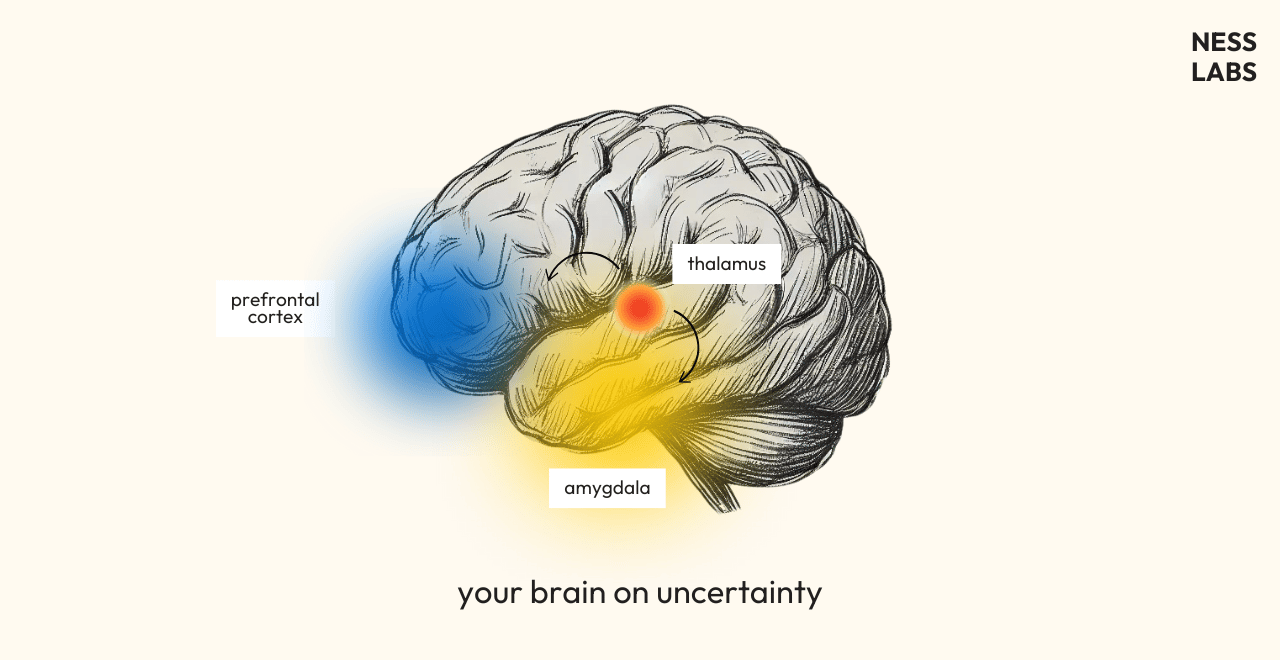
Neurobiologically, uncertainty strongly activates emotional and attentional systems involved in threat anticipation. The brain responds not only to actual danger but to prediction error—the mismatch between expected and uncertain outcomes. Under ambiguous conditions, predictive models lose reliability, increasing cognitive and emotional effort dramatically.
Stress hormones rise because the nervous system prepares for multiple possible scenarios simultaneously. This state is metabolically expensive and psychologically exhausting.
Importantly, uncertainty amplifies imagination.
When concrete information is absent, the mind fills gaps using memory, fear, expectation, and symbolic association. The brain continuously generates possible futures in attempts reducing unpredictability. Yet because emotionally salient possibilities receive attentional priority, negative scenarios often dominate awareness disproportionately.
This explains why uncertain situations frequently feel worse psychologically than confirmed outcomes. Imagination produces endless hypothetical threats unconstrained by objective limitation.
Silence intensifies uncertainty similarly. In quiet or ambiguous environments, predictive systems search aggressively for hidden meaning because reduced sensory information weakens environmental certainty. Minor sounds acquire exaggerated significance while the absence of explanation itself becomes emotionally threatening.
This mechanism contributes to experiences of paranoia, haunting sensations, and social suspicion. The uncertain brain prefers assigning meaning—even frightening meaning—rather than tolerating unresolved ambiguity indefinitely.
Conspiracy theories reveal this tendency on collective levels. Complex or frightening events generate intense uncertainty regarding causation, control, and vulnerability. Conspiracy narratives reduce ambiguity by transforming randomness into organized intentionality.
Psychologically, a frightening explanation may feel preferable to uncertainty because coherent narratives restore predictive structure.
Religious and philosophical systems historically served similar functions partly by organizing existential uncertainty surrounding death, suffering, morality, and meaning. Humans possess powerful drives to transform ambiguity into interpretable frameworks because uncontained uncertainty destabilizes emotional regulation profoundly.
Technology has intensified uncertainty sensitivity in modern life. Continuous information exposure creates environments where individuals remain psychologically suspended within endless streams of unresolved possibility. News cycles, social media ambiguity, financial instability, and constant communication increase predictive overload.
For example, digital communication frequently lacks nonverbal emotional cues necessary for rapid uncertainty reduction. Delayed replies, ambiguous wording, or online silence therefore provoke disproportionate anxiety because predictive systems cannot interpret intent confidently.
At the same time, modern culture often encourages unrealistic expectations of certainty and control. People increasingly believe every problem should possess immediate explanation, resolution, or prediction. When reality remains ambiguous, emotional tolerance weakens further.
Existential psychology emphasizes that uncertainty represents not merely occasional discomfort but a fundamental condition of human existence. Mortality, identity, relationships, future outcomes, and meaning itself remain inherently uncertain despite efforts toward control.
Much psychological suffering therefore emerges not from uncertainty alone but from resistance to uncertainty.
The mind continuously attempts stabilizing inherently unstable realities through narrative certainty, rigid belief systems, compulsive planning, or defensive prediction. Yet because reality remains fundamentally unpredictable, these strategies often produce chronic anxiety instead of genuine security.
Mindfulness-based approaches address this paradox differently. Rather than eliminating uncertainty, mindfulness strengthens capacity to remain psychologically present without compulsive resolution-seeking. Individuals learn observing ambiguity without immediately converting it into catastrophic prediction or rigid interpretation.
This shift is profoundly important because uncertainty itself is not always dangerous. Much suffering arises from secondary reactions to ambiguity rather than from ambiguity directly.
Creative thought also depends upon uncertainty tolerance. Innovation, exploration, intimacy, and existential growth all require entering situations without guaranteed outcomes. Excessive need for certainty therefore restricts psychological flexibility and adaptive learning.
Artists, scientists, philosophers, and emotionally resilient individuals often demonstrate greater capacity to tolerate unresolved complexity without immediate closure. This tolerance allows engagement with reality in more flexible and less defensive ways.
Importantly, uncertainty tolerance does not mean emotional indifference. Rather, it involves maintaining psychological openness despite incomplete prediction. The nervous system gradually learns that ambiguity can be survived without compulsive control.
Therapeutically, strengthening uncertainty tolerance often reduces anxiety more effectively than pursuing impossible certainty itself. Exposure-based approaches intentionally help individuals remain present with unresolved outcomes long enough for catastrophic expectations to weaken naturally.
Over time, the brain learns that uncertainty does not automatically equal danger.
Ultimately, the brain fears uncertainty because prediction lies at the core of survival-oriented consciousness. Human perception, emotion, memory, and behavior all depend upon anticipating future conditions sufficiently to guide adaptive action. Ambiguity disrupts this predictive stability, forcing the nervous system into metabolically and emotionally demanding vigilance.
The resulting anxiety reflects not weakness but evolutionary design.
Yet modern consciousness also possesses capacities beyond survival reflex alone. Human beings can develop awareness that certainty itself is often psychologically constructed rather than objectively attainable. Reality remains partially unpredictable regardless of defensive effort.
The challenge therefore becomes not eliminating uncertainty but learning to exist within it without surrendering entirely to fear-driven prediction.
In this sense, psychological maturity may involve recognizing that the mind’s desperate search for absolute certainty often creates more suffering than uncertainty itself ever could.