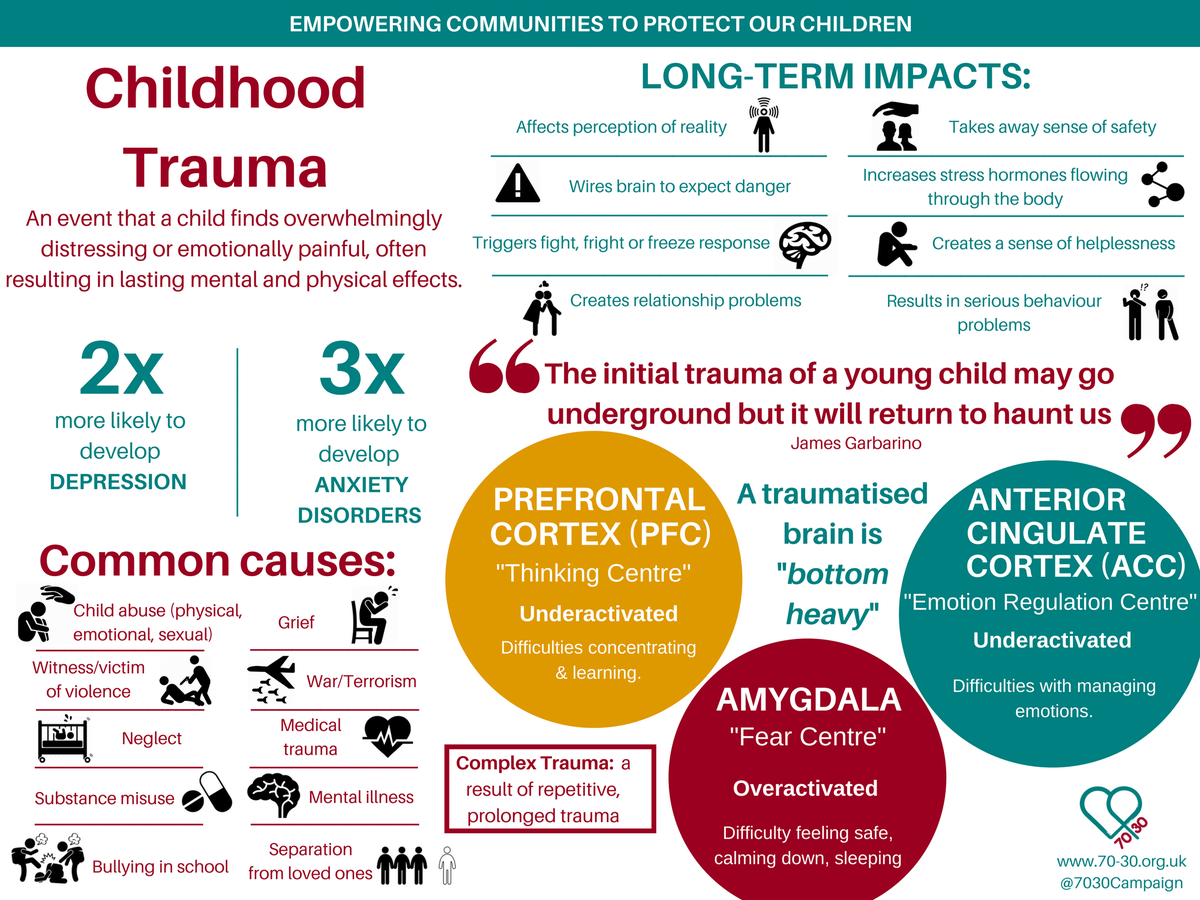
Childhood trauma is among the most extensively studied yet profoundly complex subjects in modern psychiatry. Unlike ordinary stressful experiences, psychological trauma occurring during childhood develops while the brain itself is still forming. During this period, neural circuits responsible for emotional regulation, memory, language, social cognition, stress adaptation, and self-identity remain highly plastic. Consequently, traumatic experiences do not simply become memories stored in the brain. They may actively influence the biological architecture through which future experiences are interpreted. This raises one of developmental psychopathology’s most important questions: why do childhood traumas continue affecting mental health decades after the original events have ended?
For many years, trauma was understood primarily as an emotional wound.
Contemporary neuroscience has expanded this perspective considerably.
Childhood trauma represents not only a psychological experience but also a developmental event capable of influencing brain maturation, neuroendocrine regulation, immune function, cognitive development, and interpersonal attachment.
The effects are therefore multidimensional.
No single symptom defines childhood trauma.
Instead, trauma may alter multiple psychological systems simultaneously.
The developing brain differs fundamentally from the mature adult brain.
During childhood, billions of neural connections are continuously strengthened, eliminated, and reorganized according to experience.
This process allows extraordinary learning and adaptation.
However, it also increases vulnerability.
Repeated exposure to fear, unpredictability, neglect, abuse, or chronic emotional insecurity may influence which neural pathways become reinforced and which gradually weaken.
The brain adapts to the environment in which it develops.
When that environment is consistently threatening, survival becomes the primary developmental priority.
From an evolutionary perspective, this adaptation is logical.
A child growing up within dangerous circumstances benefits from heightened vigilance.
Detecting subtle signs of anger, rejection, or violence may improve survival.
The nervous system therefore becomes increasingly sensitive to potential threats.
Attention shifts toward danger.
Stress responses activate rapidly.
Emotional regulation prioritizes protection over exploration.
These adaptations may be highly effective during childhood.
The difficulty emerges when the same biological strategies persist into adulthood after the environment has changed.
The individual continues responding to ordinary situations as though danger remains imminent.
One of the central biological systems involved is the hypothalamic-pituitary-adrenal axis.
This neuroendocrine network regulates stress hormones throughout the body.
Acute activation prepares the organism for immediate survival.
Heart rate increases.
Blood glucose rises.
Attention narrows.
Reaction time improves.
Following resolution of danger, hormone levels ordinarily return to baseline.
Chronic childhood trauma repeatedly activates this system.
Over time, its regulation may become altered.
Some individuals develop exaggerated stress responses.
Others eventually demonstrate reduced physiological responsiveness following prolonged exposure.
Both patterns reflect adaptation rather than simple dysfunction.
Attachment theory provides another essential framework.
Human infants depend upon caregivers not only for physical survival but also for emotional regulation.
Before children can regulate their own emotions, caregivers perform this function externally.
Consistent comfort teaches the developing nervous system that distress can be reduced safely.
Unpredictable or frightening caregiving interferes with this learning.
Instead of associating relationships with safety, children may associate intimacy with uncertainty, fear, or rejection.
These early attachment patterns often influence interpersonal relationships throughout adult life.
Importantly, attachment patterns are not permanent destinies.
They represent developmental adaptations capable of changing through corrective relationships and therapeutic intervention.
Memory develops differently under traumatic conditions.
Ordinary autobiographical memories gradually become integrated into coherent life narratives.
Traumatic experiences frequently resist this integration.
Instead of being remembered as completed events located in the past, traumatic memories may remain fragmented into sensory impressions, bodily sensations, emotional reactions, or isolated images.
Years later, seemingly harmless reminders may reactivate these fragments with remarkable intensity.
The individual experiences emotions belonging to childhood while remaining physically present in adulthood.
This phenomenon contributes significantly to post-traumatic symptoms.
The amygdala plays an important role in threat detection throughout development.
Repeated exposure to chronic stress may increase its sensitivity.
Consequently, ambiguous situations become interpreted as potentially dangerous.
Minor interpersonal conflict may evoke intense fear.
Unexpected noises produce exaggerated startle responses.
Neutral facial expressions appear threatening.
These reactions often occur automatically before conscious reasoning has fully developed.
Meanwhile, regions of the prefrontal cortex responsible for executive regulation continue maturing into early adulthood.
Early adversity may influence communication between emotional and regulatory systems.
The result is not simply stronger emotions but reduced capacity to modulate them effectively.
This imbalance contributes to emotional dysregulation observed across numerous psychiatric disorders associated with childhood trauma.
Identity formation also becomes profoundly affected.
Children gradually develop beliefs regarding themselves through repeated interactions with caregivers and the surrounding environment.
Consistent acceptance encourages secure self-concepts.
Repeated criticism, neglect, humiliation, or abuse may gradually become incorporated into identity.
Children rarely conclude that caregivers are fundamentally wrong.
Instead, they often conclude that they themselves are fundamentally defective.
These beliefs may persist for decades despite overwhelming contradictory evidence.
Shame therefore becomes one of childhood trauma’s most enduring psychological consequences.
Trauma influences cognition as well.
Attention becomes biased toward detecting possible danger.
Working memory may become overloaded by persistent vigilance.
Decision-making increasingly prioritizes immediate safety rather than long-term goals.
Learning becomes organized around avoiding harm.
These cognitive adaptations often prove advantageous within threatening environments.
Outside those environments, however, they may interfere with education, employment, relationships, and emotional well-being.
Developmental psychopathology increasingly emphasizes cumulative rather than isolated adversity.
Repeated emotional neglect, chronic criticism, domestic violence, bullying, parental mental illness, substance misuse within the family, or persistent insecurity may produce significant psychological effects even without catastrophic single events.
Trauma therefore exists along a continuum.
Severity depends not only upon the event itself but also upon developmental timing, duration, predictability, available support, genetic vulnerability, and opportunities for recovery.
One particularly important concept is complex trauma.
Unlike single-event trauma, complex trauma develops through prolonged interpersonal adversity during childhood.
The resulting psychological profile often extends beyond fear alone.
Individuals may experience chronic emotional dysregulation, unstable relationships, identity disturbance, persistent shame, dissociation, difficulties trusting others, and altered self-perception.
Modern psychiatry increasingly recognizes complex trauma as distinct from traditional post-traumatic stress presentations.
Epigenetic research has introduced another fascinating perspective.
Traumatic experiences may influence patterns of gene expression without altering DNA sequences themselves.
Environmental stress interacts continuously with biological vulnerability.
Genes influence responses to experience.
Experience influences genetic expression.
This dynamic interaction explains why trauma affects individuals differently despite similar environments.
Resilience deserves equal scientific attention.
Not every child exposed to adversity develops psychiatric illness.
Protective relationships, supportive adults, stable educational environments, community resources, emotional intelligence, and adaptive coping strategies significantly reduce long-term risk.
Resilience is not the absence of suffering.
Rather, it reflects the nervous system’s capacity to recover, reorganize, and adapt despite adversity.
Psychotherapy increasingly utilizes knowledge derived from developmental neuroscience.
Rather than focusing exclusively upon past events, contemporary trauma therapy aims to restore emotional regulation, strengthen present-moment awareness, integrate fragmented memories, reduce physiological hyperarousal, and reconstruct healthier interpersonal expectations.
Recovery does not erase childhood experiences.
Instead, it changes how the brain organizes and responds to those experiences.
Neuroplasticity remains possible throughout life.
The same biological flexibility that allowed childhood environments to shape the developing brain also permits later therapeutic experiences to establish healthier neural patterns.
Ultimately, childhood trauma persists not because the brain refuses to forget the past but because the developing nervous system learns from the environments in which it matures. The child’s brain does exactly what evolution designed it to do: adapt for survival. When danger becomes the developmental context, emotional systems, attention, memory, stress regulation, and interpersonal expectations organize themselves accordingly.
The tragedy lies not within these adaptations themselves but in their persistence after childhood has ended. Adult environments often require trust rather than vigilance, flexibility rather than constant defense, and emotional openness rather than survival-oriented protection. Modern psychiatry increasingly understands healing as the gradual process through which the brain learns that the world it once adapted to no longer defines the reality in which it now lives.