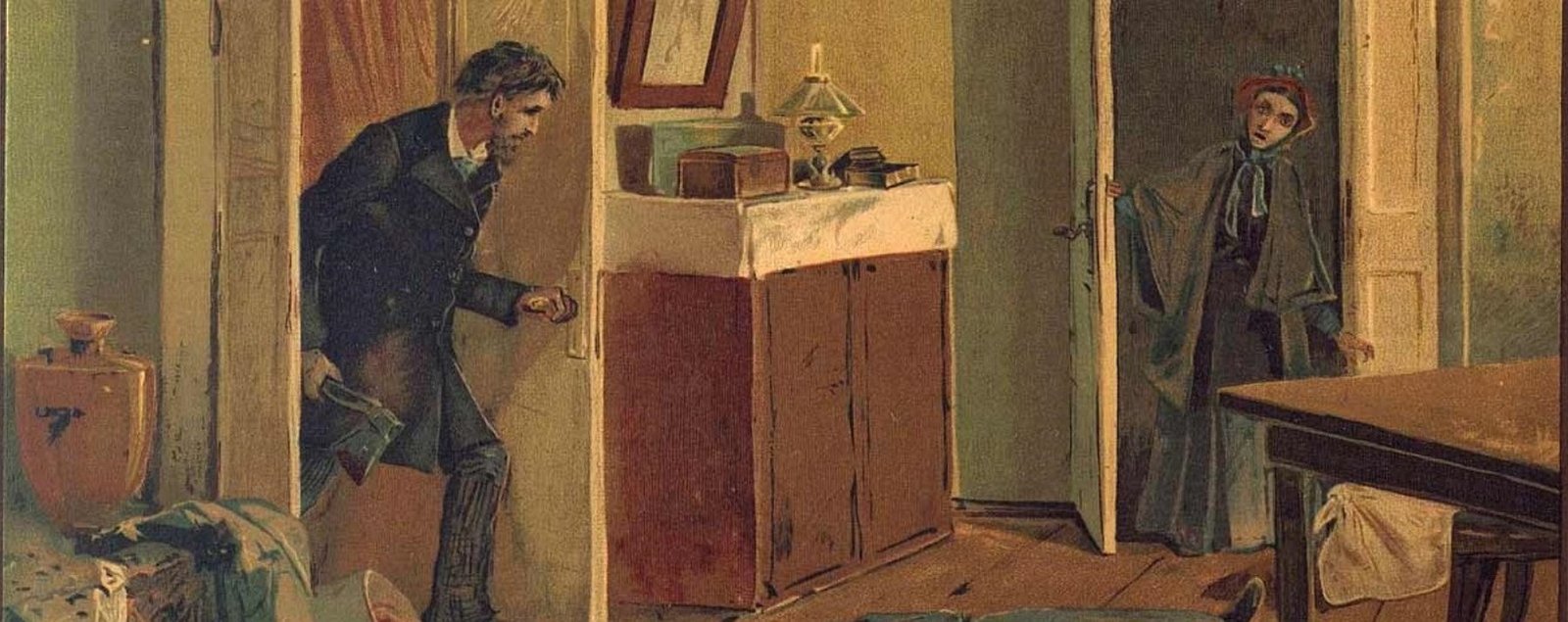
Fyodor Dostoevsky’s Crime and Punishment is one of the most psychologically complex works in world literature. Published in 1866, the novel examines crime, guilt, morality, isolation, suffering, rationalization, and the possibility of psychological transformation through the experiences of Rodion Raskolnikov, a young former student living in poverty in St. Petersburg. Although the novel is often discussed as a philosophical or moral work, its psychological depth is equally significant. Dostoevsky does not simply ask whether a person is capable of committing a crime. He explores what happens inside the human mind before, during, and after a morally destructive act.
Raskolnikov is particularly interesting from a psychological perspective because his crime is not motivated by a single emotion. His behavior develops through a complicated combination of intellectual ideas, poverty, resentment, isolation, pride, compassion, and a desire to test his own theory about human beings. He attempts to construct a rational justification for murder, yet his emotional and moral responses repeatedly contradict his intellectual arguments. The resulting conflict becomes the central psychological drama of the novel.
At the beginning of the story, Raskolnikov is socially isolated. He is poor, unemployed, and has withdrawn from many ordinary social relationships. His physical environment reflects his psychological condition. His small room, limited financial resources, hunger, and separation from society contribute to a sense of confinement. His isolation is not merely economic. He increasingly lives inside his own thoughts, developing theories without sufficiently testing them through ordinary human interaction.
Social isolation can influence psychological functioning in several ways. When individuals have limited opportunities to receive alternative perspectives, their internal beliefs may become increasingly dominant. A person can repeatedly analyze the same idea without encountering another person who challenges its assumptions. Raskolnikov’s intellectual isolation therefore becomes important to the development of his theory.
His theory divides people into two broad categories. According to his reasoning, ordinary people are expected to obey established moral and legal rules, whereas exceptional individuals may have the right to violate those rules if their actions contribute to a greater historical purpose. He uses figures such as Napoleon as examples of individuals who committed acts of violence while becoming historically significant. Raskolnikov begins to wonder whether truly exceptional people possess a special right to cross moral boundaries.
Psychologically, this theory can be interpreted as an attempt to transform moral uncertainty into intellectual certainty. Instead of confronting the complexity of human morality, Raskolnikov creates a conceptual system that appears to provide clear answers. If some people are “extraordinary,” then perhaps extraordinary people are permitted to perform actions that ordinary people cannot.
However, the theory contains an important psychological problem. Raskolnikov does not merely want to determine whether the theory is intellectually defensible. He wants to discover which type of person he himself is. The planned crime becomes an experiment involving his own identity. He wants to know whether he possesses the strength, courage, and psychological independence that his theory associates with exceptional individuals.
This makes the crime psychologically different from an ordinary act motivated solely by material gain. Raskolnikov does need money, but the money is not the complete explanation. His intellectual curiosity, pride, resentment, and desire to test himself become deeply connected to the decision. He attempts to turn murder into a philosophical experiment.
This is one of the novel’s most important psychological ideas: human beings may construct rational explanations for behaviors that are also influenced by emotions that they do not fully recognize. Raskolnikov consciously emphasizes philosophical reasoning, but beneath the theory are feelings of humiliation, anger, superiority, helplessness, and alienation. His reasoning does not eliminate these emotions. Instead, it provides them with an intellectual framework.
Before committing the crime, Raskolnikov repeatedly moves between determination and hesitation. His behavior demonstrates psychological ambivalence. He wants to act, yet another part of him resists. He imagines the crime, rejects the idea, returns to it, and experiences physical and emotional distress. This instability illustrates the conflict between abstract reasoning and emotional response.
Ambivalence is common in psychologically significant decisions. People can simultaneously desire and fear the same outcome. One part of the mind may perceive an action as necessary while another part recognizes its emotional or moral consequences. Raskolnikov’s internal conflict becomes increasingly intense because the action he is considering is irreversible.
The murder itself is also psychologically important because reality does not behave according to his theory. He imagines a controlled and rational act, but the actual event becomes chaotic. He kills the pawnbroker Alyona Ivanovna and unexpectedly kills her sister Lizaveta as well. The second killing is especially significant because it disrupts the intellectual simplicity of his original plan. The crime is no longer a clean philosophical experiment.
The gap between theory and reality becomes one of the novel’s central psychological mechanisms. Before the crime, Raskolnikov can think about murder abstractly. After the crime, he must experience its concrete consequences. The person he intellectually reduced to an obstacle is no longer an abstract object. The physical reality of violence confronts him with the consequences of his actions.
Immediately after the crime, his psychological state becomes increasingly unstable. He experiences fear, confusion, physical exhaustion, suspiciousness, and emotional disorganization. He worries about being discovered but also appears psychologically disturbed by what he has done. His behavior cannot be explained simply as fear of punishment. Something deeper is occurring: his self-concept has been damaged.
Raskolnikov had imagined that an exceptional person could commit such an act without being psychologically destroyed by it. His own reaction provides evidence against his theory. He discovers that the psychological consequences of the crime cannot simply be controlled through intellectual reasoning.
Guilt is one of the central psychological themes of the novel. Guilt involves the recognition that one’s behavior has violated a moral standard and harmed another person. It can motivate repair, confession, or behavioral change. Raskolnikov experiences guilt in a complicated form because he initially attempts to deny the moral meaning of his action while simultaneously showing signs of psychological distress.
His guilt is not expressed only through explicit statements. It appears in his dreams, physical reactions, emotional fluctuations, avoidance, confusion, and contradictory behavior. Dostoevsky therefore presents guilt not merely as an abstract moral concept but as an experience that penetrates thought, emotion, behavior, and bodily states.
The novel also illustrates the difference between guilt and shame. Guilt is often associated with the judgment “I did something wrong,” whereas shame can involve the more global feeling “There is something fundamentally wrong with me.” Raskolnikov appears to experience elements of both. He knows that he committed a terrible act, but he also struggles with what the crime means about his identity.
His greatest psychological crisis is therefore not simply the fear of imprisonment. It is the collapse of the identity he attempted to construct. He wanted to discover that he was an extraordinary individual capable of transcending ordinary morality. Instead, his emotional response reveals that he remains deeply connected to other human beings.
This connection is visible in his relationship with suffering people. Although he has committed murder, he repeatedly demonstrates compassion toward others. He gives money to people in need, worries about his family, and becomes involved in the suffering of others. These behaviors contradict the image of a completely cold and detached individual.
This contradiction makes Raskolnikov psychologically complex. He is neither simply “good” nor simply “evil.” His personality contains compassion and cruelty, pride and humility, rationalization and emotional sensitivity. Dostoevsky’s psychological realism emerges partly from refusing to reduce the character to one characteristic.
The novel also explores the psychological consequences of isolation. Raskolnikov frequently withdraws from people even when he needs connection. He hides information, rejects assistance, and becomes suspicious of others. Yet isolation intensifies his distress. This creates a self-reinforcing cycle: psychological discomfort encourages withdrawal, withdrawal increases loneliness, and loneliness creates more intense internal thinking.
His relationship with Sonia Marmeladova becomes particularly important in this context. Sonia is also exposed to extreme poverty and suffering, but her response differs from Raskolnikov’s. Her character provides a contrasting model of suffering, compassion, and human connection. She does not respond to suffering by constructing a theory of superiority. Instead, she remains emotionally connected to other people.
From a psychological perspective, Sonia represents the possibility that suffering can be processed through connection rather than isolation. Her relationship with Raskolnikov creates an interpersonal space in which he can gradually acknowledge the reality of his actions.
The psychological importance of interpersonal relationships is also visible in Porfiry Petrovich, the investigator. Porfiry does not simply pursue Raskolnikov through physical evidence. He engages him psychologically. Their conversations revolve around motives, ideas, personality, morality, and behavior. Porfiry understands that the most important evidence may eventually come from Raskolnikov himself.
The relationship between Raskolnikov and Porfiry demonstrates another psychological principle: people sometimes reveal internal conflict through behavior even when they attempt to conceal information verbally. Anxiety, contradictions, defensiveness, and unusual reactions can communicate psychological tension.
Porfiry also recognizes that confession cannot necessarily be forced through external pressure alone. Raskolnikov must eventually confront the psychological consequences of his own theory. This makes the investigation partly a psychological process.
Dreams play an important role in the novel as well. Dostoevsky uses dreams to represent emotional material that cannot easily be expressed through rational thought. Raskolnikov’s dreams often contain violence, suffering, helplessness, and compassion. They reveal aspects of his psychological world that contradict his conscious intellectual position.
Dream interpretation should be approached carefully because modern psychology does not support the idea that every dream has one fixed symbolic meaning. Nevertheless, dreams can reflect emotional concerns, memories, fears, and preoccupations. In literature, they can also function as narrative representations of internal conflict. Dostoevsky uses them in precisely this way.
Raskolnikov’s dream involving a beaten horse is especially significant. He witnesses an animal being violently abused and experiences intense emotional distress. The dream presents him as deeply affected by suffering, contradicting the idea that he is psychologically capable of treating human life as an abstract calculation.
This contradiction is central to his character. His intellectual theory attempts to separate certain people from ordinary moral obligations, but his emotional responses repeatedly restore the humanity that his theory attempts to remove.
Another important psychological concept in the novel is rationalization. Rationalization occurs when a person constructs a plausible explanation for behavior that may also be influenced by less conscious motives. Raskolnikov’s philosophical theory provides an intellectual justification for an act that is also connected to resentment, poverty, pride, and psychological conflict.
The novel does not suggest that intellectual reasoning is inherently dangerous. Rather, it demonstrates that intelligence does not automatically protect a person from emotional distortion. A highly intelligent individual can use sophisticated reasoning to defend a psychologically motivated decision. Rationality and psychological objectivity are therefore not identical.
Raskolnikov also displays elements of grandiosity. His theory places him in the position of deciding whether he belongs to an exceptional category of humanity. Such thinking can provide psychological compensation for feelings of powerlessness. A person who feels insignificant may construct an internal identity of exceptional importance as a way of protecting self-esteem.
This does not mean that every ambitious person is psychologically unhealthy. Ambition and confidence are normal human characteristics. The problem arises when superiority becomes dependent on devaluing other people or violating fundamental moral boundaries.
Raskolnikov’s poverty also deserves attention. Economic deprivation does not cause criminal behavior automatically, and most people experiencing poverty do not commit serious crimes. Nevertheless, poverty can increase stress, restrict opportunities, create feelings of humiliation, and contribute to psychological vulnerability. In the novel, material hardship interacts with intellectual isolation and personal resentment.
The psychological impact of poverty is therefore presented as part of a larger system rather than as a simple cause. Raskolnikov’s environment contributes to his emotional state, but he remains responsible for his decisions. This distinction between explanation and justification is essential.
Another significant theme is the relationship between suffering and psychological transformation. The novel does not present suffering as inherently beneficial. Suffering can damage individuals, produce despair, and intensify psychological problems. However, in Raskolnikov’s case, confronting the consequences of his actions creates the possibility of change.
His eventual confession represents more than legal submission. Psychologically, it begins the collapse of the defensive structure he constructed around himself. He can no longer maintain the idea that the crime was merely an intellectual experiment. The act becomes something he must acknowledge as part of his own history.
The concept of confession is therefore connected to psychological integration. A person may experience internal conflict when different parts of their identity are incompatible. Raskolnikov attempts to preserve the identity of the superior intellectual while simultaneously experiencing compassion and guilt. Confession begins to bring these contradictory elements into the same psychological reality.
Sonia’s presence is important because confession occurs within a relationship rather than in complete isolation. Human beings often require another person to witness difficult experiences. Shame can become more intense when a person believes they must hide their worst actions or feelings indefinitely. Honest acknowledgment within a relationship can create the possibility of psychological change.
The novel’s ending does not present transformation as immediate or simple. Raskolnikov’s psychological development remains incomplete. This is realistic because profound changes in identity, morality, and emotional functioning rarely occur instantly. Recognition may begin a process without completing it.
From a modern psychological perspective, Crime and Punishment can therefore be read as an exploration of cognitive conflict, moral emotions, isolation, self-concept, rationalization, guilt, shame, interpersonal connection, and psychological transformation. The novel does not provide a scientific theory of psychology, and it should not be treated as a clinical case study. Its value lies in its detailed representation of subjective experience.
One of its most important insights is that human beings cannot always understand themselves through conscious reasoning alone. People may create explanations for their behavior without fully recognizing the emotional forces behind those explanations. Self-awareness requires more than intelligence. It requires the ability to tolerate uncomfortable emotions, question one’s own assumptions, recognize contradictions, and remain connected to other people.
Raskolnikov’s experience also demonstrates the psychological cost of extreme isolation. His intellectual world becomes increasingly detached from ordinary human relationships. Without meaningful connection, his theory becomes more powerful because there are fewer interpersonal experiences capable of challenging it. His eventual movement toward other people becomes part of his psychological transformation.
The novel can also be understood as a study of moral identity. People do not merely perform actions; they develop beliefs about what kind of person they are. When behavior contradicts identity, psychological distress may emerge. Raskolnikov wants to see himself as exceptional, but his actions and emotional responses continuously challenge that identity.
This raises a broader psychological question: How much of human behavior is determined by abstract beliefs, and how much is shaped by emotional and interpersonal needs? Crime and Punishment suggests that the two cannot easily be separated. Human beings reason, but they also fear, love, suffer, desire recognition, experience guilt, and seek connection.
The novel also demonstrates that psychological change often begins when defensive explanations become impossible to maintain. Raskolnikov initially tries to explain his crime intellectually. Eventually, however, the emotional consequences become stronger than his rationalizations. He must confront the difference between what he believed he could be and what he actually experienced.
For modern readers, this aspect of the novel remains relevant. People may not commit crimes, but they can still construct elaborate explanations for behaviors that conflict with their values. Someone may justify emotional withdrawal as independence, perfectionism as ambition, excessive control as responsibility, or avoidance as prudence. Psychological maturity involves examining not only whether an explanation sounds logical but also what emotional function the behavior serves.
Crime and Punishment therefore remains psychologically powerful because it portrays the human mind as conflicted rather than simple. Raskolnikov is intelligent but not fully self-aware, isolated but deeply concerned with other people, proud but vulnerable, rationalizing but emotionally sensitive. His contradictions are precisely what make him psychologically believable.
The novel ultimately suggests that human beings cannot easily escape the psychological consequences of their actions by constructing intellectual justifications. Ideas can influence behavior, but emotional life continues to respond. Guilt, empathy, attachment, fear, shame, and the need for human connection can remain active even when a person attempts to suppress them.
From this perspective, the “punishment” in the novel is not limited to the legal consequences of crime. It also includes the internal psychological conflict that follows the destruction of one’s moral and interpersonal connection. The possibility of “redemption” is similarly psychological as well as moral: it involves acknowledging reality, accepting responsibility, reconnecting with others, and gradually developing a different relationship with oneself.
Dostoevsky’s achievement lies in showing that the most important conflict may occur not between a criminal and society but within the individual. Raskolnikov attempts to divide humanity into ordinary and extraordinary people, yet his own psychological experience continually demonstrates the complexity of human nature. His story reveals that people can hold contradictory motives, experience conflicting emotions, and behave in ways that challenge their own beliefs.
For this reason, Crime and Punishment can be read as a profound literary exploration of guilt, isolation, identity, rationalization, and moral psychology. It does not offer simple psychological answers. Instead, it invites readers to examine how ideas, emotions, relationships, and personal history interact within the human mind. Its enduring psychological significance comes from this complexity: the human being is not merely a rational decision-maker but a deeply emotional, social, and morally conflicted individual whose actions can transform the way they understand themselves.