Social media has become one of the most influential psychological environments of modern life. Platforms that allow people to communicate, share photographs, watch short videos, follow news, build communities, and express opinions are now integrated into everyday routines. For many people, checking social media is one of the first activities of the morning and one of the last activities before sleep. This transformation has created an important psychiatric and psychological question: Can social media affect mental health?
The answer is not simply yes or no. Digital environments can provide connection, information, entertainment, education, and access to psychological support. At the same time, excessive or problematic use can be associated with loneliness, emotional distress, sleep problems, cyberbullying, unhealthy comparison, and exposure to harmful content. The World Health Organization emphasizes that the relationship between digital technology and mental health is complex and can operate in both directions: psychological difficulties may increase technology use, while problematic digital experiences may also worsen psychological well-being.
One of the most discussed psychological mechanisms is social comparison. People naturally compare themselves with others, but social media dramatically increases the number of people available for comparison. Users may see hundreds of carefully selected photographs, achievements, vacations, relationships, physical transformations, and professional successes in a single day. What they see, however, is rarely a complete representation of another person’s life.
This creates an important psychological distortion. An individual may compare their ordinary life with another person’s most carefully selected moments. Someone might see photographs of a friend’s successful career, beautiful home, attractive appearance, or happy relationship without seeing the person’s financial difficulties, arguments, insecurities, failures, or ordinary days. Repeated exposure to these idealized representations can produce the feeling that one’s own life is inadequate.
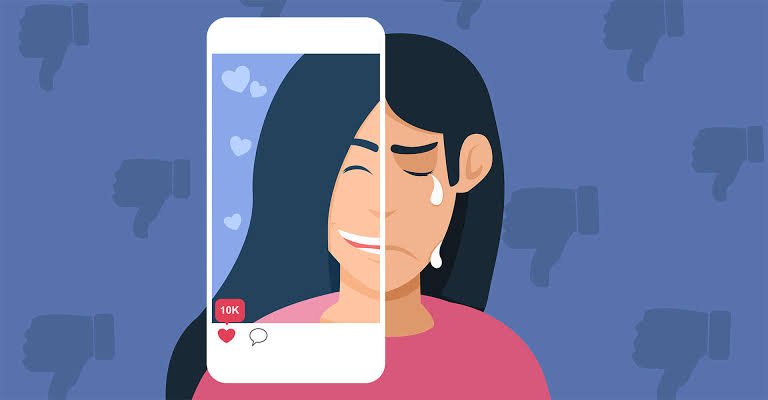
Self-esteem can therefore become connected to online feedback. Likes, comments, views, followers, and shares can function as forms of social evaluation. When positive feedback is received, a person may experience temporary satisfaction. When a post receives little attention, the individual may interpret the lack of engagement as rejection. Over time, external digital feedback can become an important source of self-worth.
This is particularly significant during adolescence. Young people are still developing their identities and are highly sensitive to acceptance and rejection. The need to belong is a fundamental psychological need, and online environments can intensify social evaluation because approval and criticism may be visible to large numbers of people.
Recent research continues to examine these relationships. A 2026 systematic review and meta-analysis found an association between social media use and loneliness among adolescents and young adults, although the researchers emphasize that the relationship is complex rather than a simple cause-and-effect process.
Loneliness is especially interesting because social media appears to provide connection while sometimes being associated with feeling disconnected. A person may communicate with dozens of people online and still lack meaningful emotional intimacy. Digital interaction can therefore create the appearance of social connection without necessarily satisfying deeper psychological needs.
The type of use matters. Active communication—talking with friends, participating in communities, sharing meaningful experiences—may have different psychological effects from passive scrolling. Passive consumption can involve watching other people’s lives without meaningful interaction. Research increasingly suggests that the psychological consequences depend not only on how much time someone spends online but also on what they do during that time and how they experience it.
Another important issue is problematic social media use. This is different from simply using social media frequently. A person may spend considerable time online without experiencing significant psychological problems. Problematic use involves difficulty controlling the behavior and continuing to use platforms despite negative consequences.
A person may intend to check social media for five minutes and remain online for an hour. They may repeatedly return to an application while studying, working, eating, or attempting to sleep. They may become restless when unable to access the platform. Such patterns can interfere with daily functioning.
Sleep is one of the most important areas affected by excessive digital engagement. People may stay awake late watching short videos, responding to messages, or scrolling through content. Notifications can also interrupt sleep. Reduced sleep can then contribute to irritability, poor concentration, emotional instability, and anxiety.
This creates a psychological cycle. A person feels stressed, uses social media for distraction, stays online late, sleeps poorly, becomes more emotionally vulnerable the following day, and then uses social media again to escape unpleasant feelings. The technology may therefore become part of a broader pattern of emotional regulation.
Social media can also expose individuals to cyberbullying. Unlike traditional bullying, online harassment can continue beyond school or the workplace and may reach the victim at home. Harmful comments, humiliating photographs, threats, exclusion, and repeated messages can create significant psychological distress.
For young people, online environments can also expose them to unrealistic standards of physical appearance. Highly edited photographs, filters, cosmetic procedures, and carefully constructed images can influence perceptions of what a “normal” body or face should look like. Some individuals become increasingly dissatisfied with their appearance as a result.
This does not mean that every person who uses social media will develop depression, anxiety, or low self-esteem. Individual vulnerability is extremely important. Existing mental health difficulties, family relationships, offline social support, personality, age, gender, socioeconomic conditions, and the type of online experiences all influence outcomes. WHO specifically notes that the effects of digital technology are not uniform and that vulnerable young people may experience greater negative effects.
Social media can also have positive psychological effects. People who feel isolated because of geography, disability, social stigma, or unusual interests may find communities online that they cannot easily access offline. Digital platforms can help individuals maintain relationships across distance and find people with similar experiences.
For someone experiencing loneliness, an online community can sometimes provide genuine emotional support. People may share experiences, exchange practical advice, and discover that they are not alone. Mental health information and professional resources can also become more accessible through digital platforms.
The problem therefore is not technology itself. The psychological question is how technology is used and what function it serves in a person’s life.
Social media may become particularly problematic when it is used primarily as an escape from emotional discomfort. If someone feels lonely and repeatedly scrolls through content instead of developing meaningful relationships, the underlying loneliness may remain. If someone feels insecure and constantly seeks online approval, temporary reassurance may reinforce dependence on external validation.
Another emerging issue is artificial intelligence and digital companionship. People increasingly interact with AI systems for information, entertainment, emotional conversation, and advice. This development has created new psychological questions concerning attachment, loneliness, emotional dependence, and the boundaries between human and artificial interaction. The World Health Organization has identified generative AI as part of the rapidly changing digital environment affecting young people’s mental health.
Recent psychological literature has also begun discussing “artificial intimacy,” particularly the possibility that young people may form emotionally meaningful relationships with AI companions. Because adolescence is a period of heightened need for belonging and validation, researchers are examining both potential benefits and risks of these relationships.
Another contemporary concern is the design of digital platforms themselves. Many applications are structured around continuous engagement. Notifications, recommendations, infinite scrolling, short-form videos, and personalized content can make it difficult for users to stop. This does not mean that every platform is intentionally causing mental illness, but it does mean that individual self-control is not the only factor involved.
Current public debate increasingly focuses on whether responsibility should fall entirely on individuals and parents or whether technology companies should also change platform design. WHO’s recent work on digital environments emphasizes safer platform design, digital literacy, prevention, and policies that reduce harmful online experiences.
The issue has become particularly prominent regarding children and adolescents. In 2026, debates and legal actions concerning social media and youth mental health have intensified in several countries, reflecting growing concern about addictive design, harmful content, age restrictions, and children’s online safety.
However, it is important not to exaggerate the evidence. Not every study finds large negative effects, and some recent research suggests that the associations between adolescent social media use and health outcomes can be relatively weak. One 2026 study described the negative associations as small and noted that social media was among several factors influencing adolescent health rather than being the single dominant predictor.
This is an important scientific distinction. Saying that social media can contribute to psychological difficulties is different from saying that social media causes mental illness in everyone. Mental health is influenced by multiple interacting factors, and technology is only one part of that system.
Healthy digital behavior therefore does not necessarily require completely abandoning social media. Instead, individuals can develop more intentional patterns of use. Turning off unnecessary notifications, avoiding social media immediately before sleep, taking regular breaks, limiting passive scrolling, and prioritizing face-to-face relationships can help create healthier boundaries.
It is also useful to notice emotional reactions to social media. If someone consistently feels inferior, anxious, lonely, angry, or dissatisfied after using a particular platform, that emotional response provides important information. The goal is not simply to count screen minutes but to understand what the technology is doing psychologically.
Parents can also help children develop digital literacy rather than relying only on prohibition. Children need to understand that online images are often edited, algorithms select content according to engagement, popularity does not equal personal worth, and online behavior can have real psychological consequences.
Schools can contribute by teaching students about cyberbullying, online comparison, privacy, emotional regulation, misinformation, and healthy technology use. Mental health education increasingly needs to include digital environments because online and offline life are no longer completely separate worlds.
Ultimately, the psychological impact of social media depends on the relationship between the person and the technology. For one individual, a platform may provide friendship, creativity, education, and belonging. For another, the same platform may become a source of comparison, compulsive behavior, sleep disruption, and emotional distress.
In conclusion, social media can influence mental health, but its effects are complex and highly individual. Excessive or problematic use can contribute to loneliness, emotional distress, sleep problems, low self-esteem, cyberbullying, and exposure to harmful content, while healthy use can strengthen communication, community, learning, and access to support. Current psychological research therefore increasingly moves away from the simple question of whether social media is “good” or “bad.” A more useful question is how digital environments shape attention, relationships, identity, emotional regulation, and daily behavior. Understanding that relationship may be one of the most important psychological challenges of the digital age.