


Human psychological life depends not only on perception or emotion, but on meaning attribution — the continuous, mostly unconscious process by which the mind assigns importance, relevance, and value to internal and external events. Meaning tells us what to attend to, what to ignore, what to pursue, and what to avoid. It organizes experience into a hierarchy. When this system collapses, the world does not disappear, but it becomes radically undifferentiated. Everything feels equally irrelevant — or equally overwhelming. Nothing stands out. Nothing calls. Nothing matters. The collapse of meaning attribution is distinct from depression, anhedonia, or apathy. In depression, meaning still exists but feels unreachable. In apathy, interest is diminished but selective. In meaning collapse, the mechanism that generates significance itself fails. The mind loses its internal compass. Experience becomes flat not because emotion is gone, but because value assignment has dissolved. This phenomenon appears in severe existential depression, late-stage burnout, schizophrenia-spectrum disorders, advanced dissociation, prolonged trauma exposure, and certain neurodegenerative or neuroinflammatory states. Across diagnoses, the subjective experience converges: the person no longer knows why anything should matter more than anything else — including themselves. At a basic level, meaning attribution relies on the integration of emotion, memory, and prediction. Emotion flags significance, memory contextualizes it, and prediction uses it to guide future action. When chronic stress, trauma, or neurobiological disruption decouples these systems, meaning collapses. The brain continues to register stimuli, but cannot rank them. A loud sound, a moral dilemma, a personal loss, and a trivial detail arrive with the same internal weight: near zero. From the inside, this state is profoundly disorienting. The individual may describe feeling “blank,” “lost,” or “ungrounded,” but these words barely capture the experience. The deeper reality is indecision at the level of reality itself. The person cannot decide what deserves attention, effort, or care. Choice becomes impossible not because options are unclear, but because no option carries intrinsic value. This collapse creates a unique paralysis. Without meaning, motivation cannot form. Without motivation, agency dissolves. The person may sit for hours unable to begin or end an activity, not due to indecision, but because beginning and ending feel equivalent. Time passes, but nothing accumulates into significance. Life becomes a sequence of unweighted moments. In schizophrenia-spectrum conditions, collapse of meaning attribution can manifest paradoxically as excess meaning. When the system that filters significance breaks down, the mind may attempt to compensate by assigning meaning indiscriminately. Trivial events become loaded with cosmic importance. Coincidences become messages. This is not insight, but a desperate attempt to restore structure to a value-less world. Delusion, in this sense, is meaning run amok after meaning has first collapsed. In trauma-related states, meaning collapse is often defensive. When meaning has repeatedly led to pain — when caring results in loss, attachment results in betrayal, or hope results in humiliation — the psyche learns that assigning value is dangerous. The safest strategy becomes disengagement at the level of significance itself. If nothing matters, nothing can hurt. Over time, this defense generalizes until the entire world loses emotional gravity. Existentially, collapse of meaning attribution produces a quiet but devastating nihilism. This is not philosophical skepticism; it is experiential void. The individual does not believe life is meaningless — they feel it at a visceral level. Language about purpose, values, or goals sounds foreign or naive. Moral distinctions blur. Even suffering loses its protest, because protest requires believing that something should be different. Interpersonally, this state creates profound disconnection. Relationships depend on selective valuation — caring about this person more than others, this moment more than another. When valuation collapses, intimacy becomes impossible. The individual may appear emotionally distant or indifferent, not because they lack care, but because their system cannot prioritize attachment over neutrality. Clinically, collapse of meaning attribution is often mistaken for resistance, laziness, or lack of insight. Interventions that rely on goal-setting, cognitive reframing, or motivational enhancement frequently fail, because they presuppose an intact value system. Asking “What matters to you?” becomes an unanswerable question. Treatment must therefore begin beneath meaning, not above it. The task is not to convince the person that things matter, but to help the nervous system relearn how significance feels. This often involves grounding in sensory experience, rhythmic activity, and relational presence — experiences that generate salience without requiring interpretation. Meaning must re-emerge bottom-up, not be imposed top-down. The first signs of recovery are subtle. A sound captures attention. A moment lingers. A person feels slightly more real than the background. These micro-signals indicate that the valuation system is restarting. Over time, differentiation returns. Some things begin to matter more than others. Choice becomes possible again. The world regains depth. Ultimately, the collapse of meaning attribution reveals a fundamental psychological truth: meaning is not an abstract belief, but a biological and emotional function. When it fails, existence flattens. When it returns, life reclaims its contours. Healing is not the rediscovery of grand purpose, but the quiet restoration of the ability to feel that this matters more than that — and that one’s own existence matters at all.

Identity Without Ownership
One of the most unsettling experiences in severe psychopathology is not the loss of identity itself, but the loss of ownership over identity. In this state, thoughts still occur, emotions still arise, and actions still unfold — yet none of them feel authored by the self. The individual does not say “I am gone,” but rather “this is happening, but it is not mine.” Consciousness persists, cognition functions, behavior continues — but the sense of being the subject behind experience collapses. Normally, human experience is structured by an implicit ownership tag. Thoughts feel like my thoughts. Feelings feel like my feelings. Actions feel initiated by me. This ownership is not intellectual; it is prereflective and automatic. It is the glue that binds mental events into a self. When this glue dissolves, the mind fragments into processes without a center. This phenomenon appears across several psychiatric conditions: depersonalization disorder, schizophrenia-spectrum disorders, severe dissociation, trauma-related identity disturbances, and some melancholic or catatonic states. Despite differing diagnoses, the subjective experience converges on the same core disturbance — a rupture between experience and authorship. From the inside, loss of ownership feels profoundly alienating. The person may think clearly, speak coherently, and behave purposefully, yet experience all of this as mechanical. Thoughts arise “by themselves.” Emotions feel imposed rather than felt. Actions seem executed by the body rather than chosen. The individual becomes a witness to their own mind — present, alert, but dispossessed. This is not metaphorical detachment. Patients often say, “I know this is my body, but it doesn’t feel like it belongs to me,” or “I hear my thoughts, but they don’t feel like they come from me.” In psychotic variants, this can evolve into thought insertion or passivity experiences, where mental events are attributed to external forces. In non-psychotic forms, insight remains intact, making the experience even more disturbing: the person knows nothing supernatural is occurring, yet the loss of ownership feels absolute. Neurocognitively, ownership emerges from the integration of prediction, agency, and sensory feedback. The brain constantly predicts its own actions and thoughts; when prediction matches outcome, ownership is inferred. In conditions where this predictive loop is disrupted — due to trauma, neurodevelopmental vulnerability, or stress-induced dysregulation — mental events lose their signature of self-generation. Experience becomes untagged. Psychodynamically, loss of ownership often develops as a defense against unbearable internal conflict. When thoughts, desires, or emotions feel dangerous — morally unacceptable, overwhelming, or threatening to attachment — the psyche distances itself from them. Over time, this distancing generalizes. The mind learns not only to disown specific contents, but to disown authorship itself. What begins as protection becomes alienation. In trauma-related conditions, ownership is sacrificed to survive. If feeling leads to punishment, desire leads to loss, or agency leads to harm, the safest solution is to stop feeling like an agent altogether. The self becomes an observer because observation is safer than participation. In this sense, loss of ownership is not pathology at its origin — it is an adaptation that outlives its usefulness. Existentially, identity without ownership creates a unique form of despair. The person exists, but does not inhabit existence. Responsibility feels abstract. Choice feels illusory. Moral agency feels compromised. This can lead to profound guilt or fear: “If my actions don’t feel like mine, am I responsible for them?” The self becomes legally and socially accountable, yet subjectively absent. Interpersonally, this state is deeply isolating. Relationships require presence, intention, and emotional investment. When ownership is lost, interaction feels scripted. Words emerge without emotional backing. Affection is recognized but not felt as coming from within. Others may sense distance or inauthenticity, reinforcing the individual’s fear that they are not truly there. Therapeutically, restoring ownership is delicate. Directly challenging the experience (“These are your thoughts”) often fails, because ownership cannot be argued into existence. Instead, treatment focuses on reestablishing agency at the most basic levels: bodily movement, sensory grounding, intentional micro-actions, and relational attunement. Ownership returns through doing, not thinking. Somatic approaches are particularly important. When the body is re-experienced as a source of sensation rather than an object, the mind slowly relearns authorship. Relational consistency also plays a crucial role. Being met as a subject — not analyzed as an object — allows the patient to feel real in the presence of another, which can later be internalized. Recovery does not arrive suddenly. Ownership flickers. A thought feels briefly “mine.” An action feels chosen. An emotion feels internally generated. These moments are fragile and often frightening at first. But over time, they accumulate. The self reclaims its position not as controller, but as participant. Ultimately, identity without ownership reveals a fundamental truth about human consciousness: the self is not the sum of mental events, but the felt sense of authorship that binds them together. When that sense dissolves, the person does not vanish — but they become homeless within their own mind. Healing is the slow return home.

Emotional Extinction
Emotional extinction is not numbness in the ordinary sense, nor is it the temporary blunting seen in stress or fatigue. It is the progressive disappearance of the capacity to feel — a slow fading of affective life in which emotions do not merely dull, but cease to arise at all. Unlike depression, which still contains pain, or dissociation, which hides emotion behind distance, emotional extinction represents a deeper psychic event: the collapse of the emotional-generating system itself. The person does not feel sad, empty, or anxious. They feel nothing, and worse, they no longer expect to feel anything again. This phenomenon develops gradually, often unnoticed, in individuals exposed to prolonged psychological overload — chronic trauma, sustained helplessness, severe melancholia, long-term institutionalization, advanced schizophrenia, or years of emotional suppression. At first, emotions weaken selectively. Joy disappears first, then curiosity, then anger, then grief. What remains is a flat internal silence. The emotional world does not hurt anymore because it no longer exists. From the inside, emotional extinction feels like living after an internal winter has killed all growth. The individual may describe themselves as “hollow,” “blank,” or “dead inside,” but these metaphors are insufficient. It is not the presence of emptiness but the absence of affective possibility. Emotional events register cognitively but fail to resonate. A loss occurs, and the person knows it should matter, yet nothing moves inside. A loved one cries, and the individual recognizes the meaning without feeling empathy. The mind continues to function, but the emotional body has gone silent. Emotion is not merely a reaction; it is a biological signal that assigns importance, value, and urgency. When emotions vanish, the world loses its hierarchy. Nothing stands out. Nothing pulls attention. Nothing demands action. This is why emotional extinction is closely tied to motivational collapse. Without affect, desire cannot form, and without desire, agency dissolves. Life becomes maintenance rather than engagement. Neurobiologically, emotional extinction reflects severe dysregulation in limbic and paralimbic systems — particularly the amygdala, insula, and anterior cingulate cortex — combined with chronic suppression from higher cortical control. Over time, repeated inhibition of emotional response leads not just to dampening but to functional shutdown. The brain learns that feeling is dangerous, useless, or overwhelming, and gradually stops producing affect altogether. This is not a choice; it is neural adaptation to prolonged threat. Psychodynamically, emotional extinction often emerges as the final defense when all others have failed. When expression leads to punishment, vulnerability leads to humiliation, and desire leads to loss, the psyche draws a brutal conclusion: feeling itself is unsafe. The solution is not repression — repression still contains energy — but eradication. The emotional system is starved into dormancy. One of the most disturbing aspects of emotional extinction is the loss of suffering. While this may sound like relief, it is catastrophic. Suffering is a sign of life. When suffering disappears alongside joy, the person loses the capacity to signal distress, to seek help, or even to recognize their own deterioration. They may appear “stable,” “calm,” or “improved,” while internally they are vanishing. This makes emotional extinction particularly dangerous and often overlooked. Interpersonally, emotional extinction creates a profound rupture. Relationships require affective reciprocity — subtle emotional exchange, resonance, responsiveness. Without emotion, the individual becomes opaque and unreachable. Loved ones may feel shut out, confused, or rejected. The emotionally extinct person may withdraw not out of hostility, but because connection no longer registers. Isolation deepens, reinforcing the extinction. Existentially, emotional extinction is a form of psychological death. The person continues to exist biologically and cognitively, but the subjective richness that makes existence meaningful has evaporated. Time flattens. Memory loses emotional color. Identity becomes conceptual rather than lived. The individual often reports feeling like a “machine,” “observer,” or “empty container.” This is not metaphorical dissociation — it is affective annihilation. Recovery from emotional extinction is possible but extraordinarily slow. Emotion cannot be forced to return; attempts to provoke feeling often increase shutdown. Treatment must focus on safety at the deepest level — safety to feel anything, even discomfort. Somatic approaches are often essential, as emotion must re-emerge through the body before it can be named. Relational warmth, consistency, and non-demanding presence are critical. The emotional system must relearn that activation will not lead to catastrophe. The first returning emotions are rarely pleasant. Anxiety, grief, anger, or sorrow often emerge before joy. This can be terrifying for the patient, who has lived without affect for years. The task of therapy is to help them tolerate this return without retreating back into extinction. Slowly, with time, emotional signals regain strength. The world begins to register again. Meaning cautiously returns. Emotional extinction teaches psychiatry a sobering truth: the deepest injury is not pain, but the loss of the ability to feel pain. Where emotion disappears, life becomes biologically present but psychologically absent. And yet, even in extinction, the system is not dead — it is dormant. With sufficient safety, patience, and care, affect can reawaken, and with it, the possibility of being fully alive again.

Psychological Time Collapse
Human consciousness is not only defined by thought or emotion, but by time. To exist as a self is to experience continuity — a remembered past, a lived present, and an anticipated future woven into a coherent flow. Psychological time gives structure to identity, motivation, and meaning. When this temporal integration collapses, the self does not simply become distressed; it becomes unmoored. Psychological time collapse is a profound but underrecognized phenomenon in severe psychopathology, where the mind loses its ability to experience life as a temporal continuum. In this state, the past no longer feels owned, the present feels unreal or frozen, and the future becomes inaccessible or meaningless. The person does not merely feel “stuck”; they feel as though time itself has fractured. Days do not accumulate into a life. Experiences do not integrate into memory. The self exists in fragments of now, without narrative momentum. Psychological time collapse is commonly observed in chronic trauma, severe depression, dissociative disorders, schizophrenia-spectrum conditions, and prolonged existential crises. Unlike ordinary distress, which unfolds within time, this collapse destroys the framework that allows distress to be processed and resolved. Without temporal flow, nothing heals — because healing requires the belief that something can change. One manifestation of time collapse is past disconnection. Memories feel distant, unreal, or belonging to someone else. The person may intellectually know their history but cannot emotionally access it. Childhood feels fictional. Achievements feel unearned. Traumas feel frozen rather than remembered — not part of a narrative, but suspended events that intrude unpredictably. Without an emotionally integrated past, identity loses depth. The self becomes thin, rootless, and unstable. A second manifestation is present flattening. The present moment loses texture, urgency, and emotional color. Instead of feeling alive, the present feels paused or looping. People describe this as living “behind glass,” “on autopilot,” or “outside of time.” This is not mindfulness; it is temporal paralysis. The mind cannot fully inhabit now because now no longer connects to before or after. The most devastating aspect is future collapse. The future ceases to feel real or reachable. Planning becomes abstract and exhausting. Hope feels naive or irrational. Even imagining tomorrow feels empty. This is not pessimism; it is temporal blindness. Without a felt future, motivation withers, agency dissolves, and existence becomes survival rather than movement. Neuropsychologically, psychological time collapse reflects disruptions in systems responsible for autobiographical memory, emotional salience, and predictive processing. The brain normally uses past experience to simulate future outcomes, creating a sense of direction. Trauma and severe stress interrupt this process. When the nervous system remains locked in survival mode, it cannot afford to simulate the future — the present is treated as perpetual emergency. Time collapses into a narrow window of now. Philosophically, psychological time collapse reveals that time is not objective inside the mind. Clock time may continue, but psychological time is constructed. When construction fails, the self loses its narrative spine. The person still exists, but existence becomes static rather than developmental. Life happens, but it does not go anywhere. Interpersonally, time collapse creates profound alienation. Relationships rely on shared temporal assumptions — shared histories, anticipated futures, continuity of presence. The person suffering from time collapse may appear unreliable, detached, or stagnant, not because they lack care, but because they lack temporal anchoring. Promises feel unreal. Memories fade quickly. Commitment feels impossible. Clinically, this phenomenon is often misdiagnosed as laziness, lack of insight, or resistance. In reality, the patient cannot mentally travel through time in the way required for planning, responsibility, or sustained change. Traditional cognitive approaches fail because they assume access to a stable past and imaginable future. Treatment must focus on restoring temporal continuity, not forcing motivation. This includes grounding the nervous system, stabilizing daily rhythms, and gradually re-linking memory to emotion. Therapeutic work often involves reconstructing personal narrative in small, tolerable segments, helping the patient experience themselves as a being who persists across moments. Somatic regulation helps re-anchor the present. Relational consistency helps rebuild trust in continuity. Recovery from psychological time collapse is not dramatic. It is subtle. One day, the person notices that yesterday feels connected to today. Another day, they imagine next week without dread or emptiness. Time begins to stretch again. The future regains faint color. The past regains emotional ownership. The present regains weight. Ultimately, psychological time collapse exposes a fundamental truth: without temporal continuity, the self cannot fully exist. Identity is not only who we are, but how we move through time. When time collapses, the self freezes. When time flows again, life becomes possible.

Annihilation Anxiety
Annihilation anxiety is not the fear of death as commonly understood. It is the fear of psychological non-existence — the terror that the self may dissolve, disappear, fragment, or cease to be experienced as a coherent entity. This anxiety operates beneath language, beneath conscious thought, and often beneath recognizable emotion. It is one of the most primitive forces in psychopathology, shaping symptoms long before it is ever named or understood. Unlike ordinary anxiety, which anticipates danger, annihilation anxiety anticipates erasure. The individual does not fear something happening to them; they fear not being. This fear may manifest as panic, dissociation, rage, clinging, psychotic disorganization, or emotional shutdown, depending on how the psyche attempts to defend against the perceived threat of self-collapse. Annihilation anxiety originates early in development, when the infant’s sense of self is fragile and dependent on external regulation. In healthy development, caregivers provide consistent emotional containment — they mirror, soothe, and stabilize the infant’s internal states. Through this process, the child internalizes a sense of continuity: “I exist even when distressed.” When caregiving is chaotic, neglectful, intrusive, or frightening, this continuity fails to consolidate. The child experiences states of uncontained affect that feel endless and overwhelming, producing a primal terror of dissolution. This terror does not disappear with age. Instead, it becomes buried beneath layers of defensive organization. In some individuals, annihilation anxiety fuels hypervigilance — a constant scanning for threats to identity or attachment. In others, it fuels control, perfectionism, or rigidity, as structure becomes a substitute for inner stability. In still others, it drives dissociation, where consciousness withdraws to avoid experiencing the terror directly. Clinically, annihilation anxiety is central to severe personality disorders, complex trauma, dissociative disorders, and certain psychotic states. In borderline personality organization, it appears as an overwhelming fear of abandonment — not because the other person is merely lost, but because the self collapses without them. Separation feels like annihilation. Emotional pain becomes existential threat. In psychosis, annihilation anxiety can overwhelm symbolic processing altogether. The self may feel invaded, dissolved, duplicated, or controlled. Patients describe experiences such as “I am disappearing,” “I’m turning into nothing,” or “My thoughts aren’t mine anymore.” These are not metaphors; they are literal descriptions of a collapsing self-boundary. Delusions and hallucinations often emerge as emergency structures — last-ditch attempts by the psyche to preserve coherence when annihilation feels imminent. Annihilation anxiety also underlies chronic depersonalization and derealization. The person distances themselves from experience not because reality is too intense, but because being present feels unsafe. Presence risks collapse. Detachment becomes survival. Over time, this defense becomes habitual, leaving the person numb, unreal, and estranged from their own existence. Neurobiologically, annihilation anxiety is associated with extreme dysregulation of the autonomic nervous system. The organism oscillates between hyperarousal (panic, agitation) and hypoarousal (freeze, shutdown). These states reflect the body’s attempt to respond to a threat it cannot fight or escape — the threat of internal disintegration. The nervous system treats psychological collapse as equivalent to physical death. One of the most tragic aspects of annihilation anxiety is its invisibility. Patients rarely say “I fear I will cease to exist.” Instead, they say “I can’t be alone,” “I feel unreal,” “I’m empty,” “I’m losing myself,” or they act impulsively, cling desperately, or dissociate entirely. The surface behavior distracts clinicians from the deeper terror driving it. Therapeutically, annihilation anxiety cannot be confronted directly at first. Naming it too early can intensify fear. Treatment must focus on containment before insight — creating a relational environment where the self can exist without threat. Consistency, emotional attunement, predictable boundaries, and the therapist’s capacity to remain present during intense affect all serve as external scaffolding for a self that cannot yet hold itself together. Over time, as the patient internalizes this containment, annihilation anxiety loses its absolute power. The individual begins to experience distress without dissolving, separation without collapse, emotion without extinction. This is not merely symptom relief; it is the construction of an internal sense of existence that was never fully formed. Ultimately, annihilation anxiety reveals a profound truth about the human psyche: the deepest fear is not pain, rejection, or death, but non-being. To exist as a self is a psychological achievement, not a given. When that achievement is threatened, the mind will do anything — dissociate, hallucinate, cling, or shut down — to survive. Healing is the slow discovery that the self can endure experience without vanishing. That existence does not require perfection, control, or constant defense. And that even when shaken, the self can remain.

Emptiness as the Final Frontier of Consciousness
Emptiness, once seen as an affliction, reveals itself at last as a horizon — not a void to be crossed but a depth to be understood. The patient who has endured the slow erosion of meaning eventually begins to perceive something subtle beneath the silence: a pulse, a presence without name. This is not the return of emotion as it once was; it is the first whisper of existence becoming aware of itself again. Out of nothing, consciousness begins to weave the faint threads of new meaning. The transformation does not occur through will or logic. It happens quietly, in the hidden spaces between despair and surrender. When the self stops trying to rebuild its old architecture, a new form of being begins to arise — not constructed but discovered. The emptiness that once felt like death now becomes transparent, and through it, life glows in its rawest form. The individual realizes that what they called “nothing” was never absence at all; it was pure potential, unshaped and infinite. Psychiatry, standing at the edge of this revelation, faces a paradigm shift. Its tools — neuroimaging, pharmacology, psychotherapy — can touch the surface of emptiness but not its essence. For the void is not a neural dysfunction; it is consciousness in transition. The brain, that intricate instrument of perception, undergoes a kind of quantum reorganization when meaning collapses. Default patterns of thought and emotion dissolve, making space for a new order — not imposed, but emergent. The process mirrors what physicists describe in the universe: chaos preceding new form, entropy preceding creation. In this sense, the psyche is cosmological — a small universe learning to reinvent itself. Those who have passed through the Emptiness Syndrome often speak of an after-state that defies diagnosis. They describe an unexpected peace, not of happiness but of transparency. They still see the same world, yet it appears weightless, luminous, somehow realer than before. Objects no longer carry the heavy demand to signify; they simply are. Emotions no longer chain them; they move freely, like clouds. What once felt like detachment now becomes clarity. The mind no longer clings — it observes, participates, and releases. It has learned the art of lightness without loss. In this new consciousness, meaning is not something to be found but something that flows through presence itself. Every act — breathing, speaking, touching — becomes a small creation of significance. There is no longer the old dichotomy of purpose and purposelessness; there is only participation. The individual no longer asks, “Why do I exist?” but rather, “How can I fully exist in this moment?” This subtle shift marks the end of existential anxiety. The void remains, but it has become friendly. Neuropsychologically, this shift corresponds to a rebalancing between the brain’s default mode network and its task-positive systems — between self-referential rumination and direct engagement. The self that once looped endlessly in internal reflection now rests in dynamic equilibrium with the world. The sense of “I” becomes fluid, relational, grounded not in thought but in awareness itself. The psychiatric implication is profound: healing does not mean returning to one’s former identity but learning to exist without needing one. Culturally, this awakening challenges the very foundation of modern identity. The capitalist psyche thrives on lack — the endless hunger for more: more achievement, more validation, more self. But those who have touched true emptiness discover that fulfillment does not come from addition but subtraction. The richest state of mind is not abundance but simplicity. A society built on constant stimulation will find this truth almost unbearable — for silence cannot be monetized, and presence cannot be marketed. Yet it is precisely this silence that our age most desperately needs. Spiritually, emptiness becomes revelation. The mystics have said for millennia what neuroscience is only beginning to confirm: that the core of consciousness is void, but that void is luminous. The Buddhists call it śūnyatā, the mystics union, the poets grace. All point to the same realization — that to lose oneself completely is to discover the one self that never leaves. In this state, there is no boundary between self and other, subject and object, therapist and patient. The psychiatrist who accompanies such a journey no longer treats illness but witnesses awakening. The consulting room becomes a sacred space where two awarenesses dissolve into one shared silence. At the deepest level, emptiness teaches that consciousness is self-generating. Meaning is not something added to existence; it is existence perceiving itself through form. Every mind is thus a mirror in which the universe contemplates its own unfolding. To encounter nothingness is to see through the illusion of separation — to understand that the suffering of emptiness was never punishment, but preparation. The soul empties itself so that it can hold infinity. This understanding reshapes psychiatry’s ethical foundation. No longer can healing be defined merely as the restoration of function or normality. True healing means awakening — helping the mind remember its own depth. The psychiatrist’s role, in this new paradigm, is not only to cure but to accompany: to stand beside another consciousness as it traverses its inner cosmos. The tools of medicine remain vital, but they serve a greater end — the expansion of awareness itself. Psychiatry thus becomes the art of conscious evolution. And so, the story comes full circle. What began as pathology ends as philosophy. The patient who once whispered, “I feel nothing,” becomes the one who can finally say, “I feel everything, and I am at peace.” Emptiness reveals itself as the mother of meaning, the silent origin of all experience. The void that once terrified now feels like home.

The Psychopathology of Fragmented Identity
The human self is typically experienced as a continuous thread—stable across time, coherent across situations, and unified across internal states. Yet in some individuals, the self does not function as a single organism but as a shifting constellation of incompatible parts. This fragmentation is not merely dissociation, nor simple mood variability. It is a structural disruption of selfhood—a fundamental failure of psychological integration. Modern psychiatry encounters this phenomenon in severe trauma disorders, borderline personality organization, dissociative identity disorder, chronic neglect syndromes, and some forms of psychosis, where the self becomes an unstable parliament of conflicting sub-agencies. Fragmented identity begins as an adaptive process. In early development, children rely on caregivers to help them integrate emotional states. If caregivers are unpredictable, abusive, or absent, the child cannot metabolize overwhelming affect. As a result, painful states become split off into isolated mental compartments. Over years, these compartments become autonomous clusters of emotion, memory, and perception. Fragmentation emerges not from weakness, but from extraordinary psychological survival mechanisms. Clinically, fragmented identity presents as radical fluctuations in self-perception. One moment the individual feels competent and connected; the next, they feel worthless or alien. These states are not merely moods but distinct self-configurations with unique beliefs, relational expectations, and action tendencies. Patients often describe themselves as “switching into another person,” “watching myself from outside,” or “losing the thread of who I am.” Yet to them, this is normal—they have never known a continuous self. In borderline personality structure, fragmentation manifests as unstable identity, rapid shifts between idealization and devaluation, and contradictory self-images. Under stress, the patient may lose access to entire emotional systems, becoming briefly like a different person. This instability fuels impulsivity, rage, and intense fear of abandonment, as each self-state operates with different relational logic. In dissociative disorders, fragmentation becomes more literal: discrete identity states may hold different memories, traumas, or roles. These parts are not hallucinations but dissociated self-structures created by overwhelming early experiences. Therapy must treat not only symptoms but the internal relationships among these parts, fostering cooperation instead of conflict. In psychosis, fragmentation takes a more surreal quality. The self may feel invaded, duplicated, controlled, or dissolved. Thoughts, emotions, and bodily sensations lose their sense of ownership. Patients report experiences such as “This isn’t my thought,” or “I feel like I disappeared and someone else took my place.” Here, fragmentation is not defensive but the result of cognitive-perceptual disintegration. Neurobiologically, fragmented identity correlates with impaired integration across regions responsible for autobiographical memory, affect regulation, and self-referential processing. Trauma disrupts the brain’s capacity to create unified self-representations, leaving behind a mosaic of disconnected self-fragments that activate depending on context or sensory cues. Interpersonally, fragmentation is devastating. Relationships collapse because each self-state relates differently—some cling, some withdraw, some attack, some seduce, some numb out. To others, the person appears inconsistent or manipulative; internally, the experience is chaotic, frightening, and exhausting. Treatment requires an unusually delicate approach. Confrontation can deepen fragmentation by triggering defensive splits. Instead, therapy must build cohesion slowly by strengthening reflective capacity and linking isolated emotional states. The therapist acts as an external integrator, offering stable mirroring and consistent emotional presence until the patient’s internal world can begin to unify. Integration does not mean erasing parts but creating permeability and dialogue between them. Ultimately, fragmented identity challenges psychiatry’s most basic assumption: that there is a singular “self” to heal. Instead, there may be a fractured ecosystem of self-states, each carrying burdens the person could not bear as a child. Healing is not the merging of these states but the transformation of an internal battlefield into a cooperative community. Integration is achieved not by force but by compassion—by meeting each fragment with the respect it never received.

The Psychopathology of Memory Distortion
Memory is often imagined as a passive archive of lived experience — a faithful recording of events, emotions, and sensory impressions. Yet modern psychiatry has revealed a far more unsettling truth: memory is an active, reconstructive, and frequently deceptive process. The mind does not store the past; it continually rewrites it. When this reconstruction becomes unstable or pathologically altered, memory itself becomes a source of suffering, confusion, or delusional certainty. Memory distortions, once considered curiosities of cognitive science, now stand at the heart of several major psychiatric conditions, including trauma-related disorders, dissociation, psychosis, and severe mood disorders. At the core of pathological memory lies the tension between experience and interpretation. The brain never stores events as they occurred; instead, it encodes fragments, compresses meaning, and later reassembles these pieces into a coherent narrative. Under stress or psychiatric illness, this reassembly process becomes biased, rigid, or chaotic. Some patients remember too much — intrusions, flashbacks, hyper-real recollections loaded with sensory intensity. Others remember too little — amnesias, blank spaces, identities without continuity. And some remember incorrectly, with firm conviction, generating false memories that feel more real than the objective past ever did. One of the most extreme examples appears in trauma-based memory fragmentation, where overwhelming experiences bypass normal encoding and become stored as raw sensory packets: disjointed sights, body sensations, or sounds that reemerge involuntarily. These memory shards behave almost independently from the person’s conscious narrative; they intrude, erupt, and impose a parallel timeline. In chronic PTSD, the brain’s fear circuitry repeatedly re-installs the past into the present, creating a state where memory is not recollection but recurrence. Equally complex are dissociative memory distortions. Dissociation disrupts the sense of ownership over one’s experiences, leading to memories that feel alien, dreamlike, or belonging to someone else entirely. In severe dissociative disorders, entire identity states may encapsulate separate memory systems, creating a patchwork self with inconsistent autobiographical continuity. The mind becomes a multi-archivist, each custodian guarding its own fragment of time, inaccessible to the others. On the opposite end of the spectrum lies psychotic memory formation, where fantasy, perception, and recollection blend into a unified but distorted truth. In delusional disorders, false memories are not created to deceive but to justify an internal belief system. The psychotic mind reshapes the past to maintain coherence. If the individual believes they are persecuted, memory will spontaneously reconfigure to highlight past cues of threat. If they believe they are chosen or special, the past will reconstruct itself with signs and prophecies. These are not voluntary manipulations but the mind defending its own narrative architecture. Mood disorders also exert powerful gravitational forces on memory. In major depression, negative memory bias narrows the retrieval field to failures, losses, and guilt-laden events. The depressive mind does not merely recall sadness — it rewrites ambiguous or positive memories into darker versions. Conversely, in mania, autobiographical memory becomes inflated, edited toward triumph, capability, and boundless potential. The manic individual reinterprets past restraint as injustice, past consequences as misunderstandings, and past limitations as irrelevant. Thus, memory becomes a mood-infused prism rather than an objective timeline. Perhaps the most philosophically disturbing form of pathological memory is the phenomenon of confabulation, often seen in frontal-lobe or Korsakoff-related disorders. Patients generate detailed but entirely fabricated recollections, not out of deceit but necessity. When the brain cannot retrieve information, it spontaneously fills the void with plausible narratives. Confabulation reveals a central truth of human cognition — the mind prefers a false story to no story. Identity demands continuity, even if the continuity is invented moment by moment. The deeper question is not why memory becomes distorted during psychiatric illness, but why accurate memory is possible at all. Neuroscience increasingly shows that memory is not a storage system but a simulation engine. Each recollection is an act of creative neural construction, influenced by present mood, current goals, and implicit emotional schemas. Psychiatric disorders exaggerate this process, pushing normal reconstructive tendencies into pathological extremes. In this sense, memory distortions are not malfunctions but intensifications of mechanisms inherent to all human cognition. As our understanding of memory deepens, psychiatric treatment increasingly emphasizes not only stabilizing mood or eliminating hallucinations but reshaping the patient’s narrative relationship with the past. Therapeutic modalities such as EMDR, trauma-focused CBT, schema therapy, and narrative therapy do not attempt to restore an “objective” memory — because such an objective past does not exist. Instead, they aim to integrate fragmented memories, soften traumatic imprints, challenge delusional interpretations, and construct narratives that are psychologically adaptive rather than chronologically perfect. Ultimately, pathological memory teaches us something profound: human identity is not anchored in the accuracy of recollection but in the coherence of meaning. When memory becomes distorted, the self becomes unstable — not because the events are wrong, but because the narrative dissolves. Understanding these distortions is not merely a clinical task; it is a philosophical exploration of how fragile and fluid our internal history truly is.

Depersonalization and the Loss of the First-Person Reality
Depersonalization is not merely a feeling of strangeness; it is a profound disruption of the first-person structure of consciousness — the sense that experience is happening to me. In this state, the individual does not lose awareness but loses ownership of awareness. They watch their life unfold from a distance, as though their subjective “I” has dissolved into a ghostly observer. Depersonalization is not the absence of self; it is the presence of self without inhabiting it — a self that sees but does not feel, that thinks but does not exist from within its own thinking. The phenomenon arises when the mind attempts to shield itself from overwhelming emotional or existential pressure. Instead of allowing experience to penetrate the core of the psyche, consciousness withdraws, suspends the feeling of presence, and places the self behind glass. This distancing is not voluntary; it is an automatic, protective alteration of consciousness. The mind chooses dissociation over collapse, numbness over fragmentation, observation over participation. As a result, the individual remains fully aware but profoundly detached — trapped in a state of hyper-conscious unreality. What makes depersonalization uniquely disturbing is that it affects the most basic layer of mental life: the prereflective sense of being someone. Usually, selfhood is felt before it is thought — a steady, silent certainty that “I am the one experiencing this.” In depersonalization, this prereflective foundation flickers. The person becomes aware of their own awareness in an unnatural way, like hearing one’s heartbeat amplified in a quiet room. This excessive self-observation paradoxically erodes the sense of self. The more one looks at consciousness, the less one is inside it. Neuroscientifically, this corresponds to an overactivation of prefrontal monitoring systems and a suppression of limbic emotional networks. The frontal regions begin to analyze experience as if examining a foreign object, while the emotional centers fail to provide the sense of embodiment and subjective “ownership.” Consciousness becomes a mirror reflecting itself instead of a window to the world. The result is a surreal, flattened form of existence — too clear and too distant at the same time. The person feels unreal not because they are delusional, but because the neural integration that produces the felt sense of “me” has weakened. Emotion becomes particularly distorted. Individuals often report that they can identify emotions cognitively but cannot access them somatically. They know they should feel sadness, joy, fear, or affection, yet the emotional resonance fails to arrive. This creates a split between thought and experience, between recognition and embodiment. The emotional interiority that normally anchors the self in reality becomes inaccessible. The person begins to doubt the authenticity of their own inner life — a hollowing that feels like the world has lost color and texture. Depersonalization also warps the perception of time. Without emotional engagement, moments lose their experiential depth; time feels flat, continuous, and indistinguishable, as though the past, present, and future no longer carry personal significance. Memories feel like someone else’s, and the future feels like an abstract concept rather than a destination one is moving toward. The self loses temporal continuity and becomes a drifting point of consciousness rather than a narrative agent. Interpersonally, depersonalization produces a quiet, invisible isolation. The depersonalized individual can speak, interact, and perform daily tasks, yet everything feels automatic, scripted, and externally controlled. They may care about loved ones intellectually but cannot feel the warmth of connection. Eye contact becomes mechanical. Touch feels distant. Conversations feel rehearsed. This emotional deadening does not reflect a lack of love but a lack of the ability to inhabit the relational space where love is felt. The person feels exiled from their own life, watching themselves enact roles without inhabiting them. The existential impact is enormous. Most psychiatric symptoms disturb specific domains; depersonalization disturbs the core of being itself. It undermines the basic certainty that “I exist as a subject.” Philosophers have long argued that the self cannot be doubted because the doubter is always present. Depersonalization challenges this assumption. It creates a state where consciousness persists without the felt presence of a conscious subject. One becomes the echo of a self — thinking, perceiving, navigating the world, yet feeling fundamentally absent from the center of experience. Despite its terrifying qualities, depersonalization is not madness. Individuals retain full insight; they know the world is real even though it feels unreal. This preserved rationality distinguishes depersonalization from psychosis. The problem is not belief but perception — a perceptual distortion of selfhood rather than a cognitive one. This insight provides some protection, but it also intensifies the suffering; the person is trapped in a state they understand but cannot undo. Healing requires grounding consciousness back into the body, reducing hyper-monitoring, and restoring emotional resonance. Thought cannot reconstitute the self because thought is precisely what has become overactive. Instead, the individual must relearn how to feel presence through sensory, relational, and embodied experiences. Warmth, weight, motion, breath, texture — these primal anchors gently restore the sense of being someone inside one’s own skin. Emotional experiences, even mild ones, must be allowed to return at their own pace without scrutiny. Ultimately, depersonalization reveals how delicate the experience of selfhood truly is. The first-person reality we take for granted is not guaranteed; it is an active, dynamic integration of perception, emotion, memory, and embodiment. When this integration falters, the self becomes a spectator, consciousness becomes a stage, and existence becomes a performance without an actor. Yet beneath the estrangement lies a self waiting to re-enter the world — not vanished, but dimmed, like a flame protected from the storm by withdrawing into its own shadow.
Existential Depression
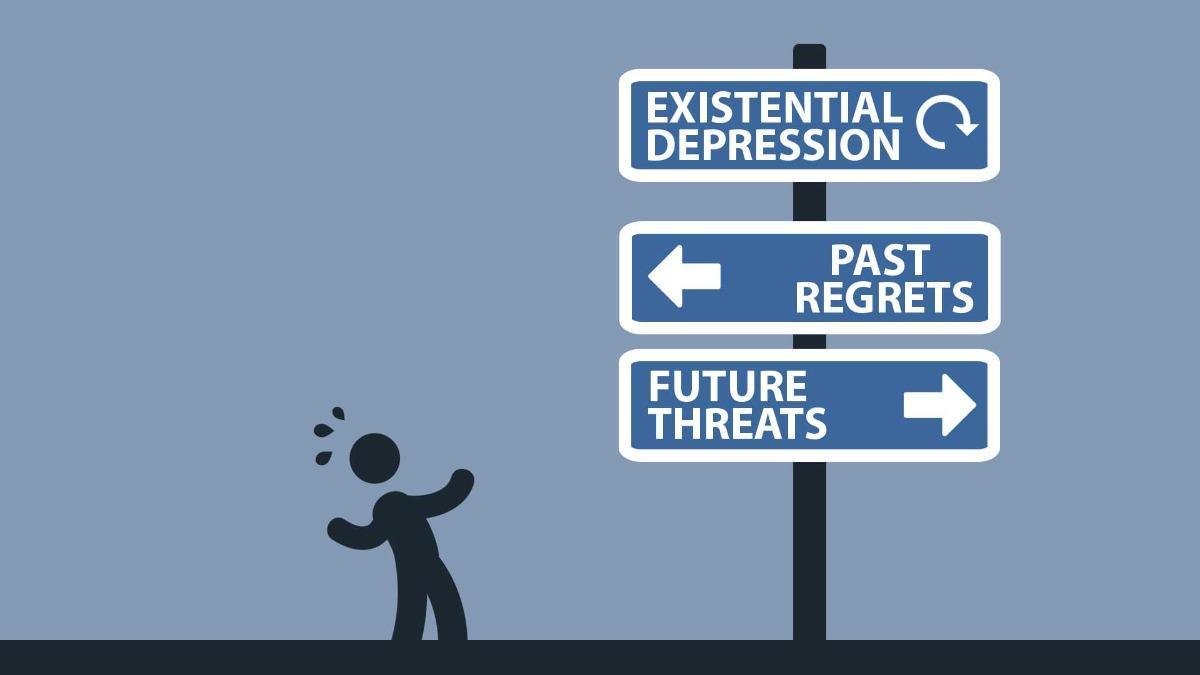
Existential depression is not sadness, nor is it the emotional heaviness commonly associated with mood disorders. It is a collapse of the structures that make experience meaningful — a failure not of emotion, but of interpretation. In ordinary depression, feelings darken; in existential depression, the very framework through which feelings acquire significance dissolves. The world remains visible but hollowed, stripped of narrative coherence, moral gravity, and personal relevance. The individual does not simply feel bad; they feel absent from the meaning-making fabric of existence. At the heart of existential depression lies a breakdown of ontological security — the normally unexamined assumption that life has a stable purpose, that the self is real and continuous, that time moves toward something. When these assumptions collapse, the psyche enters a freefall. Everyday actions lose justification. Decisions feel arbitrary. Values feel constructed and brittle. Goals once pursued with conviction now appear artificial, as though borrowed from a script everyone else is performing without question. The person sees through everything, but what they see is emptiness. This collapse often arises in individuals with high introspective capacity, acute self-awareness, or a temperament inclined toward abstraction. Such minds tend to think not only about their feelings but about the architecture of meaning itself. When this reflective lens turns inward during periods of emotional vulnerability — loss, disillusionment, betrayal, or chronic stress — it can destabilize the scaffolding that supports a coherent worldview. What begins as questioning becomes unraveling. The mind, in its search for truth, strips reality of its comforting illusions and discovers not clarity but void. Neurologically, existential depression corresponds to hyperactivity in the default mode network — the system responsible for self-reflection, autobiographical memory, and internal narrative construction. When overactivated, the DMN generates loops of abstract rumination disconnected from embodied experience. These loops dissect meaning until nothing survives the scrutiny. Instead of grounding the individual, the reflective apparatus destroys the very foundations it is meant to stabilize. The mind becomes a self-consuming machine, generating thoughts that nullify themselves, leaving only an echoing intellectual wasteland. Emotionally, existential depression is characterized less by pain and more by flattening. The individual does not mourn meaning; they feel as though meaning were never real. Joy appears counterfeit. Love seems contingent. Achievement feels irrelevant. Even suffering loses its drama. The absence of meaning numbs both pleasure and pain, creating a profound indifference that is often mistaken for apathy but is more accurately described as ontological exhaustion. Without meaning, emotion cannot attach to anything; it dissipates before fully forming. The existentially depressed individual often feels estranged from others. Social rituals seem mechanical, driven not by authenticity but by mutually agreed illusions. The depressed person sees people chasing goals without understanding why, expressing values that feel culturally inherited rather than individually chosen. This perception creates a quiet but devastating isolation — not loneliness in the presence of others, but loneliness in the presence of their apparent certainty. To inhabit a world where everyone seems convinced of things that feel hollow is to exist as a ghost among believers. Temporal experience also distorts. Without meaning, the future collapses. Plans lose their motivational traction, and time becomes a series of interchangeable moments devoid of direction. The past, too, loses significance as memories no longer contribute to a coherent identity narrative. The self becomes suspended in a perpetual present — not in the meditative sense, but in a stagnant one. Life continues, but it no longer progresses. One of the paradoxes of existential depression is that it often coexists with high intelligence. The capacity to analyze, to question, to deconstruct is a double-edged sword. When life is stable, this analytical depth enriches experience. But when a destabilizing event occurs, that same depth can dismantle foundational beliefs with ruthless precision. The mind becomes its own adversary, using its strengths to undermine its stability. Insight without meaning becomes corrosive. Healing from existential depression requires more than restoring mood; it requires rebuilding meaning. This cannot be forced by positive thinking or superficial optimism. Meaning must be reconstructed from the ground up, through lived experience rather than abstract reasoning. Paradoxically, the way out is not more thinking but more being. Embodiment — sensory engagement, relational presence, creative activity — reconnects the self to the world before the intellect has the chance to nullify it. Meaning grows not from analysis but from involvement. Therapeutically, the goal is not to provide answers but to help the individual tolerate meaninglessness long enough for new meaning to emerge organically. This requires patience, humility, and the acceptance that some questions cannot be answered intellectually. The existentially depressed person must learn to trust small experiences again: a conversation, a melody, a moment of connection, a fleeting curiosity. These micro-meanings accumulate, gradually reweaving the fabric of significance that abstraction had torn apart. Ultimately, existential depression reveals the fragility of the structures that sustain human life. Meaning is not inherent, but constructed; not permanent, but maintained. When those structures collapse, the psyche confronts a terrifying freedom — the freedom to rebuild or to despair. Yet within this collapse lies a profound opportunity. To question meaning is also to have the capacity to create it. Existential depression is not the end of significance but the shadow of its rebirth — a silent, painful threshold through which the self must pass before discovering a meaning that belongs not to society, but to itself.