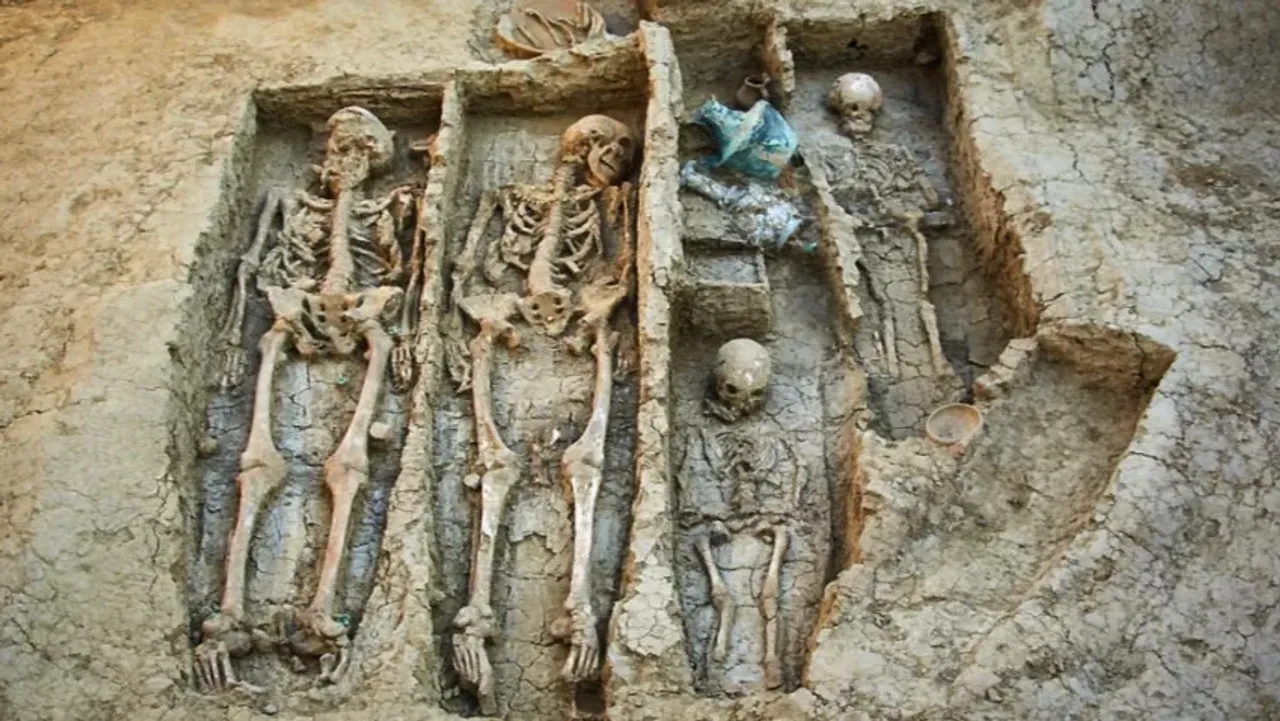
Throughout human history, death has been surrounded by rituals, beliefs, and social expectations. Some of these traditions may seem extremely disturbing from a modern perspective. Among them was the practice, found in certain historical societies, of a widow being killed or otherwise compelled to die and be buried with her deceased husband. One of the best-known examples is the practice commonly associated with sati in parts of South Asia, although similar ideas and rituals have appeared in different forms in other cultures and historical periods.
From a modern psychological perspective, such practices raise a difficult question: how could a society make the death of a living person appear acceptable, honorable, or even desirable?
The answer cannot be explained simply by saying that people in the past were cruel or that women willingly wanted to die. Human behavior is strongly influenced by culture, social expectations, fear, belonging, authority, and the meanings that a society gives to life and death. When these forces become powerful enough, an individual may make choices that would appear impossible outside that cultural environment.
One of the strongest psychological mechanisms involved in such traditions is social conformity. Human beings have a fundamental need to belong to a group. Throughout history, survival often depended on remaining within one’s community. Being rejected could mean losing protection, resources, family connections, and social identity. Consequently, people can sometimes tolerate enormous personal suffering when they believe that refusing a social expectation will result in rejection.
For a widow, the death of her husband could therefore represent much more than the loss of a loved one. In societies where a woman’s social identity was strongly connected to her husband, widowhood could mean a dramatic loss of status, security, and belonging. If the surrounding culture taught that a “good wife” should follow her husband even after death, the woman might experience enormous pressure to conform.
This is where psychological conditioning becomes important. Beliefs are rarely created in adulthood from nothing. They are usually learned gradually. A girl growing up in a community where marital devotion is repeatedly described as the highest form of female virtue may internalize the idea long before she becomes a wife.
She may hear stories about women who followed their husbands into death and were praised as loyal, pure, courageous, or spiritually elevated. At the same time, women who refused may be described negatively. Through repeated exposure, the practice can become psychologically normalized.
What appears horrifying to an outsider may therefore have been interpreted very differently by someone raised inside the culture.
This does not mean that the person was necessarily free from fear or coercion. Psychological pressure does not always look like physical force. A person can be controlled through shame, social exclusion, threats, religious authority, economic dependence, or fear of dishonoring the family.
The distinction between voluntary choice and social coercion is especially important. If someone is told from childhood that one possible choice will bring honor while another will bring disgrace, their decision cannot be understood independently of that environment.
Another psychological factor is identity fusion. Identity fusion occurs when a person’s sense of self becomes extremely connected to another person or group. In a strongly patriarchal marriage system, a woman’s identity might be defined primarily through her role as someone’s wife. Her personal ambitions, individuality, and social status could become secondary to the marriage.
If the husband died, the psychological structure supporting her identity could collapse.
Modern psychology recognizes that bereavement can produce a profound disruption of identity. People sometimes describe the loss of a spouse as losing part of themselves. However, in a society where the individual’s identity is already almost completely merged with the marital role, widowhood could be experienced not merely as emotional loss but as social disappearance.
This helps explain why rituals surrounding death can become extremely powerful. Rituals give structure to experiences that are otherwise difficult to understand. Death creates uncertainty, and humans naturally search for meaning when confronted with it.
A culture may therefore develop a narrative in which the death of a spouse is transformed into a sacred event. The widow’s death may be interpreted as proof of loyalty, spiritual purity, family honor, or eternal union. Such beliefs can reduce psychological uncertainty by providing a clear explanation for an otherwise devastating event.
Fear also plays an important role.
Many historical death rituals were connected to beliefs about what happens after death. If people genuinely believed that husband and wife would remain together in another existence, dying together could be interpreted not as separation but as reunion.
This psychological interpretation is important because people do not respond to death only according to biological instinct. They respond according to what death means to them.
If death is understood as annihilation, dying may be terrifying. If it is understood as transition, reunion, purification, or spiritual continuation, the emotional meaning can be completely different.
However, beliefs about the afterlife can also be used to reinforce social control. If a woman is told that dying with her husband will bring spiritual honor while remaining alive will bring shame or punishment, religious belief becomes intertwined with social pressure.
Another factor is the power of authority.
Human beings are capable of following instructions from powerful authorities even when those instructions conflict with their personal instincts. Authority can come from religious leaders, elders, family members, rulers, or the wider community.
When an entire social environment communicates the same message, resistance becomes psychologically difficult. The individual may no longer experience the expectation as simply another person’s opinion. It can feel like an unquestionable truth.
The presence of other people can intensify this effect. Collective rituals create powerful emotional environments. Music, clothing, religious symbols, crowds, ceremonies, and repeated phrases can alter emotional states and reduce the feeling of ordinary individual choice.
A person standing alone may question an action that seems impossible. The same person surrounded by hundreds of people treating that action as sacred may experience the situation differently.
This is one reason collective behavior deserves careful psychological examination. Human beings do not make decisions in isolation. Context can change perception.
Another important element is shame.
Shame is one of the strongest social emotions. Guilt tells a person, “I did something wrong.” Shame can tell a person, “I am wrong.” When social identity is built around honor and reputation, the fear of shame can become stronger than personal preference.
A widow who believed that refusing a cultural expectation would permanently disgrace her family might experience an intense psychological conflict. Survival instincts could tell her to remain alive, while social conditioning could tell her that remaining alive makes her dishonorable.
This creates a tragic psychological situation in which the individual’s basic desire for survival conflicts with the identity imposed by society.
Gender inequality also needs to be considered. Historical societies were not equally structured around the interests and freedoms of men and women. In many patriarchal systems, women had fewer economic opportunities, weaker legal rights, and less control over property and marriage.
Consequently, widowhood could place women in a particularly vulnerable position.
If a woman had no independent income, no property rights, limited access to education, and little authority within the family, her ability to resist a social expectation could be severely restricted.
Therefore, interpreting such practices purely as “religious belief” would be incomplete. Religion, economics, gender hierarchy, family structure, and psychological conditioning could interact with one another.
There is also a psychological phenomenon known as learned helplessness, although it should be applied cautiously to historical populations. When individuals repeatedly experience situations in which they believe they have no control, they may eventually stop expecting that their actions can change the outcome.
A woman who had spent her entire life being told what she should be, how she should behave, whom she should obey, and what her role in society was might have had very little experience of autonomous decision-making.
The absence of perceived alternatives can therefore be psychologically significant.
At the same time, it is important not to assume that every woman subjected to such a ritual experienced it in the same way. Historical individuals were not psychologically identical. Some may have believed deeply in the practice. Others may have been frightened. Some may have resisted. Others may have felt intense pressure from relatives or the community.
Human behavior under cultural pressure is rarely simple.
This is also why modern observers should be careful about using the word “choice.” A choice made under extreme social coercion is not psychologically equivalent to a choice made under conditions of freedom.
Imagine a person being offered two possibilities: one associated with honor, acceptance, spiritual reward, and family pride; the other associated with shame, rejection, social isolation, and condemnation. Technically, there may be two options. Psychologically, however, the situation is heavily unequal.
The practice also reveals something broader about human psychology: societies can redefine the meaning of suffering.
People do not automatically interpret suffering as meaningless. They often ask what suffering represents. If suffering is presented as noble, sacred, necessary, or honorable, people may tolerate levels of suffering that would otherwise seem unacceptable.
This mechanism can be observed in many less extreme situations today. People sometimes tolerate exhausting work because they believe it proves their worth. They remain in destructive relationships because suffering is interpreted as loyalty. They sacrifice personal needs because self-sacrifice has been defined as virtue.
The historical practice of widows dying with their husbands therefore provides an extreme example of a much broader psychological phenomenon: human beings can sacrifice personal needs when a social system convinces them that sacrifice is meaningful.
Perhaps the most disturbing lesson is that social normalization can change moral perception.
When an entire community repeatedly sees something, talks about it, celebrates it, and gives it symbolic meaning, the practice can become psychologically familiar. Familiarity does not make an action morally right, but it can make the action feel less shocking to those who grow up within the system.
This is why psychological analysis of historical traditions is valuable. It reminds us that people are deeply influenced by the worlds in which they are raised.
The human capacity for adaptation is extraordinary. It allows people to survive in different environments, understand different cultures, and create meaning in difficult circumstances. But the same capacity can also allow harmful traditions to persist when they are supported by authority, fear, social pressure, and identity.
The history of widow burial rituals is therefore not simply a story about death. It is a story about belonging, identity, power, belief, grief, and the extraordinary influence of society on individual behavior.
It also reminds us that the question “Why didn’t she simply refuse?” may be psychologically inadequate. To understand a person’s behavior, we must ask what alternatives she believed existed, what consequences she expected, what authorities influenced her, what beliefs she had internalized, and how much freedom she actually possessed.
Human psychology does not exist separately from culture. Our ideas about love, loyalty, honor, family, marriage, sacrifice, and even death are shaped by the societies in which we live.
That is perhaps the most important lesson hidden within these disturbing historical practices: people do not simply live inside cultures. Cultures also live inside people.