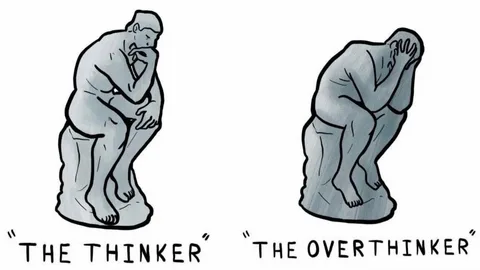
Overthinking is a common human experience in which thoughts repeatedly return to the same questions, events, decisions, or possible future outcomes. A person may spend hours analyzing a conversation, reconsidering a decision, imagining negative scenarios, or trying to understand another person’s behavior. Although reflection can support learning and problem-solving, repetitive thinking may become emotionally exhausting when it produces little new information or leads to no meaningful action. The psychological importance of overthinking lies not simply in the amount of time a person spends thinking, but in the function those thoughts serve, the emotions that accompany them, and their influence on everyday life.
Thinking is an essential mechanism through which people interpret experience, anticipate consequences, and make decisions. Reflective thought allows individuals to recognize mistakes, evaluate alternatives, and develop a more coherent understanding of themselves. However, not every thought process is productive. Sometimes, the mind continues examining a problem even after the available evidence has been considered. The individual may feel that one more analysis will finally provide certainty, emotional relief, or a complete explanation. Instead, the same questions return, often with increasing emotional intensity. This pattern is frequently described as rumination or worry, although these concepts are related rather than identical.
Rumination generally involves repeatedly thinking about past experiences, current distress, or the possible meaning of negative events. A person may ask why a relationship changed, why a particular comment was made, or why a previous decision resulted in disappointment. Worry, in contrast, is often oriented toward the future and involves anticipating possible threats or undesirable outcomes. Someone who worries excessively may mentally rehearse conversations, imagine failures, or attempt to prepare for every possible difficulty. Both processes can become repetitive, and both may create the impression that continued thinking is necessary for protection or understanding.
One possible explanation for overthinking is the human desire to reduce uncertainty. Uncertainty can be uncomfortable because it prevents individuals from knowing exactly what will happen or how other people will respond. When faced with an ambiguous situation, the mind may generate multiple explanations in an effort to identify the safest or most convincing one. For example, if a friend responds to a message with an unusually brief answer, a person may consider several possibilities: the friend is busy, irritated, distracted, emotionally distant, or simply communicating quickly. The difficulty arises when the individual repeatedly evaluates these explanations without obtaining additional evidence.
In such situations, thinking may become an attempt to achieve certainty that the circumstances cannot provide. Human relationships are inherently uncertain because other people have private experiences, changing emotions, and motivations that cannot always be observed directly. No amount of internal analysis can guarantee access to another person’s thoughts. Recognizing this limitation can be important because it shifts the goal from eliminating uncertainty to responding reasonably despite it.
Overthinking may also be associated with perfectionism. Individuals who place exceptionally high demands on themselves may feel that every decision must be correct and every mistake must be prevented. Before making a choice, they may examine numerous alternatives, anticipate criticism, and imagine the consequences of failure. Even relatively ordinary decisions can become emotionally demanding when they are treated as tests of personal competence or worth.
Perfectionistic thinking often contains an implicit belief that sufficient preparation should eliminate the possibility of regret. However, many decisions involve incomplete information and competing priorities. Choosing one option usually means giving up another, and even a reasonable decision may produce an undesirable result. When individuals interpret every disappointing outcome as evidence that they should have thought more carefully, they may reinforce the habit of excessive analysis. Over time, decision-making can become slower and less satisfying because the individual is attempting to achieve an impossible standard of certainty.
Fear of making mistakes may be another contributing factor. Mistakes can have practical consequences, but they can also threaten a person’s self-image. Someone who strongly associates achievement with personal value may experience an ordinary error as evidence of inadequacy. In this context, repeated thinking may function as a form of psychological preparation: if every possibility is examined in advance, perhaps embarrassment or rejection can be avoided. Yet the emotional cost of this strategy may be substantial, particularly when the feared event is unlikely or cannot be controlled.
The relationship between overthinking and anxiety deserves particular attention. Anxiety often involves anticipating danger, uncertainty, or loss. Repetitive thinking can maintain anxious feelings by repeatedly directing attention toward possible threats. When a person imagines a negative outcome, the body may respond with tension, increased alertness, or other signs of stress. These sensations can then be interpreted as evidence that the situation is dangerous, prompting further analysis. A cycle may develop in which worry increases distress and distress makes the original worry feel more convincing.
This does not mean that every person who overthinks has an anxiety disorder. Repetitive thinking can occur during periods of ordinary stress, conflict, grief, fatigue, or significant change. Its presence alone is not sufficient to establish a psychological diagnosis. The relevant questions include how persistent the pattern is, how difficult it is to interrupt, how much distress it causes, and whether it interferes with sleep, relationships, work, or other daily activities.
Past experiences may also influence the way people respond to uncertainty. Individuals who have experienced unpredictable relationships, repeated criticism, rejection, or prolonged stress may become especially attentive to subtle changes in their environment. They may learn to monitor other people’s expressions, tone of voice, or patterns of behavior in an attempt to anticipate conflict. In some circumstances, this attentiveness may have developed as an understandable response to earlier experiences. Later, however, the same strategy may continue even when the current environment is more secure.
It is important not to assume that a particular childhood experience inevitably produces overthinking. Human development is influenced by many interacting factors, including temperament, relationships, social circumstances, learning, and later experiences. Two individuals exposed to similar circumstances may develop very different coping strategies. Nevertheless, examining the personal history of repetitive thinking can sometimes help explain why certain situations trigger disproportionate concern or why uncertainty feels especially difficult to tolerate.
Overthinking can also be connected with a person’s understanding of responsibility. Some individuals feel responsible not only for their own choices but also for other people’s emotions, reactions, and interpretations. After a disagreement, they may repeatedly examine what they said, wondering whether they caused unnecessary pain or whether they should have responded differently. Reflection about interpersonal behavior can be constructive, particularly when it leads to accountability and repair. It becomes less useful when the individual assumes responsibility for everything that another person feels or does.
A balanced understanding of responsibility requires distinguishing between influence and control. People can influence relationships through their words and actions, but they cannot fully control another person’s interpretation, emotional response, or decisions. A person may communicate respectfully and still be misunderstood. They may set a reasonable boundary and still disappoint someone. Accepting these possibilities does not mean ignoring the consequences of one’s behavior. It means recognizing that responsibility has limits.
Another difficulty is that repetitive thinking can resemble problem-solving while producing few practical results. Genuine problem-solving usually involves identifying a specific issue, considering available information, evaluating realistic options, and choosing an action. Rumination often returns to broad, difficult-to-answer questions such as why something happened, what it says about the self, or whether the future will turn out badly. These questions may be emotionally significant, but repeatedly asking them does not necessarily create new understanding.
One useful distinction is whether thinking produces new information or merely repeats an existing interpretation. If a person has already reviewed the available evidence and continues asking the same question without identifying anything new, it may be time to change the activity. This does not require suppressing the thought or forcing the mind to become completely quiet. It involves recognizing that further analysis may no longer be the most effective response.
Attempts to suppress thoughts completely can sometimes make them more noticeable. When individuals repeatedly tell themselves not to think about a particular concern, they may become increasingly attentive to whether the thought has returned. A more flexible approach is to acknowledge the thought without treating it as a command or a fact. For example, a person might recognize, “I am having the thought that I made a serious mistake,” rather than immediately concluding, “I have ruined everything.” This subtle distinction creates space between a mental event and the meaning assigned to it.
Cognitive behavioral therapy offers several approaches that may help people understand and modify unhelpful thinking patterns. One central principle is that thoughts, emotions, physical responses, and behaviors can influence one another. An ambiguous event may generate a negative interpretation, which increases anxiety and encourages avoidance or repeated checking. These behaviors may provide temporary relief while preventing the person from discovering whether the feared interpretation was accurate.
A cognitive approach encourages individuals to examine the evidence supporting and contradicting their conclusions. Consider someone who believes that a colleague’s silence means that the colleague dislikes them. Instead of accepting the interpretation immediately, the individual can distinguish observable facts from assumptions. The observable fact is that the colleague did not speak much during a particular interaction. The explanation that the colleague feels dislike is an interpretation, not an established fact. Other explanations may be possible, and additional evidence may be needed before reaching a conclusion.
The purpose of this process is not to replace every negative thought with an artificially positive one. Some concerns are realistic, and some situations genuinely require attention. The goal is to develop interpretations that are proportionate to the available evidence and flexible enough to change when new information appears. A balanced thought may acknowledge uncertainty rather than pretending that everything will certainly be fine.
Behavioral strategies can also interrupt repetitive thinking. When a concern has a practical solution, a person can identify one small, specific action. If a difficult email needs to be sent, the next step may be to draft a clear response. If an important decision requires information, the next step may be to consult a reliable source or speak with someone knowledgeable. Turning a vague concern into a manageable action can help restore a sense of agency.
However, not every problem can be solved immediately. Some experiences involve loss, rejection, uncertainty, or decisions that depend on other people. In these cases, the task may be to tolerate an unresolved situation rather than to continue searching for an answer. This can be challenging for individuals who believe that every uncomfortable emotion must be explained or eliminated before they can continue with daily life. Sometimes, progress involves accepting that a question remains unanswered while choosing to engage in meaningful activities.
Mindfulness-based approaches offer another way to relate differently to repetitive thoughts. Mindfulness involves paying attention to present experience with openness and without immediately judging or reacting to every mental event. When a person notices that their mind has returned to an old conversation, they can acknowledge the thought and gently redirect attention toward what they are doing. The thought may return several times. The aim is not necessarily to prevent its appearance but to reduce the automatic tendency to follow it into an extended chain of analysis.
For some individuals, mindfulness practices are helpful when they involve ordinary activities such as walking, drinking tea, preparing food, or reading while paying attention to the present experience. Formal meditation may also be useful, although it is not equally comfortable or effective for everyone. People who find inward attention distressing may prefer grounding techniques that emphasize external surroundings, physical movement, or structured activities.
Writing can be another practical tool, particularly when thoughts feel disorganized. A person may record the concern, the evidence currently available, the aspects that remain uncertain, and the actions that are realistically possible. This can help separate facts from predictions and identify whether the problem requires action or acceptance. However, writing may become another form of rumination if the individual repeatedly records the same fears without reaching a new perspective. Its usefulness depends on whether it supports clarity rather than extending the cycle.
Time boundaries may also help. A person can set aside a limited period to consider a concern and then deliberately return to another activity. This is not a guarantee that thoughts will disappear when the allotted time ends. Rather, it is a way of practicing the ability to choose when and how to engage with them. If the concern returns later, the individual can decide whether new information has emerged or whether the same mental process is repeating itself.
Sleep and physical well-being should not be overlooked. Fatigue can make emotional regulation more difficult and reduce the capacity to evaluate problems calmly. When people are tired, ambiguous events may feel more threatening, and decisions may seem harder than they would under better conditions. Persistent stress, irregular sleep, and insufficient recovery can contribute to a cycle in which exhaustion increases repetitive thinking and repetitive thinking makes rest more difficult.
For this reason, addressing overthinking may involve changes beyond thought-focused techniques. Regular sleep routines, physical activity, manageable daily expectations, social support, and periods of genuine rest can support emotional regulation. These measures are not substitutes for professional care when significant difficulties are present, but they can form part of a broader approach to psychological well-being.
Relationships may become strained when overthinking repeatedly influences communication. A person may interpret delayed replies as rejection, assume that neutral comments contain criticism, or rehearse conversations so extensively that spontaneous interaction becomes difficult. In some cases, the individual may seek repeated reassurance from others. Reassurance can be comforting, but if it becomes the only way to manage uncertainty, relief may be temporary and the need for further reassurance may return.
Clear communication can help reduce unnecessary interpretation. Instead of trying to infer another person’s intentions from limited evidence, a person may ask a respectful, direct question when the relationship and circumstances make that appropriate. For example, “I was unsure how to interpret our conversation earlier. Did you mean that you were unhappy with the decision?” invites clarification more effectively than silently constructing multiple explanations. Of course, direct communication cannot guarantee an honest or complete answer, and it may not be appropriate in every situation. The important point is to recognize when assumptions can be checked rather than endlessly analyzed.
Overthinking can also affect identity. Individuals who repeatedly examine their motives, emotional responses, and personal history may become highly self-aware, but they may also begin to treat every feeling as a problem that must be explained. A moment of irritation becomes evidence of being an unkind person; a period of sadness becomes a reason to question one’s entire life; a mistake becomes a judgment about personal worth. This pattern can turn self-reflection into self-surveillance.
Self-awareness and self-criticism are not the same. Self-awareness involves noticing internal experiences and learning from them. Self-criticism often involves evaluating those experiences through rigid standards or global judgments. A person can acknowledge anger without concluding that they are fundamentally bad. They can recognize a mistake without defining themselves entirely by it. They can admit uncertainty without assuming that they lack intelligence or competence.
Developing a more compassionate internal dialogue may help reduce the emotional intensity of repetitive thinking. This does not mean avoiding accountability or excusing harmful behavior. It means applying standards to oneself that are realistic enough to support learning. A useful question is whether the same interpretation would seem fair if it were applied to a friend facing the same circumstances. If the answer is no, the individual may be relying on a harsher standard than the situation warrants.
It is equally important to understand that thinking deeply is not inherently harmful. Many people are naturally reflective and enjoy examining ideas, motives, and complex problems. Deep thought can support creativity, intellectual development, ethical reasoning, and emotional understanding. The distinction between reflection and overthinking is not simply the difference between thinking a little and thinking a lot. It concerns flexibility, usefulness, and emotional consequences.
Productive reflection usually allows a person to reach a provisional conclusion, learn something, or decide on a next step. Repetitive thinking tends to remain rigid, circular, and difficult to disengage from. Productive reflection can include uncertainty without becoming paralyzed by it. Overthinking often treats uncertainty as a problem that must be eliminated before life can continue.
Professional support may be appropriate when repetitive thinking becomes persistent, distressing, or difficult to manage independently. A qualified mental health professional can help assess whether the pattern is associated with anxiety, depression, obsessive-compulsive symptoms, trauma-related difficulties, sleep problems, or other concerns. These conditions differ in their presentation and treatment, so it is important not to assume that all repetitive thoughts have the same cause. In particular, intrusive thoughts and compulsive behaviors may require a more specific assessment than general advice about worrying less.
Treatment depends on the nature of the difficulty. Cognitive behavioral therapy may be useful for some patterns of worry and rumination, while other evidence-based approaches may be more appropriate in different circumstances. A professional can help identify the relevant processes and develop strategies suited to the individual’s needs. Seeking support does not mean that a person is weak or incapable of managing their own life. It can be a practical response to a pattern that has become difficult to change alone.
Ultimately, the goal is not to create a mind that never questions, analyzes, or revisits the past. Such a goal would be unrealistic and unnecessary. The more meaningful objective is to develop a flexible relationship with thought: to reflect when reflection is useful, take action when action is possible, seek clarification when appropriate, and tolerate uncertainty when no complete answer is available.
A person does not need to resolve every internal question before making a decision, entering a relationship, beginning a project, or enjoying an ordinary day. Some questions become clearer through experience rather than analysis. Others remain uncertain because the available information is incomplete or because life does not offer a single definitive explanation.
Learning when to stop thinking is not a rejection of intelligence or depth. It is an aspect of using thought wisely. When reflection helps a person understand experience and act according to their values, it serves an important purpose. When it repeatedly produces distress without new understanding, a different response may be needed. Psychological flexibility involves recognizing that difference and allowing life to continue even when the mind has not answered every question.