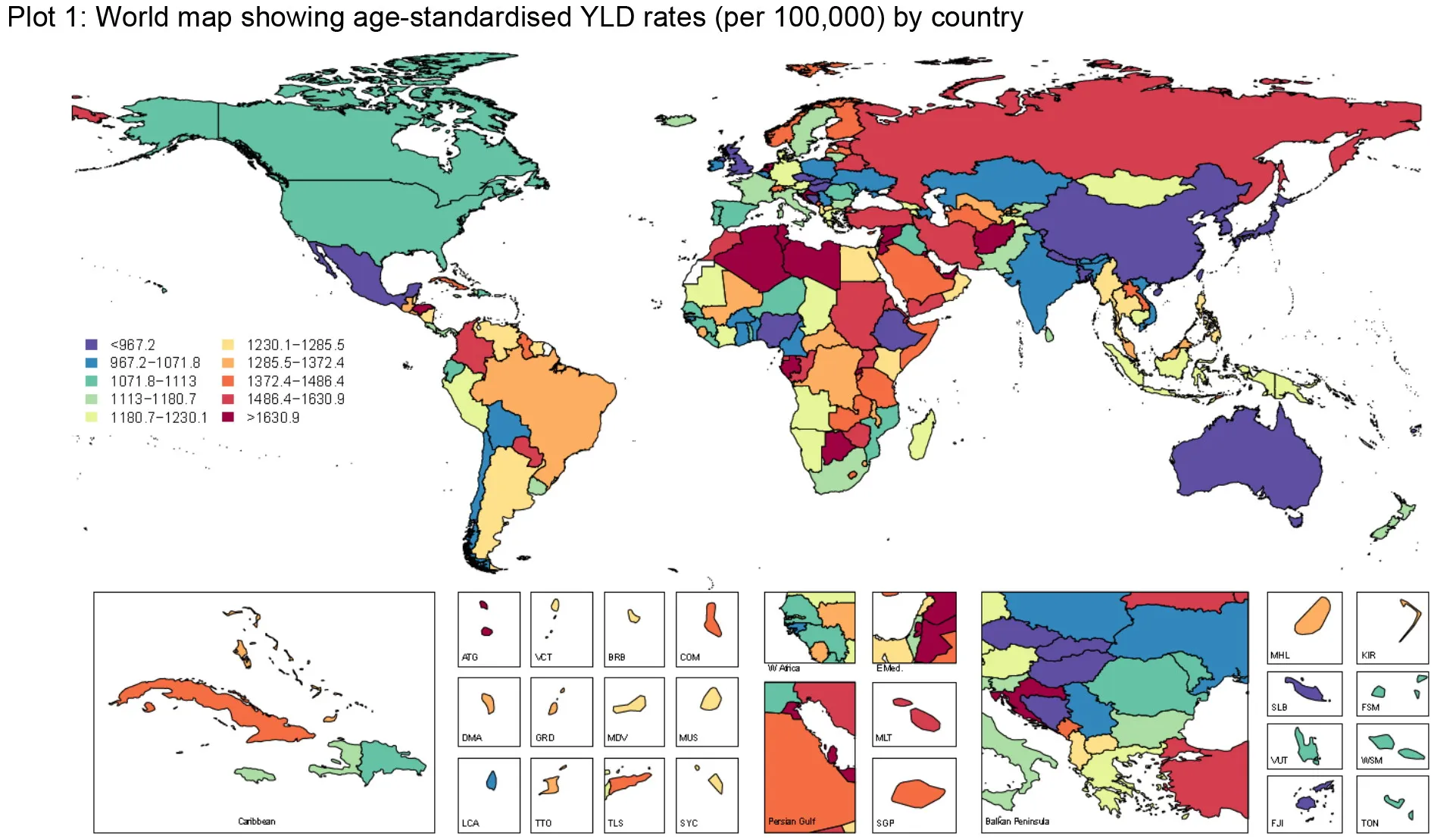
Mental disorders are a major global health issue, but their prevalence is not the same in every country. Differences can be seen in the estimated rates of depression, anxiety disorders, bipolar disorder, eating disorders, schizophrenia, and other mental health conditions. According to the World Health Organization, nearly one in seven people worldwide lives with a mental disorder. However, comparing countries is more complicated than simply creating a ranking because mental health data are affected by diagnosis, access to healthcare, reporting practices, social attitudes, and differences in research methods.
The latest estimates from the Institute for Health Metrics and Evaluation’s Global Burden of Disease study provide one way to compare countries. In 2023, the estimated proportion of people living with a mental health disorder was particularly high in several European and Middle Eastern countries. The Netherlands was estimated at about 23.2%, Portugal at 22.3%, Iran at 22.1%, and the United Kingdom at about 22.0%. Australia was estimated at 21.7%, Brazil at 21.3%, and Malta at 20.3%. These figures include several categories of mental disorders rather than one specific condition.
The United States was estimated at approximately 18.0%, while France was around 18.7%, Spain 18.6%, Switzerland 18.4%, and Sweden 17.1%. Canada was estimated at about 16.7%. These numbers show that relatively high estimated prevalence is not restricted to one geographical region. Both European and non-European countries appear among countries with higher estimates.
At the same time, several countries have considerably lower estimated percentages. Japan was estimated at around 12.5%, China at 13.4%, South Korea at 13.1%, India at 14.7%, and Indonesia at about 10.0%. Vietnam was estimated at 8.8%, while Thailand was approximately 10.2%. These differences should not automatically be interpreted as meaning that people in countries with lower estimates are psychologically healthier. A lower reported or estimated prevalence can also reflect differences in detection, diagnosis, data availability, cultural attitudes, and access to mental healthcare.
Azerbaijan provides an interesting example. The 2023 estimate places the share of the population with one of the included mental health disorders at approximately 12.9%. This is lower than the estimates reported for countries such as the Netherlands, Portugal, the United Kingdom, or the United States. However, this number should not be interpreted as evidence that mental disorders are rare in Azerbaijan. Our World in Data specifically notes that reliable national mental-health estimates are not available for many countries, creating an important global data gap.
One of the most important problems with international comparisons is underdiagnosis. Many people experiencing depression, anxiety, or other disorders never receive a formal diagnosis. They may not recognize their symptoms as a mental health condition, may avoid professional help because of stigma, or may simply have no access to appropriate services. Consequently, medical records alone cannot provide a complete picture of mental illness in a population.
For this reason, international researchers use several types of evidence, including epidemiological studies, surveys, medical records, national statistics, and statistical models. The Global Burden of Disease estimates attempt to combine these sources to produce comparable estimates across countries. However, uncertainty remains, particularly in countries where direct population-level data are limited.
Depression is one of the most important disorders to examine separately. According to the World Health Organization, an estimated 5.7% of adults globally experience depression. Women are more likely than men to experience depression, and depression can significantly affect relationships, education, employment, and everyday functioning.
Country-level estimates for depressive disorders also vary. In 2023, the age-standardized estimated prevalence was particularly high in Syria, at approximately 7.95%. The United Kingdom was estimated at 6.80%, the Netherlands at 6.21%, and several countries affected by conflict or severe social difficulties also had relatively high estimates. Turkey was estimated at about 5.04%, while Afghanistan was around 5.16%.
These numbers raise an important question: why might some countries have higher estimated rates than others?
One possible explanation is exposure to stress and adversity. War, displacement, poverty, unemployment, political instability, social inequality, natural disasters, and violence can increase psychological risk. Countries experiencing prolonged conflict may therefore have substantial mental-health burdens. However, social stress alone cannot explain all international differences.
Economic development also has a complicated relationship with mental health. It would be incorrect to assume that richer countries automatically have fewer mental disorders. In fact, several high-income countries have relatively high estimated prevalence. This may partly reflect better detection and more complete reporting. People in countries with stronger healthcare systems may be more likely to recognize symptoms, seek professional help, receive a diagnosis, and appear in health statistics.
In contrast, a country with limited mental-health services may appear to have a lower prevalence simply because many cases remain unidentified. This is one reason why a country’s position in a statistical ranking should never be interpreted without considering its healthcare system.
Culture also influences mental-health reporting. In some societies, psychological symptoms may be described using physical complaints rather than emotional language. A person experiencing depression might report fatigue, headaches, sleep problems, or physical pain rather than saying that they feel depressed. In other cultures, seeking psychological help may be more socially acceptable, leading to greater diagnosis and reporting.
The availability of professionals is another important factor. Psychologists, psychiatrists, psychiatric nurses, social workers, and other specialists are not distributed equally around the world. According to recent global analyses, mental-health care remains scarce everywhere, but the difference between high-income and low-income countries is particularly large. Government mental-health spending is dramatically higher in high-income countries than in low-income countries.
This creates an important paradox. A country can have a high estimated prevalence because its population genuinely experiences substantial mental-health problems, because its healthcare system detects more cases, or because both factors are present. Conversely, a country can have a lower estimate because the underlying prevalence is lower, because fewer people are diagnosed, or because reliable data are missing.
Another important point is that “mental disorders” is a broad category. Depression is different from schizophrenia. Anxiety disorders are different from bipolar disorder. Eating disorders, post-traumatic stress disorder, obsessive-compulsive disorder, and substance-use disorders have different causes, symptoms, and patterns. Therefore, a single percentage cannot describe the entire mental-health situation of a country.
The overall global estimate is nevertheless striking. The WHO states that nearly one in seven people worldwide lives with a mental disorder. Its 2025 global report also emphasizes that more than one billion people live with a mental disorder and that most people who need care do not receive adequate support.
The burden is therefore not simply about how many people experience symptoms. It is also about whether they can receive effective treatment. Two countries could have similar levels of depression or anxiety but very different outcomes if one has a strong mental-health system and the other has very limited access to care.
Another useful measure is the contribution of mental disorders to overall disease burden. This is often measured using disability-adjusted life years, or DALYs. In 2023, mental disorders accounted for a particularly large share of total disease burden in some countries, including Qatar, the United Arab Emirates, Iran, Kuwait, and Oman. Azerbaijan was estimated at approximately 6% of total DALYs from mental disorders.
However, prevalence and disease burden are not the same thing. Prevalence tells us approximately how many people are living with a condition at a given time. Disease burden also considers the effects of illness on functioning, disability, and premature mortality. A disorder that affects many people but causes relatively limited disability can therefore have a different burden profile from a less common but highly disabling disorder.
International statistics should consequently be interpreted as estimates rather than absolute measurements. The available evidence is strongest for some conditions and weaker for others. Data on major depressive disorder, for example, are available from more countries than data on some less commonly studied conditions. Our World in Data notes that many mental illnesses have limited underlying country-level data, creating substantial uncertainty in global comparisons.
There is also a major difference between mental-health prevalence and mental-health awareness. A country may report relatively high rates partly because its population has greater awareness of psychological symptoms and its healthcare system has stronger diagnostic practices. Another country may report lower rates because mental disorders are less recognized or because people are reluctant to seek help.
This means that saying “Country A has more mental illness than Country B” can be misleading. A more accurate statement is that current international estimates suggest different levels of mental-disorder prevalence, but these estimates are influenced by both real differences in population health and differences in measurement.
The statistics nevertheless reveal an important global pattern: mental disorders exist in every part of the world. They are not limited to wealthy countries, poor countries, large cities, particular cultures, or specific age groups. What differs is how frequently conditions are estimated, how successfully they are identified, how willing people are to seek help, and how much treatment is available.
Mental health should therefore be understood as both a medical and a social issue. Economic conditions, education, employment, family relationships, exposure to violence, social support, healthcare access, and cultural attitudes can all influence mental health. No single factor can explain why one country has a higher estimate than another.
The most important lesson from country-level statistics is therefore not which country occupies the first position in a ranking. The more important question is whether people who experience psychological suffering can be identified and supported. A low prevalence estimate is not necessarily good news if it reflects missing data or widespread underdiagnosis. Similarly, a high estimate does not necessarily mean that a country’s population is uniquely unhealthy; it may partly indicate that mental disorders are being detected more effectively.
International mental-health statistics are valuable because they allow researchers and governments to identify patterns, compare health systems, estimate unmet needs, and plan services. At the same time, the numbers must be interpreted carefully. Behind every percentage are individuals experiencing emotions, symptoms, difficulties, and changes in everyday life.
The global picture is clear: mental disorders affect hundreds of millions of people, and no country is completely protected from them. The differences between countries are real, but the statistics also reflect differences in diagnosis, data quality, culture, healthcare access, and social conditions. For this reason, the most useful approach is not simply to ask which country has the most mental illness, but to ask why the differences exist and what countries can do to improve prevention, early recognition, treatment, and access to psychological care.