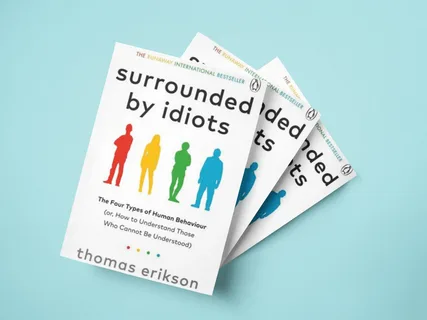
Thomas Erikson’s book *Surrounded by Idiots* explores differences in human behavior and communication through a four-color model: red, yellow, green, and blue. The model is intended to help readers recognize different behavioral tendencies, understand why misunderstandings occur, and adapt their communication to different people. Rather than assuming that everyone thinks, feels, and responds to situations in the same way, Erikson encourages readers to consider how individual differences influence everyday interactions. The framework has become popular because it offers a relatively simple vocabulary for discussing recognizable patterns in communication. However, it is best understood as a practical interpretive model rather than a scientifically established system for classifying every person’s personality.
In Erikson’s framework, red is associated with directness, determination, decisiveness, and an emphasis on results. Yellow represents sociability, enthusiasm, expressiveness, and a preference for interaction. Green is associated with patience, stability, cooperation, and a desire for harmony. Blue represents analytical thinking, precision, attention to detail, and a preference for structure. These colors are not clinical categories, and people should not be assumed to possess only one set of characteristics. An individual may display different tendencies depending on the situation, their responsibilities, their emotional state, and the people with whom they interact.
The red behavioral style is commonly associated with people who prefer direct communication and rapid decision-making. Such individuals may focus on objectives, efficiency, and practical outcomes. When confronted with a problem, they may immediately look for a solution rather than spend a long time discussing how the problem makes everyone feel. They often appreciate clarity, independence, and opportunities to influence decisions. In professional settings, these tendencies can be useful when a group needs direction, a decision must be made quickly, or a difficult task requires persistence.
Nevertheless, the strengths associated with the red style can also produce interpersonal difficulties. Directness may be interpreted as aggression, confidence may appear to be arrogance, and efficiency may come at the expense of emotional sensitivity. A person who wants to resolve a problem quickly may become impatient with someone who needs more time to explain their concerns. From the red individual’s perspective, the conversation may seem unnecessarily complicated. From the other person’s perspective, the same interaction may feel dismissive or intimidating. Neither interpretation automatically reveals the person’s intentions; the conflict may arise from different expectations about how communication should work.
When communicating with someone who displays red tendencies, it can be helpful to present information clearly, identify the main issue, and explain what decision or outcome is needed. Excessive indirectness may create confusion, while lengthy explanations without a clear purpose may reduce the person’s attention. However, adapting communication does not mean accepting disrespectful behavior. Directness is not a justification for humiliation, intimidation, or controlling others. Effective communication requires both clarity and respect, regardless of personality style.
The yellow behavioral style, by contrast, is associated with enthusiasm, expressiveness, social engagement, and an interest in exchanging ideas. People who identify with this description may enjoy conversations, group activities, new experiences, and opportunities to influence others through enthusiasm. They may communicate animatedly, move quickly between ideas, and express emotions openly. Their energy can help groups become more engaged, encourage participation, and generate creative possibilities. In social settings, they may contribute warmth and spontaneity.
However, the same tendencies can create challenges. Enthusiasm may sometimes lead to overpromising, overlooking details, or making decisions before considering every practical consequence. A highly expressive person may unintentionally dominate a conversation, while someone who prefers quiet reflection may find the pace overwhelming. The yellow style’s emphasis on social interaction can also lead others to underestimate the individual’s capacity for serious thought or emotional depth. Being outgoing does not mean that a person lacks complexity, just as being quiet does not mean that a person lacks interest.
Communication with someone who displays yellow tendencies may benefit from warmth, engagement, and opportunities to exchange ideas. A purely impersonal or excessively rigid approach may make interaction less productive. At the same time, important plans and agreements should be clarified rather than left to enthusiasm alone. Written summaries, specific responsibilities, and realistic deadlines can help translate promising ideas into practical outcomes. These strategies should be offered as useful communication practices, not as assumptions that every sociable person is disorganized.
The green behavioral style is associated with patience, consistency, cooperation, and a preference for predictable interpersonal environments. People who display these tendencies may value trust, stability, and relationships in which individuals listen to one another. They may be attentive to the emotional atmosphere of a group and reluctant to create unnecessary conflict. In families, friendships, and workplaces, these qualities can support cooperation and provide a sense of reliability. A person who listens carefully and responds calmly may help others feel comfortable expressing themselves.
Yet a strong preference for harmony can sometimes make difficult conversations more challenging. An individual may avoid disagreement because they fear damaging a relationship, disappointing someone, or creating tension. They may agree outwardly while privately feeling uncomfortable. If this pattern continues, resentment can develop because personal needs remain unexpressed. Others may mistakenly assume that the person has no objections, when in reality the person simply finds confrontation difficult.
When communicating with someone who displays green tendencies, patience and predictability can be helpful. Abrupt demands, unnecessary pressure, or sudden changes may make it harder for the person to express their perspective. Providing time to consider a decision and explicitly inviting an honest opinion can support more open communication. However, patience should not become a reason to exclude the person from difficult decisions. Respectful disagreement is an ordinary part of healthy relationships, and maintaining harmony does not require suppressing every difference.
The blue behavioral style is associated with analysis, accuracy, systematic thinking, and attention to detail. People who display these tendencies may prefer to examine information carefully before reaching a conclusion. They may ask questions, compare alternatives, look for evidence, and consider possible errors. In academic, technical, administrative, and other detail-sensitive tasks, such habits can be valuable. A willingness to verify information may prevent avoidable mistakes and improve the quality of decisions.
However, careful analysis can sometimes slow decision-making, particularly when complete information is unavailable. A person may continue evaluating alternatives because they want to reduce uncertainty or avoid an error. Others may interpret this behavior as hesitation, excessive criticism, or emotional distance. Meanwhile, the analytical individual may view a quick decision without sufficient evidence as careless. These opposing expectations can create frustration even when both people are attempting to achieve a reasonable outcome.
When communicating with someone who displays blue tendencies, it is often useful to provide clear information, explain the reasoning behind a proposal, and distinguish verified facts from assumptions. Specific examples and well-organized explanations may be more persuasive than vague assurances. Allowing reasonable time for analysis can also improve cooperation. Nevertheless, precision should not be confused with infallibility. Detailed reasoning can be valuable, but no person possesses complete information in every situation, and an analytical approach does not eliminate the influence of emotions, assumptions, or personal bias.
One of the central practical ideas behind Erikson’s model is that communication difficulties may arise when people interpret differences in behavior as evidence of bad intentions. A direct person may perceive a cautious colleague as indecisive. A highly expressive person may interpret a quiet colleague as uninterested. A harmony-seeking individual may experience a blunt comment as unnecessarily hostile, while the speaker may believe they are simply being honest. An analytical person may see an enthusiastic proposal as insufficiently considered, whereas the person proposing it may feel that their creativity is being dismissed.
These misunderstandings illustrate why it can be useful to separate observable behavior from conclusions about character. Someone who speaks little during a meeting is not necessarily arrogant or disengaged. Someone who asks many questions is not necessarily trying to obstruct progress. Someone who disagrees openly is not necessarily disrespectful, and someone who avoids disagreement is not necessarily dishonest. Behavior can have several explanations, and a fair interpretation requires attention to context rather than an immediate judgment about personality.
The four-color model can therefore serve as a starting point for reflecting on communication preferences. It encourages people to ask whether they are being sufficiently clear, whether they listen patiently, whether they explain their reasoning, and whether they make space for others to express disagreement. Its greatest practical value may lie not in assigning a color to every person, but in encouraging flexibility. Communication becomes more effective when individuals recognize that the approach that feels natural to them may not work equally well for everyone else.
At the same time, the model has limitations. Human personality is complex and cannot be adequately captured by four colors alone. Research in personality psychology commonly examines traits such as extraversion, agreeableness, conscientiousness, emotional stability, and openness to experience. These traits are studied using different methods and should not be treated as interchangeable with Erikson’s color categories. The four-color framework is a simplified popular model, and the color labels should not be mistaken for formal psychological diagnoses or definitive measurements of personality.
People also change their behavior according to their circumstances. A normally quiet individual may become assertive when protecting a child or defending an important principle. A decisive manager may become cautious when facing unfamiliar risks. A sociable person may need solitude during a difficult period, while an analytical individual may make an intuitive decision when time is limited. These examples demonstrate that behavior is influenced by context, learning, motivation, and emotional state as well as relatively stable individual differences.
For this reason, labeling another person too quickly can undermine the very understanding the model is intended to promote. If someone is described as a red personality, every disagreement may be interpreted as aggression. If someone is labeled yellow, their ideas may be dismissed as superficial. If someone is considered green, their objections may be overlooked because others assume they always want harmony. If someone is classified as blue, their emotional needs may be ignored because they are expected to prioritize logic. In each case, a descriptive label can become a filter that prevents people from seeing evidence that does not fit their expectations.
A more balanced approach is to treat the colors as tentative descriptions of behavior rather than fixed identities. Instead of asking, “What color is this person?”, it may be more useful to ask, “What does this person seem to need in this particular conversation?” One person may need a clear decision, another may need space to explore ideas, another may need reassurance that disagreement will not damage the relationship, and another may need enough information to evaluate the options. These needs may overlap, and the same individual may express different needs in different situations.
The framework can also encourage self-reflection. People often recognize their own preferred communication style more easily than they recognize its limitations. A highly direct person may need to consider how their words affect others. An enthusiastic communicator may benefit from listening without interrupting. A person who avoids conflict may need to practice expressing disagreement respectfully. Someone who analyzes every detail may need to recognize when further information is unlikely to change the decision. These are not defects belonging exclusively to particular colors; they are possible areas for development that can occur across personality styles.
Ultimately, Thomas Erikson’s *Surrounded by Idiots* invites readers to reconsider the assumption that other people should communicate in the same way they do. Its four-color model offers an accessible vocabulary for discussing differences in directness, sociability, stability, and analytical behavior. Used cautiously, it can help people notice communication patterns and consider alternative explanations for interpersonal conflict. Used rigidly, it can encourage stereotyping and oversimplification.
Understanding others requires more than identifying a color. It requires curiosity, observation, empathy, and a willingness to revise one’s interpretation when new information becomes available. A person’s communication style may explain part of an interaction, but it does not reveal their entire personality, intentions, values, or emotional life. The most constructive lesson is therefore not that some people are surrounded by idiots, but that people often misunderstand one another because they assume their own way of thinking is universal. Better communication begins when this assumption is replaced by a more careful question: how can two different people understand one another without requiring either person to become exactly the same?