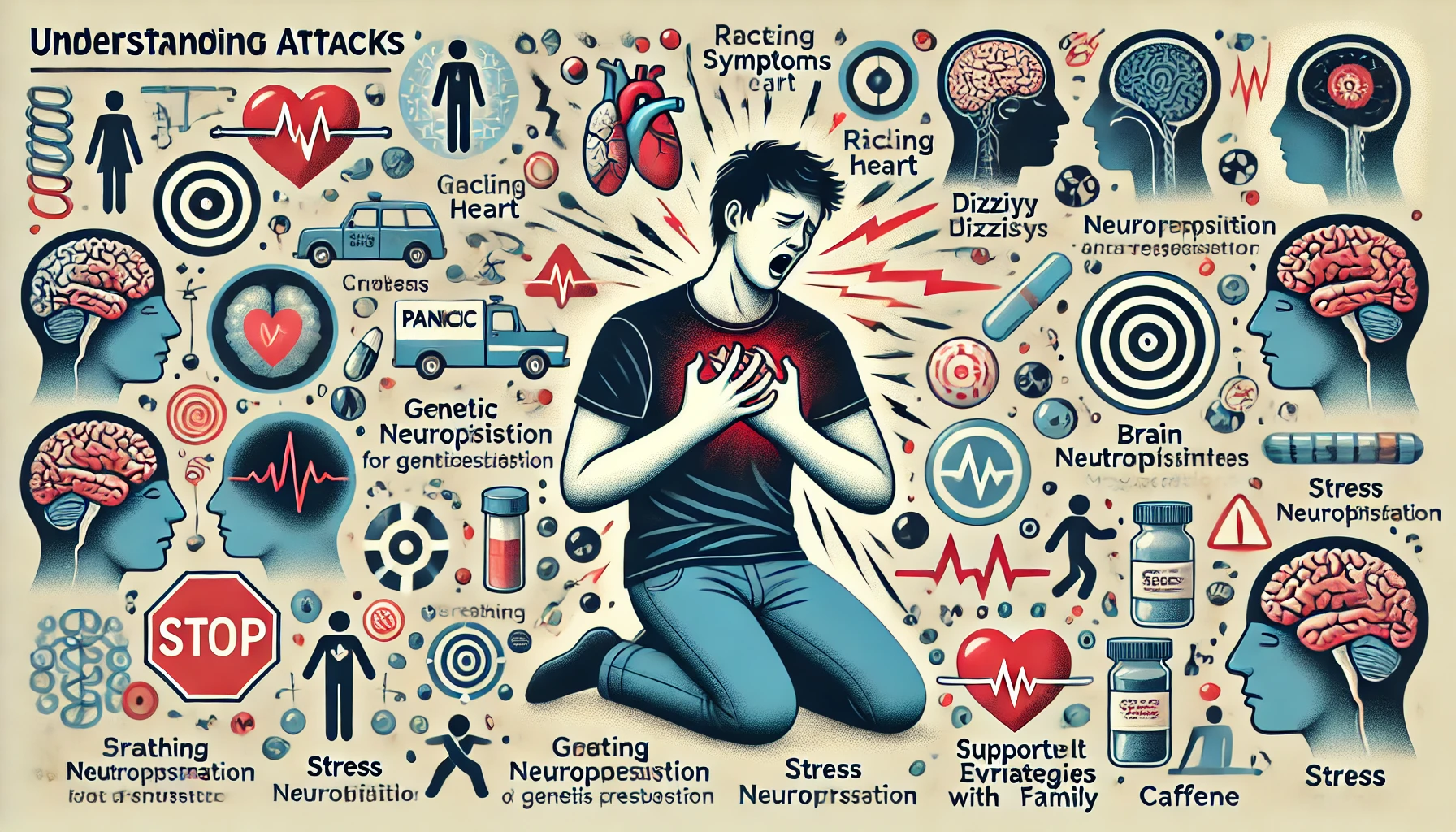
Panic attacks are intense episodes of sudden fear or discomfort that can appear unexpectedly and produce powerful physical, emotional, and cognitive reactions. During a panic attack, a person may experience a rapidly beating heart, shortness of breath, dizziness, trembling, sweating, chest discomfort, nausea, or a feeling of losing control. Some individuals describe the experience as if something catastrophic is about to happen, even when there is no immediate external danger. Because the physical symptoms can be extremely strong, people experiencing a panic attack for the first time may believe that they are having a serious medical emergency.
Although panic attacks are often associated with anxiety, they are not simply moments of ordinary nervousness. They involve a complex interaction between the brain, autonomic nervous system, bodily sensations, emotions, memories, and interpretations of perceived danger. Understanding these mechanisms can help explain why panic attacks can feel so overwhelming and why the fear may continue even after the immediate physical symptoms begin to disappear.
A panic attack is characterized by a sudden surge of intense fear or discomfort that reaches a peak relatively quickly. The episode can occur in response to a particular situation, but it can also occur without an obvious trigger. Some people experience panic attacks while driving, speaking in public, entering crowded places, or being in an enclosed environment. Others experience them while resting at home, sleeping, or performing an ordinary activity. The absence of an obvious external threat can make the experience especially confusing.
The human nervous system is designed to detect danger and prepare the body to respond. When the brain interprets a situation as threatening, the autonomic nervous system can activate the body’s emergency response. Heart rate increases, breathing changes, muscles become more prepared for movement, attention becomes focused on possible danger, and the body releases stress-related chemicals. These responses are adaptive when a person actually needs to escape or protect themselves. During a panic attack, however, this alarm system can become activated very strongly even when there is no proportionate external threat.
The fight-or-flight response is therefore an important part of understanding panic attacks. The body does not necessarily distinguish perfectly between an external physical danger and an internally generated perception of danger. A thought, memory, unusual bodily sensation, or ambiguous situation can sometimes activate the same physiological systems involved in responding to an external threat.
The brain plays a central role in this process. Several interconnected regions are involved in detecting threats, processing emotions, regulating bodily states, and evaluating information. The amygdala is particularly important in the processing of fear and potential danger. It receives information from different parts of the brain and can contribute to rapid defensive responses. Other regions, including the prefrontal cortex, hippocampus, hypothalamus, and brainstem, also participate in networks involved in emotional regulation, memory, autonomic responses, and threat processing.
During a panic episode, communication between these systems can contribute to an exaggerated sense of danger. The person may notice a physical sensation such as a rapid heartbeat and interpret it as evidence that something is seriously wrong. This interpretation can increase fear, which can further increase physiological arousal. A self-reinforcing cycle may therefore develop.
For example, a person may suddenly notice that their heart is beating faster than usual. The sensation itself may be harmless and could result from caffeine, physical activity, fatigue, stress, or normal fluctuations in heart rate. However, if the person immediately thinks, “Something is wrong with my heart,” anxiety may increase. Increased anxiety can further elevate heart rate and alter breathing. The person then notices these changes and interprets them as confirmation of the original fear. The cycle can escalate rapidly.
This process is closely related to the cognitive interpretation of bodily sensations. People do not simply experience physical sensations; they also assign meaning to them. Two individuals may experience the same bodily sensation and interpret it differently. One person may recognize a rapid heartbeat as a normal response to stress, while another may interpret it as evidence of imminent danger. The second interpretation can intensify emotional arousal.
This does not mean that panic attacks are imaginary or that people simply create them through negative thinking. The physical symptoms are real. Changes in heart rate, breathing, muscle tension, sweating, dizziness, gastrointestinal activity, and other bodily functions can occur during an episode. The important point is that psychological interpretation and physiological activation can influence each other.
Breathing is particularly relevant. Anxiety can change breathing patterns, sometimes leading to faster or deeper breathing. In some circumstances, excessive ventilation can lower carbon dioxide levels in the blood and contribute to sensations such as dizziness, tingling, light-headedness, and feelings of unreality. These sensations can themselves become frightening and may strengthen the belief that something dangerous is happening.
The resulting feedback loop can be understood as a relationship between sensation, interpretation, fear, and additional physiological activation. A bodily sensation attracts attention. The person interprets it as threatening. The interpretation increases fear. Fear activates the body’s alarm system. The resulting physiological changes create additional sensations, which are then interpreted as further evidence of danger.
Attention is therefore another important factor. During a panic attack, attention can become highly focused on the body. A person may continuously monitor their heartbeat, breathing, balance, chest sensations, vision, or other physical experiences. This heightened monitoring can make ordinary sensations feel more prominent. The more closely a person observes the body for signs of danger, the more sensations they may notice.
This phenomenon is sometimes described as interoceptive attention, meaning attention directed toward internal bodily sensations. Interoception itself is a normal and necessary function. The brain constantly receives information from the heart, lungs, digestive system, muscles, and other organs. Problems can arise when normal variations in these sensations are consistently interpreted as signs of catastrophe.
Fear of bodily sensations can also lead to avoidance. A person who has experienced a panic attack while exercising may begin to avoid physical activity because increased heart rate reminds them of the previous episode. Someone who experienced panic in a crowded store may begin avoiding shopping centers. Another person may avoid public transportation, elevators, airplanes, meetings, or being alone.
Avoidance can temporarily reduce anxiety. When the person leaves the feared situation, the anxiety decreases, which can create a strong sense of relief. However, this relief may unintentionally reinforce avoidance. The brain can learn that escaping the situation is what prevented the feared outcome, even though the feared catastrophe might never have occurred.
Over time, this pattern can restrict daily life. A person may gradually reduce the number of places they visit, activities they participate in, or situations they consider safe. In some cases, fear becomes associated with being in places where escape might seem difficult or help might not be immediately available. This pattern can be associated with agoraphobia, a condition involving significant fear or avoidance of certain situations because of concerns about experiencing panic-like symptoms or being unable to escape or obtain help.
Panic attacks and panic disorder are related but not identical concepts. A person can experience a panic attack without having panic disorder. Panic attacks may occur in the context of other anxiety disorders, trauma-related conditions, certain medical conditions, substance use, or stressful circumstances. Panic disorder involves recurrent unexpected panic attacks accompanied by persistent concern about additional attacks or significant changes in behavior related to the attacks.
The distinction is clinically important because a single panic attack does not automatically indicate a psychiatric disorder. Human beings can experience intense fear under many circumstances. A diagnosis depends on the broader pattern, duration, functional impact, and clinical assessment rather than on the presence of one frightening episode.
The causes of panic attacks are complex and cannot usually be reduced to one factor. Biological vulnerability may play a role. Research suggests that genetic factors can influence susceptibility to anxiety and panic-related conditions. However, genes do not determine an individual’s psychological future. Environmental experiences, learning, stress, personality characteristics, and other biological factors can interact with genetic vulnerability.
Early life experiences may also influence how individuals respond to perceived danger. Repeated exposure to unpredictable stress, excessive criticism, family conflict, bullying, or other adverse experiences can affect emotional learning and the development of coping strategies. Nevertheless, it is important not to assume that every person with panic attacks has experienced childhood trauma or a difficult upbringing. Panic can occur in people with many different backgrounds.
Chronic stress may contribute to vulnerability as well. When an individual experiences prolonged psychological pressure, the nervous system may remain more reactive to potential threats. Work-related stress, financial difficulties, relationship problems, major life changes, sleep deprivation, and persistent uncertainty can increase overall emotional strain. In such circumstances, the threshold for experiencing intense anxiety may become lower.
Sleep has a particularly important relationship with emotional regulation. Insufficient or disrupted sleep can affect attention, mood, stress reactivity, and the ability to regulate emotions. A person who is chronically sleep-deprived may become more sensitive to physical sensations and everyday stressors. Poor sleep does not necessarily cause panic attacks by itself, but it can contribute to a state in which anxiety becomes more difficult to manage.
Stimulants can also influence anxiety symptoms. Caffeine, nicotine, and certain medications or substances can produce physiological sensations such as increased heart rate, restlessness, or tremor. For a person who is already sensitive to these sensations, such changes may be misinterpreted as signs of danger. This does not mean that everyone with panic attacks must completely avoid caffeine or other substances, but individual sensitivity can be relevant.
Medical conditions can sometimes produce symptoms that resemble panic attacks. Heart rhythm abnormalities, respiratory problems, thyroid disorders, low blood sugar, medication effects, and other conditions can produce sensations such as palpitations, dizziness, sweating, or shortness of breath. For this reason, particularly when symptoms are new, severe, unusual, or medically concerning, appropriate medical evaluation is important.
The psychological consequences of recurrent panic can extend beyond the attacks themselves. A person may begin to lose confidence in their ability to manage ordinary situations. They may constantly anticipate another episode and organize their life around preventing it. This anticipatory anxiety can become exhausting because the individual is not only dealing with the current moment but also repeatedly imagining a future attack.
The fear of fear can become a central problem. A person may become frightened not only by external situations but also by the possibility of experiencing internal sensations associated with panic. A slight increase in heart rate may become threatening. Mild dizziness may trigger immediate concern. A normal sensation of breathlessness after climbing stairs may be interpreted catastrophically.
This creates an unusual relationship between safety and anxiety. The person may attempt to eliminate every possible source of uncertainty, monitor their body continuously, carry reassurance objects, remain close to medical facilities, or avoid being alone. These behaviors can provide short-term reassurance but may maintain long-term fear by preventing the person from learning that anxiety sensations can occur without leading to catastrophe.
Psychological treatments for recurrent panic often address this cycle directly. Cognitive behavioral therapy is one established psychological approach for panic-related problems. It can help individuals identify catastrophic interpretations, understand the relationship between thoughts and bodily sensations, and gradually develop different responses to anxiety.
An important component of cognitive behavioral approaches may involve exposure. Rather than continually avoiding feared sensations or situations, individuals can learn, under appropriate professional guidance, to approach them gradually and safely. Interoceptive exposure may involve experiencing certain benign bodily sensations associated with panic so that the person can learn that the sensations themselves are uncomfortable but not necessarily dangerous.
Exposure is not simply an instruction to force oneself into frightening situations. Effective treatment is usually structured, gradual, and individualized. The purpose is not to make anxiety disappear immediately but to change the person’s relationship with anxiety and reduce the belief that anxious sensations must always be escaped or controlled.
Breathing techniques can also be useful for some people. Slow, comfortable breathing may help reduce excessive physiological arousal, particularly when a person has developed a habit of rapid breathing during anxiety. However, breathing exercises should not become a rigid safety behavior in which the person believes they must perform a particular technique perfectly to prevent catastrophe. The broader goal is to develop confidence in the body’s ability to tolerate temporary changes in arousal.
Mindfulness-based approaches may provide another useful perspective. Mindfulness involves observing thoughts, sensations, and emotions without automatically treating them as facts or commands. During anxiety, a person may experience the thought that something terrible is about to happen. Mindful awareness can create psychological distance between the sensation and the interpretation. Instead of immediately responding to the thought as a fact, the individual can recognize it as an anxiety-related mental event.
Self-compassion may also be relevant. People who experience panic attacks sometimes become ashamed of their reactions. They may believe that they are weak, incapable, or fundamentally different from others. Such self-judgment can increase anxiety and discourage help-seeking. Recognizing panic as a genuine mind-body response can reduce unnecessary shame.
Social support can have an important role as well. Trusted relationships can provide emotional stability, although reassurance alone should not become the person’s only strategy for managing anxiety. If an individual constantly needs another person to confirm that everything is safe, dependence on reassurance may maintain uncertainty rather than resolve it.
Medication is another possible component of treatment for some people. Clinicians may use different medications depending on the individual’s symptoms, diagnosis, medical history, other medications, and treatment goals. Some medications can reduce acute anxiety, while others are used as part of longer-term treatment. Medication decisions should be made with an appropriately qualified healthcare professional because different medications have different benefits, risks, and considerations.
The long-term outlook for people experiencing panic attacks varies. Some individuals experience isolated episodes and do not develop recurrent problems. Others experience repeated attacks and significant avoidance. Early recognition and appropriate treatment can be valuable when panic begins to interfere with work, education, relationships, travel, sleep, or ordinary activities.
It is also important to recognize that recovery does not necessarily mean never experiencing anxiety again. Anxiety is a normal human emotion, and occasional physiological arousal is part of ordinary life. A more meaningful goal can be learning that anxiety sensations do not automatically require escape, avoidance, or catastrophic interpretation.
The distinction between danger and discomfort is central to understanding panic. During an attack, discomfort can become so intense that it feels indistinguishable from danger. Yet the subjective intensity of an experience does not necessarily indicate the objective severity of a threat. The brain can generate a powerful alarm response even when the environment is relatively safe.
This does not mean that every episode of chest pain, breathing difficulty, faintness, or other physical symptoms should automatically be assumed to be panic. New or severe symptoms should be medically assessed when appropriate, particularly when there is uncertainty about their cause. A psychological explanation should not be used to dismiss potentially important physical symptoms.
Panic attacks also demonstrate how closely connected the mind and body are. Emotional experiences are not confined to thoughts, and physical sensations are not independent of psychological interpretation. Fear can accelerate the heart, alter breathing, increase muscle tension, change attention, and influence perception. At the same time, physical sensations can influence thoughts and emotions. Panic emerges partly from this continuous interaction.
Understanding this interaction can change how panic is perceived. Instead of viewing an attack as evidence that a person is losing control, it can be understood as an intense activation of protective systems. The system is designed to protect the individual from danger, but in panic it may become activated in circumstances where the response is disproportionate to the actual threat.
For this reason, education about panic can itself be useful. Learning about the autonomic nervous system, bodily sensations, catastrophic interpretation, avoidance, and anxiety cycles can help individuals develop a more accurate understanding of their experiences. Knowledge does not immediately eliminate fear, but it can reduce the mystery surrounding the symptoms.
Ultimately, panic attacks are complex experiences involving biological processes, psychological interpretations, learned responses, and environmental influences. They cannot be explained adequately by saying that a person is simply “too nervous” or “thinking negatively.” The physical sensations are real, the emotional experience can be profound, and the behavioral consequences can become significant when attacks recur.
At the same time, panic does not have to determine the boundaries of a person’s life. With appropriate assessment and evidence-based support, many people can learn to understand their symptoms, reduce avoidance, change catastrophic interpretations, and regain confidence in their ability to tolerate anxiety. The central psychological shift is often not the complete elimination of fear but the development of a different relationship with fear: recognizing its signals without automatically treating every signal as proof of danger.