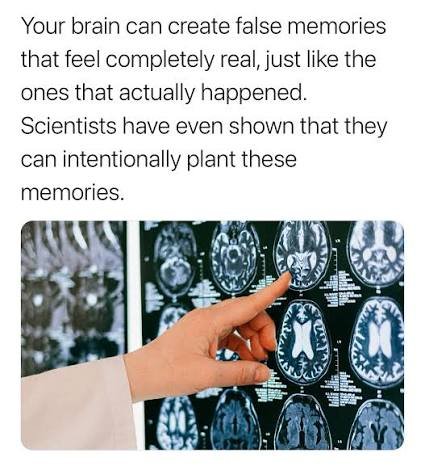
Memory is often regarded as one of the most reliable functions of the human mind. People commonly assume that important experiences are stored within the brain much like files within a computer, waiting to be retrieved whenever needed. This belief feels intuitively correct because memories often possess remarkable vividness and emotional certainty. Yet one of the most important discoveries in modern cognitive neuroscience is that memory is not a recording system. It is a reconstructive process. Every act of remembering involves rebuilding the past rather than replaying it exactly as it occurred. This realization has transformed psychology, psychiatry, and neuroscience by raising a profound question: can the brain create memories of events that never actually happened?
The answer, supported by decades of scientific research, is yes. False memories are genuine subjective experiences. Individuals who possess them are usually not lying, pretending, or intentionally distorting reality. Instead, the brain reconstructs past events in ways that may unintentionally incorporate inaccurate details, altered interpretations, or entirely imagined experiences. The resulting memory often feels just as convincing as an accurate one.
Understanding this phenomenon requires abandoning the traditional view of memory as permanent storage.
Whenever an experience occurs, the brain does not preserve every detail equally.
Instead, it selectively encodes information according to attention, emotional significance, existing knowledge, expectations, and biological state.
Only portions of the original experience become stabilized.
Many details are never stored at all.
When people later remember an event, the brain fills missing information using previous knowledge, contextual expectations, emotional associations, and logical inference.
Most of the time this reconstruction produces memories that are sufficiently accurate for everyday life.
Occasionally, however, reconstruction introduces substantial error.
The hippocampus plays a central role in this process.
Rather than functioning as a storage location, the hippocampus helps organize experiences into coherent episodic memories.
It binds together sensory information, spatial context, emotional responses, temporal sequence, and personal significance.
Later recollection depends upon reactivating these distributed neural representations.
Importantly, each retrieval changes the memory itself.
This process, known as reconsolidation, represents one of the most significant findings in modern memory research.
Contrary to earlier assumptions, recalling a memory temporarily makes it biologically unstable.
Before returning to long-term storage, it undergoes reconsolidation.
During this period, new information may become incorporated.
Interpretations may change.
Emotional meaning may shift.
Even subtle suggestions can influence future recollections.
Consequently, remembering is simultaneously an act of preservation and modification.
This explains why memories gradually evolve across years despite the individual’s confidence that they remain unchanged.
Emotion profoundly influences these mechanisms.
Highly emotional experiences are often remembered more vividly than ordinary events.
However, vividness does not necessarily indicate accuracy.
Stress hormones strengthen memory for central emotional themes while frequently reducing peripheral detail.
During traumatic experiences, attention narrows toward immediate survival.
Later recollection may therefore contain exceptionally vivid fragments alongside major gaps in contextual information.
This pattern contributes to the fragmented nature of many traumatic memories.
Contemporary psychiatry emphasizes that traumatic memory should not be understood simply as stronger memory.
Rather, it often differs qualitatively from ordinary autobiographical recollection.
False memories emerge through multiple pathways.
One involves suggestion.
Repeated exposure to misleading information gradually alters reconstruction.
Another involves imagination.
Repeatedly imagining an event increases familiarity.
Over time, familiarity itself may become interpreted as evidence that the event actually occurred.
The distinction between imagining and remembering becomes increasingly difficult to identify.
This process occurs because both imagination and episodic memory activate overlapping neural networks.
The brain does not maintain completely separate systems for reality and simulation.
Instead, similar mechanisms contribute to both.
Developmental psychology demonstrates that children are particularly susceptible to suggestion because memory systems remain immature.
However, adults are by no means immune.
Confidence should never be equated with accuracy.
Individuals frequently express complete certainty regarding memories later demonstrated to be objectively incorrect.
This discrepancy illustrates one of memory’s central paradoxes.
Subjective certainty reflects current neural reconstruction rather than historical truth.
Eyewitness testimony provides striking examples.
Legal systems have traditionally regarded confident eyewitnesses as highly reliable.
Psychological research has repeatedly challenged this assumption.
Stress, expectation, attention, lighting, suggestion, social influence, and repeated questioning all influence recollection.
Mistaken identification has contributed to numerous wrongful convictions subsequently overturned by DNA evidence.
These findings have profoundly influenced forensic psychology.
Memory contamination does not require malicious intent.
Ordinary conversation may gradually reshape recollection.
Family members discussing childhood experiences often influence one another’s memories without recognizing it.
Details borrowed from photographs, stories, or other people’s accounts become incorporated into personal autobiographical narratives.
Eventually, individuals experience these reconstructed memories as direct recollections.
Psychiatric disorders illustrate additional complexity.
Major depression biases autobiographical memory toward negative interpretation.
Anxiety enhances memory for perceived threat.
Post-traumatic stress disorder increases involuntary retrieval of emotionally significant fragments.
Psychotic disorders may occasionally involve false autobiographical beliefs arising from broader disturbances in reality monitoring.
Each condition influences reconstruction differently.
Reality monitoring represents another crucial cognitive function.
The brain continuously determines whether information originated from direct perception, imagination, dreams, conversations, or internal thought.
Healthy cognition performs this distinction remarkably efficiently.
Occasionally, however, source monitoring errors occur.
An imagined conversation becomes remembered as real.
A dream acquires qualities of autobiographical experience.
A fictional story becomes confused with personal history.
Most individuals experience minor source monitoring errors throughout life.
In psychopathology, these mechanisms may become substantially more vulnerable.
Neuroscientific investigations increasingly emphasize predictive processing.
The brain reconstructs memory partly by predicting what most likely occurred.
Predictions arise from previous experience, cultural knowledge, emotional expectations, and statistical regularities.
Most predictions prove highly useful.
However, they also introduce systematic biases.
Events consistent with expectations become easier to remember.
Unexpected details become vulnerable to omission or alteration.
Memory therefore reflects interaction between historical events and predictive reconstruction.
This principle explains why stereotypes may unconsciously influence recollection.
Expected information receives stronger cognitive support than unexpected information.
Sleep contributes significantly to memory accuracy.
During sleep, recently acquired information undergoes consolidation.
Neural representations become reorganized and integrated with existing knowledge.
Insufficient sleep impairs these processes.
Memory becomes less detailed, less stable, and increasingly susceptible to distortion.
Attention during encoding proves equally important.
Individuals cannot accurately remember information they never attended to initially.
The brain prioritizes limited resources.
Unattended details often require later reconstruction because they were never fully encoded.
One fascinating implication concerns personal identity.
Human beings define themselves largely through autobiographical memory.
Life stories organize experiences into coherent narratives explaining who they are and how they became that person.
If memory continuously changes, identity inevitably changes as well.
This does not imply that identity is false.
Rather, it suggests that personal identity remains an evolving reconstruction shaped by continual reinterpretation.
Psychotherapy often illustrates this principle.
Successful therapy rarely changes historical events themselves.
Instead, it transforms how experiences are understood.
Patients frequently reinterpret childhood events, relationships, failures, and achievements through new psychological frameworks.
The memories remain recognizable.
Their emotional significance changes.
Reconsolidation allows revised interpretations to become integrated into autobiographical identity.
Modern neuroscience increasingly investigates therapeutic reconsolidation because emotionally significant memories appear modifiable under specific conditions.
This research carries important implications for trauma treatment, phobias, addiction, and anxiety disorders.
Rather than erasing memories, therapy may weaken maladaptive emotional associations while preserving factual knowledge.
Ultimately, false memories reveal one of the most remarkable characteristics of the human brain. Memory was never designed to function as a perfect historical archive. Evolution favored flexibility over absolute precision. A reconstructive memory system allows generalization, learning, prediction, creativity, and adaptation to changing environments. The occasional cost of this flexibility is inaccuracy.
The brain therefore remembers the past not to preserve history exactly as it occurred, but to guide future behavior. Every recollection represents a dynamic interaction among perception, emotion, prediction, attention, and prior knowledge. Most of the time this process produces remarkably useful representations of experience. Occasionally, however, the same mechanisms capable of extraordinary adaptation generate memories that feel entirely real despite describing events that never actually happened. This paradox demonstrates that the human brain is not merely a recorder of experience but an active architect of personal reality itself.