Thinking is an essential human ability. People think in order to make decisions, solve problems, plan for the future, remember the past, and understand themselves and others. Reflection and careful consideration are often signs of responsibility and intelligence. However, thinking can become harmful when it becomes repetitive, excessive, and difficult to control. This pattern is commonly called overthinking. Many people describe overthinking as continuously analyzing situations, replaying conversations, imagining negative outcomes, or searching endlessly for certainty. Because occasional overthinking is common, it is often dismissed as a personality trait. Yet psychologists increasingly recognize that persistent overthinking can become a significant psychological problem that affects emotions, behavior, relationships, work, and overall quality of life.
Overthinking generally appears in two main forms. The first is rumination, which involves repeatedly focusing on past events, mistakes, losses, or disappointments. A person may think, “Why did I say that?” or “I should have acted differently,” for hours or even days. The second is worry, which involves repeatedly thinking about future threats and possible negative outcomes. A person may imagine illness, failure, rejection, financial problems, or other dangers that have not occurred. Both rumination and worry keep attention focused on problems rather than on effective action.
A key psychological feature of overthinking is the belief that more thinking will eventually produce certainty or emotional relief. People often continue analyzing because they hope to find the perfect answer, prevent mistakes, or gain complete control over the situation. Unfortunately, many life situations are uncertain and cannot be solved through endless mental analysis. Instead of creating clarity, excessive thinking often creates confusion, doubt, and emotional exhaustion.
One of the strongest links between overthinking and mental health is anxiety. Individuals who overthink tend to scan constantly for potential threats. They imagine worst-case scenarios and mentally rehearse possible problems. This process increases physiological arousal, leading to symptoms such as tension, restlessness, rapid heartbeat, and difficulty relaxing. The more a person thinks about danger, the more dangerous the situation feels, even when objective evidence is limited.
Overthinking is also closely related to depression, particularly through rumination. Depressed individuals often replay painful experiences, criticize themselves, and focus on perceived failures. Rumination maintains negative mood because attention remains fixed on distressing thoughts. Instead of moving toward problem-solving or emotional recovery, the person becomes trapped in a cycle of self-focused negative thinking.
Self-esteem is frequently affected. Overthinkers tend to evaluate themselves harshly and may interpret small mistakes as evidence of personal inadequacy. They may spend long periods analyzing their behavior after social interactions, searching for signs that they appeared foolish, rude, or inadequate. Repeated self-evaluation can gradually weaken confidence and increase self-doubt.
Decision-making becomes especially difficult when overthinking is severe. Psychologists sometimes refer to this as analysis paralysis. The individual considers every possible outcome, compares endless alternatives, and fears making the wrong choice. Even relatively simple decisions, such as sending a message, choosing a course, making a purchase, or accepting an invitation, may become stressful and time-consuming. Delayed decisions often create additional stress and reinforce the belief that decisions are dangerous.
Overthinking affects social relationships in important ways. People who constantly analyze conversations may misinterpret neutral comments as criticism or rejection. They may seek repeated reassurance from friends or partners, asking questions such as “Are you upset with me?” or “Did I say something wrong?” Excessive reassurance seeking can strain relationships, while fear of negative evaluation may lead to social withdrawal.
Sleep is particularly vulnerable to overthinking. Many individuals report that their thoughts become most active at night when external distractions decrease. They replay past events, plan future tasks, or worry about possible problems, making it difficult to fall asleep. Poor sleep then reduces emotional resilience and increases the likelihood of further overthinking the next day, creating a self-reinforcing cycle.
Cognitive functioning can also suffer. Although overthinkers spend a great deal of time thinking, the quality of thinking often declines when mental activity becomes repetitive and emotionally charged. Concentration becomes difficult, memory may feel less efficient, and creativity can decrease because attention is narrowly focused on threat or self-criticism.
Academic and occupational functioning may be affected as well. Students may repeatedly revise assignments, fear submitting work, or spend excessive time preparing for examinations. Employees may overanalyze emails, presentations, or decisions, leading to reduced productivity and increased stress. Perfectionism often accompanies overthinking, with individuals believing that they must anticipate every possible problem before taking action.
The physical effects should not be underestimated. Chronic mental tension can contribute to headaches, muscle pain, stomach discomfort, fatigue, and other stress-related symptoms. Overthinking keeps the body in a state of psychological alertness, which can become exhausting when maintained for long periods.
Modern life provides many conditions that encourage overthinking. Social media exposes people to constant comparison, feedback, and information. Messages can be reread repeatedly, online interactions can be analyzed in detail, and exposure to alarming news can increase worry. In addition, modern culture often emphasizes making the “right” choice in education, career, relationships, and lifestyle, which may increase fear of mistakes.
Importantly, overthinking is not always a separate mental disorder. It is better understood as a psychological process that can occur in many conditions, including anxiety disorders, depression, obsessive-compulsive disorder, and stress-related problems. However, even individuals without a diagnosable disorder may experience overthinking severe enough to impair daily functioning.
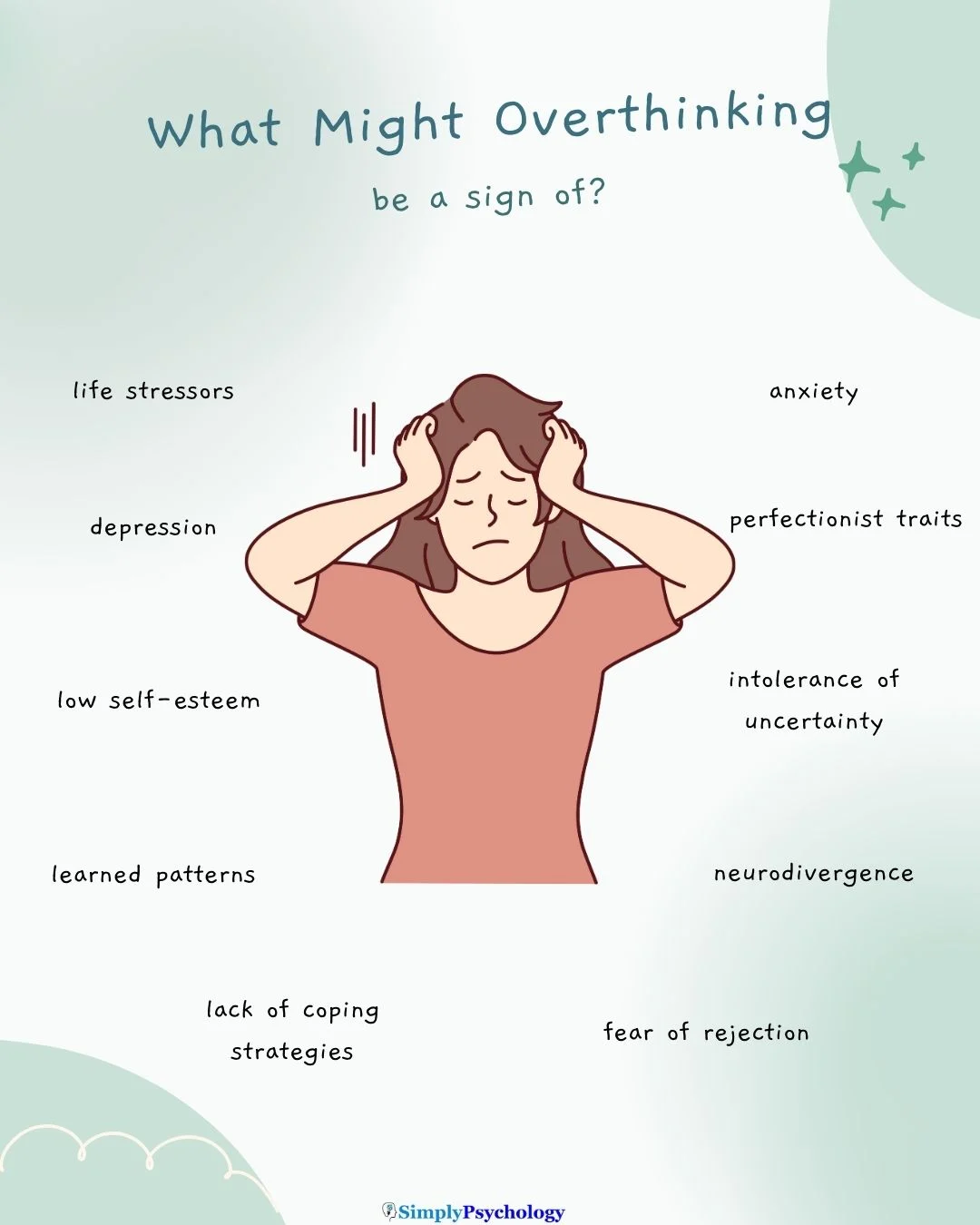
Several factors increase vulnerability to overthinking. Perfectionism, intolerance of uncertainty, low self-esteem, high sensitivity to criticism, past negative experiences, chronic stress, and certain personality traits can all contribute. People who were frequently criticized or expected to avoid mistakes may learn to monitor themselves excessively.
A useful question is how to distinguish thoughtful reflection from problematic overthinking. Reflection is usually purposeful, time-limited, and followed by action. Overthinking is repetitive, emotionally distressing, difficult to stop, and rarely leads to effective action. If thinking repeatedly produces more anxiety without producing new solutions, it is likely becoming unhelpful.
Psychological treatment can be very effective. Cognitive-behavioral therapy (CBT) helps individuals identify unhelpful thought patterns, challenge catastrophic thinking, and develop more balanced interpretations. CBT also encourages behavioral action rather than endless mental analysis. For example, instead of repeatedly imagining a conversation, the person may be encouraged to communicate directly.
Mindfulness is another valuable approach. Mindfulness teaches individuals to observe thoughts without automatically engaging with them. The goal is not to eliminate thoughts but to recognize that thoughts are mental events, not facts that must be analyzed endlessly. Many people find that mindfulness reduces the emotional intensity of overthinking.
Behavioral strategies are also important. Setting specific “worry times,” limiting repeated checking, engaging in physical activity, maintaining social contact, pursuing hobbies, and reducing late-night screen use can all decrease overthinking. Writing thoughts down may help externalize worries and reduce mental repetition.
Self-compassion plays a crucial role. Overthinkers often treat themselves much more harshly than they treat others. Learning to respond to mistakes with understanding rather than punishment reduces the emotional fuel that keeps rumination active. Accepting that imperfection and uncertainty are normal parts of life is a powerful antidote to chronic overanalysis.
Seeking professional help is advisable when overthinking causes significant distress, sleep problems, relationship difficulties, avoidance, reduced productivity, or symptoms of anxiety or depression. Early intervention can prevent these patterns from becoming more entrenched.
In conclusion, overthinking can indeed become a psychological problem when thinking becomes excessive, repetitive, emotionally distressing, and functionally impairing. Persistent rumination and worry can contribute to anxiety, depression, low self-esteem, sleep disturbance, decision-making difficulties, and relationship problems. Thoughtful reflection is a healthy human ability, but endless mental analysis is not the same as effective thinking. By developing awareness of thought patterns, tolerating uncertainty, practicing self-compassion, and using evidence-based coping strategies, individuals can reduce overthinking and regain emotional balance, clearer thinking, and greater enjoyment of daily life.