

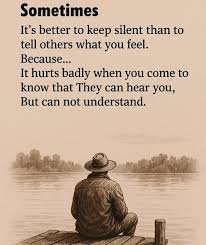
Internal Emotional Muting Syndrome (IEMS) is a subtle psychological state in which a person’s inner emotional world gradually loses its volume. Feelings do not disappear, but they become distant, faint, and strangely unreal. People with IEMS often say, “I know I should feel something, but I don’t feel it the way others seem to.” It is not depression, not apathy, and not numbness in the clinical sense. It is a slow emotional quieting that develops as a survival adaptation. This condition usually forms in individuals who learned early that strong emotions were unsafe, unwelcome, or ignored. As children, they may have been told to “calm down,” “stop overreacting,” or “be strong.” Over time, the mind discovers that emotional expression leads to discomfort, rejection, or punishment. To protect itself, it gradually lowers the internal volume of feelings. Unlike classic emotional suppression, which is active and conscious, IEMS is automatic. The person is not trying to block emotions; the system has already learned to dim them before they fully arise. Joy feels distant. Sadness feels flat. Anger feels muted. Even love may feel like a quiet echo rather than a powerful presence. People with IEMS often function extremely well. They appear calm, logical, and stable. Others may describe them as “strong” or “unbothered.” Inside, however, there is a sense of emotional thinness. They can describe emotions in words but struggle to feel their full depth. Life may feel strangely neutral, as if everything is happening behind glass. This pattern frequently emerges in environments where emotions were unpredictable or overwhelming. When a child grows up around volatile caregivers, intense conflict, or emotional chaos, the nervous system adapts by turning the emotional dial down. It is safer to feel less than to feel too much. Cognitively, IEMS is linked to over-intellectualization. The person explains feelings instead of experiencing them. They analyze instead of sensing. This creates the illusion of emotional control, but it also disconnects them from their inner life. Decisions become logical yet hollow, lacking emotional guidance. In relationships, IEMS can create distance. Partners may feel that the person is present but not emotionally reachable. Affection is shown through actions rather than emotional warmth. Vulnerability feels unnatural, even dangerous. The individual may care deeply, yet struggle to express or feel that care fully. Physiologically, IEMS is associated with shallow emotional arousal. The nervous system avoids high peaks and deep lows. While this prevents emotional overwhelm, it also limits joy, passion, and excitement. Life feels safe, but not vivid. Recovery begins with gentle emotional reawakening. Instead of forcing feelings, individuals learn to notice small emotional signals—subtle warmth, slight sadness, mild excitement. Through mindful awareness, therapy, and safe relationships, the emotional system can slowly turn its volume back up. IEMS is not a flaw—it is a learned survival response. But when safety is restored, the mind no longer needs silence to survive. Emotions can return, not as threats, but as guides back to a fuller human experience.
Can I Ever Stop Preparing for Disappointment?
Anticipatory Loss Conditioning (ALC) is a hidden psychological pattern in which individuals unconsciously expect emotional loss before it happens. It is not pessimism, not anxiety, and not trauma in the clinical sense. Instead, it is a long-term emotional conditioning process where the mind learns that good things are temporary and prepares itself for their disappearance before fully enjoying them. People with ALC often describe a strange emotional duality. When something good occurs—a new relationship, a promotion, a peaceful period—they feel grateful, yet a subtle tension arises at the same time. Part of them is already bracing for the end. This internal readiness is not dramatic or fearful. It feels practical, realistic, even mature. Yet it quietly erodes the ability to feel safe in happiness. This pattern usually develops in environments where emotional loss was frequent, sudden, or unpredictable. When a child experiences repeated disappointments, separations, broken promises, or emotional instability, the nervous system adapts by staying one step ahead of pain. Instead of being surprised by loss, the mind decides to expect it. Over time, this expectation becomes automatic. ALC does not remove joy, but it dilutes it. Pleasure is experienced with an invisible asterisk: this won’t last. The individual may mentally rehearse future endings while still in the middle of positive moments. This constant emotional rehearsal creates a background grief that never fully resolves. Cognitively, ALC expresses itself through cautious optimism. The person avoids imagining long-term success or stability, not because they doubt their abilities, but because imagining permanence feels emotionally risky. They downplay positive events, telling themselves they are “just temporary.” This mindset feels protective, but it restricts emotional expansion. Emotionally, ALC leads to a form of premature mourning. People begin grieving losses that have not yet occurred. They may feel sadness during happy moments without knowing why. This sadness is not about the present—it is about a future loss that feels inevitable. In relationships, ALC creates emotional guardedness. The individual may avoid deep attachment, subconsciously keeping one foot out the door. Even when love is genuine, they prepare for separation. This can limit vulnerability and prevent full intimacy. Physiologically, ALC keeps the nervous system in a mild state of vigilance. The body remains alert, as if waiting for something to go wrong. Over time, this can lead to fatigue, tension, and difficulty relaxing. Healing involves learning to tolerate emotional risk. Instead of preparing for loss, individuals practice staying with the present moment. They learn that joy does not need protection to be real. Gradually, the nervous system begins to trust that not all good things end in pain. ALC shows that the fear of loss can become more limiting than loss itself. By releasing the need to prepare for pain, individuals open themselves to fuller emotional lives.
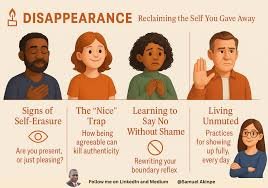
Is My Kindness a Form of Self-Erasure?
Altruistic Self-Neglect Pattern (ASNP) is a hidden psychological state in which individuals consistently prioritize the needs, emotions, and comfort of others while quietly neglecting their own inner world. It is not simple generosity or empathy. Instead, it is a learned survival strategy that equates personal worth with usefulness to others. People with ASNP are often described as kind, reliable, and selfless. They listen, help, and support without complaint. Yet internally, they may feel invisible, exhausted, or emotionally unfulfilled. Their identity becomes tied to how much they give, not to who they are. This pattern usually forms in early environments where approval was conditional. When love was earned through caretaking, compliance, or emotional maturity, the child learned that their needs were secondary. Over time, this belief becomes internal law: to be valued, I must serve. ASNP does not eliminate desire, but it pushes it aside. The individual may feel guilt when resting, setting boundaries, or choosing themselves. Self-care feels selfish. Saying no feels dangerous. Emotionally, ASNP creates chronic depletion. Giving becomes a duty rather than a choice. Resentment may grow silently, even as the person continues to help others. In relationships, ASNP leads to imbalance. Others may depend on the individual without realizing the emotional cost. The giver feels unseen, yet fears losing connection if they stop giving. Healing begins with redefining worth. When individuals learn that they deserve care without earning it, they slowly reclaim their own emotional space. ASNP shows that kindness should not require self-disappearance.

Does Silence Mean I Am Safe?
Emotional Suppression Reflex (ESR) is a subtle psychological pattern in which individuals automatically silence their emotional responses to avoid conflict, rejection, or vulnerability. It is not introversion, not emotional coldness, and not social anxiety. Instead, it is a learned reflex that equates emotional expression with danger. People with ESR often appear calm, controlled, and composed. They rarely show distress, anger, or sadness in public. Yet internally, emotions still exist—they are simply pushed downward before reaching conscious expression. This creates a split between inner experience and outer behavior. This reflex typically develops in environments where emotional expression is met with punishment, ridicule, or emotional withdrawal. Over time, the nervous system learns that silence equals safety. The body responds by inhibiting emotional expression before it can be seen. Unlike emotional numbness, individuals with ESR feel deeply, but in private. They may cry alone, process silently, and avoid sharing struggles. This pattern can appear as strength, but it is rooted in fear of being misunderstood or rejected. Emotionally, ESR leads to internal pressure. Suppressed feelings do not disappear; they accumulate. Over time, this may result in sudden emotional release, fatigue, or unexplained sadness. In relationships, ESR creates distance. Others may feel shut out, while the individual feels misunderstood. Intimacy is limited by the fear of being emotionally visible. Healing involves learning that expression does not equal danger. Through small, safe disclosures, the nervous system gradually relearns that emotions can be shared without loss of safety. ESR reminds us that silence may protect us—but it can also isolate us.

Can I Trust My Feelings at All?
Emotional Validation Uncertainty (EVU) is a subtle psychological condition in which individuals chronically doubt the legitimacy of their own emotions. It is not emotional numbness, not anxiety, and not a personality disorder. Instead, it is an internal habit of second-guessing one’s feelings, learned through repeated experiences of emotional dismissal or contradiction. People with EVU often pause before expressing how they feel—not because they fear conflict, but because they are unsure whether their emotion is “real enough” to be shared. They ask themselves whether they are overreacting, being dramatic, or misinterpreting situations. This self-questioning becomes automatic. EVU usually forms in early environments where emotions were minimized, rationalized, or invalidated. When a child hears phrases such as “you’re too sensitive,” “it’s not that bad,” or “stop exaggerating,” the nervous system learns that feelings cannot be trusted. Over time, this message becomes internalized. As adults, individuals with EVU may struggle to make decisions. Because emotions guide values and boundaries, doubting them leads to indecision and people-pleasing. The person may rely heavily on logic or others’ opinions, even when their inner experience signals discomfort. Emotionally, EVU creates a split. The person feels something, then immediately analyzes or suppresses it. This prevents emotional resolution and can lead to chronic tension, resentment, or confusion. In relationships, EVU leads to silent compromise. The individual minimizes their needs, believing they are unreasonable. Over time, this can erode self-worth and intimacy. Healing begins with emotional permission. When individuals practice naming and accepting feelings without judgment, they rebuild trust in their inner world. Over time, emotions become guides again rather than threats. EVU reminds us that feelings are not obstacles to truth—they are part of it.
Am I Living or Just Enduring?
Existential Endurance Pattern (EEP) is a quiet psychological state in which individuals continue to function, fulfill roles, and meet responsibilities while feeling as though they are merely surviving rather than truly living. It is not depression in the clinical sense, nor is it a crisis of meaning that announces itself loudly. Instead, it is a slow emotional flattening that transforms life into a series of tasks rather than experiences. People with EEP often describe their days as repetitive and heavy, even when nothing is objectively wrong. They wake, work, interact, and rest, yet feel as though something essential is missing. Joy exists, but it feels muted. Pain exists, but it feels distant. Life moves forward, but the person feels carried rather than engaged. This pattern often forms after long periods of obligation without emotional reward. When a person must be strong, responsible, or resilient for extended periods, the nervous system adapts by reducing emotional range. Feeling becomes secondary to functioning. Over time, this protective strategy becomes the default mode of being. EEP is not hopelessness. Individuals still care, plan, and dream in abstract ways. Yet their dreams feel theoretical rather than urgent. The present moment is tolerated, not inhabited. Rest feels temporary, as if it must end soon. Emotionally, EEP creates a sense of quiet resignation. People may say they are grateful, but they rarely feel fulfilled. They may achieve goals yet feel unchanged. This disconnect often leads to subtle guilt for feeling dissatisfied when life appears acceptable. Cognitively, the mind becomes focused on endurance. Thoughts revolve around getting through the day, week, or year. Long-term meaning is postponed. The individual lives in a state of emotional postponement, waiting for a future moment when life will begin. In relationships, EEP may appear as emotional distance. The person is present but tired, caring but reserved. They may avoid deep conversations because they lack the energy to engage with their own inner world. Healing begins with permission to feel again. When individuals allow themselves to explore desire, rest, and emotional expression, the nervous system slowly shifts from survival to living. Over time, endurance transforms into engagement. EEP reveals that survival alone is not enough. Humans need not only to exist, but to feel alive within their existence.

Have I Forgotten How to Want Anything?
Desire Numbing Pattern (DNP) is a subtle psychological state in which a person gradually loses access to genuine longing. It is not depression, apathy, or burnout in the clinical sense. Instead, it is a quiet flattening of desire that emerges when the nervous system learns that wanting leads to disappointment, pressure, or emotional risk. People with DNP often describe themselves as “fine.” They function, work, socialize, and meet obligations. Yet when asked what they truly want, they hesitate. Goals feel distant, dreams feel abstract, and motivation feels borrowed from expectations rather than from within. Life moves forward, but without a strong internal pull. This pattern often forms in environments where desire is repeatedly blocked or punished. When efforts are met with criticism, comparison, or instability, the mind learns to protect itself by reducing emotional investment. Over time, wanting itself becomes associated with discomfort. The safest state becomes emotional neutrality. Unlike depression, individuals with DNP still experience pleasure and interest. They enjoy moments, but they do not feel driven by them. The future feels vague, not because of hopelessness, but because the internal signal that guides aspiration has become quiet. Cognitively, DNP creates a preference for practicality. People choose what is reasonable rather than what is meaningful. They may follow socially acceptable paths, believing they are content, yet feel an underlying sense of incompleteness. Emotionally, DNP produces a quiet grief. It is not sadness about something lost, but about something never fully allowed to grow. This grief is often unnamed, appearing as restlessness, boredom, or emotional flatness. In relationships, DNP can lead to emotional passivity. The person cares, but rarely initiates change or expresses deep longing. Intimacy may feel stable but stagnant. Healing begins with small experiments in desire. By allowing themselves to want without immediately judging or suppressing it, individuals slowly reconnect with their inner drive. Over time, life regains direction—not from obligation, but from genuine longing. DNP reminds us that wanting is not weakness. It is the force that makes life feel alive.
Do My Thoughts Belong to Me or to Habit?
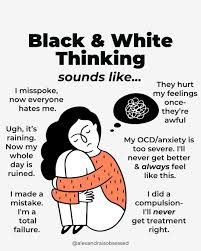
Cognitive Inertia Pattern (CIP) is a subtle psychological condition in which the mind continues to think, judge, and react according to outdated internal rules long after the original reasons for those rules have disappeared. It is not obsessive thinking, not anxiety, and not a personality disorder. It is a quiet persistence of mental habits that once protected the individual but now limit perception, choice, and emotional freedom. People with CIP often feel as though they are living on “autopilot.” Their reactions feel predictable, their interpretations repetitive, and their emotional responses strangely fixed. Even when they consciously wish to change, their mind returns to the same patterns of thought. This creates the feeling of being trapped inside a familiar mental loop. CIP develops through repetition. Early emotional experiences, social conditioning, and personal failures create internal conclusions about the world: who can be trusted, what is safe, what is possible. Over time, these conclusions harden into automatic mental pathways. The brain, designed for efficiency, prefers familiar routes—even when they no longer serve the individual. Unlike rumination, CIP is not always distressing. Many people simply feel that life lacks novelty or depth. They may say, “I already know how this will end,” even in new situations. This sense of predictability is comforting, yet it also prevents emotional growth and curiosity. Emotionally, CIP narrows the range of experience. Joy, disappointment, and hope are filtered through old expectations. New opportunities are unconsciously compared to past outcomes, often dismissed before they can be fully explored. This creates a subtle emotional stagnation. In relationships, CIP leads to unconscious projection. The individual responds to others not as they are, but as reminders of past figures. Conflicts repeat in different forms because the internal story never changes. Healing requires creating small disruptions to habit. By noticing repetitive interpretations and gently questioning them, individuals begin to reopen their mental world. Over time, thought becomes flexible again, and life feels less predetermined. CIP shows that freedom is not only external. It is the ability to update the stories the mind tells about itself and the world.

Is My Personality a Reflection or a Defense?
Adaptive Self-Mirroring Syndrome (ASMS) is a subtle psychological pattern in which individuals unconsciously reshape their personality to match the emotional and social environment around them. It is not people-pleasing in the simple sense, nor is it a personality disorder. Instead, it is a long-term adaptive strategy that gradually blurs the boundary between the authentic self and the version of the self that feels safest to present. People with ASMS often appear highly empathetic, flexible, and socially intelligent. They intuitively adjust their tone, opinions, humor, and emotional expression to fit whoever they are with. This ability is often praised, yet internally it can create confusion. Over time, the individual may struggle to identify which parts of their personality are genuine and which are adaptations. This pattern typically forms in early environments where emotional safety depended on attunement to others. When caregivers were unpredictable, critical, or emotionally unavailable, the child learned that connection required constant adjustment. The nervous system became skilled at reading subtle cues and responding in ways that maintained harmony. What began as survival gradually became identity. ASMS does not involve conscious manipulation. The shifts in behavior feel automatic and sincere in the moment. The individual truly feels like the version of themselves they are expressing. The difficulty arises later, when they are alone. Without someone to mirror, there is often a sense of emptiness or uncertainty about who they are. Emotionally, ASMS can lead to quiet exhaustion. Constant adaptation requires continuous self-monitoring. The individual may feel drained after social interactions, even when they were pleasant. This fatigue is not from people, but from the effort of maintaining multiple versions of the self. Cognitively, individuals with ASMS often overanalyze social exchanges. They replay conversations, wonder how they were perceived, and adjust future behavior accordingly. This reinforces the belief that acceptance depends on accurate performance, rather than inherent worth. In relationships, ASMS creates an illusion of closeness. Others feel deeply understood, while the individual feels unseen. Because their true preferences and emotions are rarely expressed, intimacy remains asymmetrical. The person gives emotional resonance but receives little in return. Professionally, ASMS can bring success. Adaptability, emotional intelligence, and flexibility are valuable traits. However, long-term satisfaction may be low. Career choices may reflect external expectations rather than internal desire, leading to a vague sense of misalignment. The body often holds this pattern as tension. Shoulders remain tight, breathing shallow, and rest difficult. The nervous system stays alert, prepared to adjust at any moment. Healing begins with learning to tolerate difference. When individuals practice expressing small, authentic preferences—even when they disrupt harmony—the nervous system gradually learns that authenticity does not equal danger. Over time, the mirrored self softens, allowing a more stable identity to emerge. ASMS reveals how deeply human connection shapes identity. By reclaiming the self beneath adaptation, individuals rediscover not only who they are, but that they are worthy without changing.
Why Do We Feel Like We Are Performing Our Own Lives?
Role-Identity Diffusion Pattern (RIDP) is a subtle psychological condition in which individuals experience themselves less as a unified self and more as a series of roles they perform. It is not a personality disorder, nor is it dissociation in the clinical sense. Instead, it is a quiet fragmentation of identity shaped by long-term social adaptation, performance pressure, and emotional self-monitoring. People with RIDP often feel highly functional. They know how to behave in different settings, how to speak to different people, and how to meet expectations. Yet beneath this competence lies a persistent sense of inauthenticity. Life feels like a stage, and the self feels like a character constantly adjusting to the scene. This pattern usually forms in environments where acceptance depends on behavior. When love, safety, or approval are conditional, the mind learns to prioritize performance over presence. Over time, roles replace identity. The individual becomes what is required rather than what is felt. RIDP does not mean deception. Most people are unaware that they are performing. The roles feel natural because they have been practiced for years. However, in quiet moments, a subtle emptiness emerges. Without an audience or task, the person may feel uncertain about who they are. Emotionally, RIDP creates a chronic sense of distance from oneself. Feelings are experienced, but they seem to belong to the role rather than the person. Happiness feels scripted, sadness feels restrained, and anger feels inappropriate. This emotional regulation maintains social harmony but erodes authenticity. Cognitively, the individual becomes highly self-observant. They monitor how they are perceived and adjust constantly. This creates mental fatigue and a persistent fear of being “found out,” even when nothing is being hidden. In relationships, RIDP leads to emotional asymmetry. Others may feel close, while the individual feels unknown. Intimacy becomes a performance of closeness rather than a lived experience of it. Healing involves gently rediscovering the self beneath the roles. Through reflection, creative expression, and emotional honesty, individuals begin to reconnect with their internal identity. Over time, life feels less like a performance and more like a lived experience.