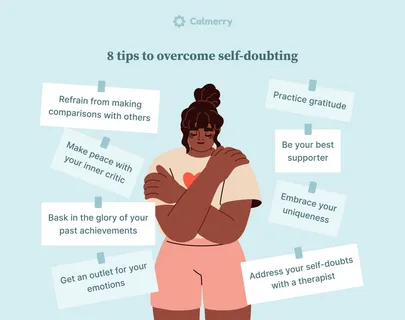
Self-doubt is a psychological experience characterized by uncertainty about one’s abilities, decisions, personal value, or potential for success. Although occasional self-doubt is a normal aspect of human experience, persistent uncertainty about oneself may influence emotional well-being, interpersonal relationships, professional development, and the ability to make important life decisions.
People who experience self-doubt do not necessarily lack competence. In many cases, they possess the necessary knowledge and skills but struggle to recognize their own abilities accurately. They may attribute success to luck, interpret mistakes as evidence of personal inadequacy, or compare themselves unfavorably with others. Over time, these patterns can contribute to reduced confidence and avoidance of challenging situations.
Self-doubt may develop through several psychological mechanisms, including perfectionism, fear of failure, negative childhood experiences, excessive criticism, social comparison, and unrealistic personal expectations. However, its origins differ between individuals, and no single explanation applies to everyone.
The following 15-question self-understanding test is designed to explore several dimensions of self-doubt and self-perception. It is not a standardized psychological instrument and cannot diagnose a mental health condition. Its purpose is to encourage reflection on personal experiences, emotional reactions, and habitual ways of thinking.
## Instructions
Read each statement carefully and select the response that best reflects your usual experience. Answer according to how you generally feel and behave, rather than how you believe you should respond.
Use the following scale for every question:
– **0 — Never**
– **1 — Rarely**
– **2 — Sometimes**
– **3 — Often**
– **4 — Almost always**
## The 15 Questions
**1. Confidence in Personal Abilities**
Even when you have sufficient evidence that you are capable of doing something, how often do you doubt your own abilities?
**2. Fear of Making Mistakes**
How often does the possibility of making a mistake prevent you from starting something you genuinely want to do?
**3. Sensitivity to Criticism**
When someone criticizes your behavior or work, how easily does that criticism influence the way you evaluate yourself as a person?
**4. Comparison with Others**
How often do you compare yourself with other people and conclude that you are less successful, intelligent, capable, or valuable than they are?
**5. Difficulty Accepting Praise**
When someone compliments you, how often do you feel uncomfortable, question the person’s sincerity, or believe that the praise is undeserved?
**6. Perfectionistic Expectations**
How often do you feel that your work must be nearly perfect before you can consider yourself successful?
**7. Fear of Rejection**
How often do you avoid expressing your genuine opinions, needs, or feelings because you are afraid that others might reject you?
**8. Dependence on External Approval**
How strongly does your sense of personal worth depend on whether other people approve of your decisions, behavior, or achievements?
**9. Overthinking Past Decisions**
How often do you repeatedly reconsider decisions you have already made, wondering whether you should have acted differently?
**10. Difficulty Recognizing Achievements**
How often do you minimize your accomplishments or focus on what you failed to achieve instead of acknowledging what you have accomplished?
**11. Fear of New Challenges**
When you encounter an unfamiliar opportunity, how often do you assume that you will probably fail before giving yourself a reasonable chance to succeed?
**12. Negative Self-Talk**
How often do you speak to yourself internally in a harsh or discouraging way, particularly after making a mistake?
**13. Difficulty Setting Boundaries**
How often do you agree to things you do not want to do because you feel guilty, fear disappointing someone, or worry about how that person will perceive you?
**14. Uncertainty About Personal Identity**
How often do you find it difficult to identify what you genuinely want, believe, or value because other people’s expectations strongly influence your choices?
**15. Trust in Your Own Judgment**
When you must make an important decision without knowing exactly what will happen, how often do you distrust your own judgment and feel that someone else would make a better decision?
## Understanding Your Responses
Each question examines a different aspect of self-perception. Taken together, the responses may help identify recurring patterns in how a person evaluates personal abilities, responds to criticism, manages uncertainty, and relates to other people’s expectations.
A high response to a particular question does not automatically indicate a psychological problem. For example, reconsidering decisions may reflect careful thinking, sensitivity to criticism may occur in an unsupportive environment, and high standards may be helpful in certain professional contexts. The meaning of each response depends on the person’s circumstances, emotional experiences, and the extent to which these patterns interfere with daily life.
Rather than treating the answers as a definitive measurement of personality, the results should be interpreted as a starting point for examining potentially useful questions: Which situations make self-doubt stronger? What kinds of criticism are particularly difficult to tolerate? Is the individual evaluating personal abilities realistically, or relying on assumptions that have never been examined?
A meaningful interpretation should consider the pattern of responses rather than relying exclusively on a total score. The assessment is intended for educational and reflective purposes, not for clinical diagnosis or comparison with population norms.
## Conclusion
Self-understanding begins with observing one’s thoughts and reactions without immediately judging them. Self-doubt is not necessarily evidence of weakness, just as confidence does not always indicate accurate self-evaluation. Both excessive self-criticism and unrealistic certainty can interfere with balanced decision-making.
By examining these 15 areas, individuals may become more aware of the beliefs and emotional responses that shape their everyday choices. The goal is not to eliminate every doubt but to develop a more realistic, flexible, and compassionate relationship with oneself.