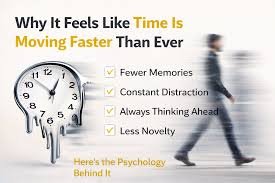
Temporal Flow Discontinuity Disorder is a psychological condition in which objective time perception remains accurate, yet the subjective sense of time passing becomes profoundly altered. Individuals can read clocks, meet deadlines, and estimate durations correctly, but no longer feel the internal flow that normally connects one moment to the next. Time is known, but it is not felt.
Those affected do not experience confusion about dates or sequences. Memory, planning, and attention remain intact. The disturbance lies in the experiential continuity of time. Moments feel isolated, as if each exists on its own without smoothly transitioning into the next. Life unfolds in a series of static “nows,” creating the impression that time is standing still even while events continue.
This disruption often produces a sense of detachment from personal narrative. Without the felt movement of time, past, present, and future lose their natural linkage. Individuals may describe their life as paused or suspended, despite knowing that it is objectively progressing. This creates an unsettling contrast between what is measured and what is lived.
Emotionally, responses remain appropriate, but they lack temporal resonance. Feelings arise in relation to events, yet do not carry the sense of unfolding or anticipation that normally accompanies emotional experience. Joy does not feel like it is growing, and sadness does not feel like it is passing. Instead, emotions appear as fixed states that exist without temporal depth.
The condition is especially noticeable during routine activities. Days may feel indistinguishable, not because they are forgotten, but because they lack a felt trajectory. Events occur, but they do not accumulate into a sense of movement or progress. This can lead to existential fatigue, as the future feels conceptually present but experientially unreachable.
Neurocognitive models suggest that Temporal Flow Discontinuity Disorder may involve disruption in neural mechanisms that integrate memory, prediction, and attention into a continuous temporal experience. In typical cognition, the brain constantly anticipates what comes next, creating a sense of flow. When this predictive continuity weakens, time is processed as information but not experienced as movement.
Behaviorally, individuals often attempt to restore temporal feeling through novelty, intense activity, or rigid scheduling. While these strategies may momentarily highlight change, the underlying sense of stasis quickly returns. Excessive reflection on time tends to intensify the disturbance, while embodied, present-focused activities may offer brief relief.