Anxiety is often understood as a rational response to threat. When a person encounters danger—a predator, an accident, or an uncertain environment—the brain activates systems that prepare the body to react quickly. Heart rate increases, attention sharpens, and muscles become ready for action. From an evolutionary perspective, this reaction is essential for survival. Yet one of the most puzzling features of human psychology is that anxiety frequently appears even when no real danger is present. Individuals may feel intense worry before a social interaction, experience fear about future events that may never occur, or sense a vague tension without any identifiable cause. This phenomenon raises a profound neurological question: why does the brain generate anxiety in the absence of immediate threat?
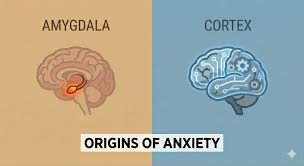
To understand this process, it is necessary to examine the brain systems responsible for detecting and responding to danger. Central among these systems is the amygdala, a small almond-shaped structure located deep within the temporal lobes. The amygdala plays a critical role in evaluating emotional significance, particularly signals related to fear and threat. When sensory information reaches the brain, it is rapidly processed by the amygdala even before conscious awareness fully interprets the situation. This rapid processing allows the body to react to potential danger within fractions of a second.
The speed of this mechanism, however, comes with an important trade-off. Because the amygdala prioritizes speed over precision, it often responds to signals that merely resemble danger rather than signals that actually represent it. From an evolutionary perspective, it is safer for the brain to mistakenly interpret a harmless stimulus as threatening than to overlook a genuine threat. A rustling sound in the bushes might be caused by wind, but if it were caused by a predator, ignoring it could be fatal. Therefore, the brain evolved to favor false alarms over missed dangers.
This evolutionary bias helps explain why anxiety can arise without obvious cause. The brain constantly scans the environment for patterns associated with risk, and it does so not only through external perception but also through internal memory. Experiences from the past shape how the brain interprets present situations. If a particular environment or situation has previously been associated with embarrassment, conflict, or harm, the brain may activate anxiety even when the current circumstances are objectively safe.
Memory plays a crucial role in this process. The hippocampus, a structure involved in contextual memory, works closely with the amygdala to evaluate whether a situation resembles past experiences of threat. When a similar context appears—such as a crowded room resembling a past stressful event—the hippocampus signals the amygdala, which may initiate an anxiety response. This reaction can occur even if the individual consciously knows that the current situation is not dangerous.
The involvement of memory introduces an important dimension to anxiety: anticipation. Unlike many animals, humans possess a highly developed capacity for imagining future scenarios. This ability is largely mediated by networks in the prefrontal cortex, the region responsible for planning, reasoning, and simulation of possibilities. The same cognitive abilities that allow humans to prepare for future challenges also enable the brain to imagine negative outcomes in vivid detail.
When the brain constructs hypothetical scenarios involving potential failure, loss, or embarrassment, the amygdala may respond as if those events were real. Physiological reactions—such as increased heart rate or muscle tension—may occur even though the imagined threat has not yet happened. In this way, anxiety can be triggered not by the external world but by the brain’s own predictions.
Predictive processing has become one of the central frameworks in modern neuroscience. According to this model, the brain is not merely a passive receiver of sensory information. Instead, it actively generates predictions about what will happen next and continuously compares these predictions with incoming sensory data. When the brain detects uncertainty or mismatch between expectation and reality, it increases vigilance in order to resolve the discrepancy.
Anxiety may therefore emerge when the brain perceives uncertainty about important outcomes. Situations involving social evaluation, unpredictable environments, or unclear expectations often trigger heightened predictive monitoring. The brain attempts to prepare for multiple possible outcomes simultaneously, which can produce a persistent state of tension. In such cases, anxiety functions as a motivational signal urging the individual to gather more information or regain a sense of control.
Another factor contributing to anxiety without immediate danger is the brain’s sensitivity to social relationships. Human survival historically depended on cooperation within groups. Exclusion from the group could have severe consequences, including loss of protection and resources. As a result, the brain developed specialized neural circuits dedicated to monitoring social acceptance and rejection.
These circuits involve regions such as the anterior cingulate cortex and the insula, both of which are associated with emotional pain. Research has shown that social rejection activates many of the same neural pathways involved in physical pain. Consequently, situations involving social evaluation—public speaking, meeting unfamiliar people, or receiving criticism—can trigger anxiety responses even though no physical threat is present.
The prefrontal cortex normally helps regulate these emotional reactions by evaluating whether a perceived threat is realistic. When functioning effectively, this region can inhibit excessive amygdala activation. However, the regulatory process requires cognitive resources and energy. Under conditions of stress, fatigue, or information overload, the prefrontal cortex may become less effective at controlling emotional signals from deeper brain structures.
When regulatory systems weaken, the amygdala may become more reactive. Minor uncertainties or ambiguous cues may then trigger exaggerated anxiety responses. This dynamic helps explain why individuals often experience stronger anxiety during periods of sleep deprivation, chronic stress, or emotional exhaustion. The underlying neural circuitry remains the same, but the balance between threat detection and rational evaluation shifts.
Hormonal systems also contribute to the persistence of anxiety. The hypothalamic-pituitary-adrenal axis regulates the release of stress hormones such as cortisol and adrenaline. When the brain perceives potential danger, this system activates the body’s stress response, preparing muscles and cardiovascular systems for action. In short bursts, this response is adaptive and beneficial.
However, when anxiety occurs repeatedly without resolution, stress hormones may remain elevated for extended periods. Prolonged cortisol exposure can influence brain function in several ways. It can increase amygdala sensitivity, reduce the flexibility of the prefrontal cortex, and alter memory processes within the hippocampus. These changes may create a feedback loop in which the brain becomes increasingly predisposed to anxiety.
Neurotransmitters also play an essential role in regulating emotional balance. Chemicals such as serotonin, gamma-aminobutyric acid (GABA), and dopamine influence how neural circuits respond to stress and uncertainty. Reduced inhibitory signaling through GABA pathways, for example, may allow anxiety signals to spread more easily across brain networks. Similarly, alterations in serotonin activity can affect mood stability and emotional resilience.
The influence of neurotransmitters helps explain why certain medications can reduce anxiety by restoring chemical balance within neural circuits. However, medication addresses only part of the picture. Environmental experiences, learned patterns of thinking, and behavioral habits also shape how the brain interprets potential threats.
One of the most important cognitive factors in anxiety is attention. The brain has limited attentional capacity, meaning that it can focus deeply on only a small number of signals at any given time. Individuals prone to anxiety often develop an attentional bias toward potential threats. Their brains become especially sensitive to signals that might indicate risk or negative outcomes.
This attentional bias reinforces anxiety by continually directing mental resources toward possible dangers. Even neutral situations may be scanned for hidden problems, maintaining a constant sense of vigilance. Over time, this pattern becomes habitual, strengthening neural pathways associated with threat detection.
Interestingly, anxiety is not purely harmful. In moderate levels, it can enhance performance and motivation. A certain degree of anticipatory tension improves focus, encourages preparation, and increases awareness of potential challenges. This relationship between anxiety and performance is often described by the Yerkes–Dodson law, which suggests that optimal performance occurs at moderate levels of arousal.
Problems arise when anxiety becomes disproportionate to the situation or persists for extended periods without resolution. In such cases, the brain remains trapped in a state of heightened monitoring that consumes cognitive resources and disrupts emotional balance. The individual may become exhausted by continuous worry, even though the original triggers are minor or hypothetical.
Developmental experiences also influence how strongly the brain generates anxiety. Early life environments shape the sensitivity of stress-regulation systems. Children exposed to unpredictable or threatening conditions may develop heightened vigilance as a protective adaptation. Their brains learn to anticipate danger even in ambiguous circumstances. While this adaptation may have been beneficial in the original environment, it can lead to excessive anxiety in safer contexts later in life.
Importantly, the brain retains the capacity to modify these patterns through neuroplasticity. Repeated experiences that contradict anxious predictions can gradually reshape neural circuits. Practices such as cognitive restructuring, mindfulness training, and gradual exposure to feared situations help the brain learn that certain environments are safe. Over time, the amygdala becomes less reactive, and regulatory systems regain balance.
Mindfulness practices are particularly interesting from a neurological perspective. By training attention to remain focused on present-moment sensations rather than imagined future threats, mindfulness reduces activity in networks responsible for rumination and worry. Neuroimaging studies suggest that regular mindfulness practice strengthens connections between the prefrontal cortex and emotional centers, improving the brain’s ability to regulate anxiety signals.
Physical activity also plays a significant role in regulating anxiety. Exercise influences neurotransmitter systems, increases blood flow to the brain, and promotes the release of neurotrophic factors that support neural resilience. These biological changes can enhance the brain’s capacity to manage stress and reduce excessive fear responses.
The phenomenon of anxiety without danger therefore emerges from a complex interaction of evolutionary design, memory systems, predictive cognition, and physiological regulation. The brain did not evolve to maximize comfort but to maximize survival. As a result, it often errs on the side of caution, generating alarm signals even when objective threats are minimal.
Understanding this principle changes how anxiety can be interpreted. Rather than viewing it solely as a malfunction or weakness, anxiety can be seen as an overactive protective system. The brain attempts to anticipate and prevent harm, sometimes extending this protective effort beyond what the situation requires. Recognizing the evolutionary origins of this process may reduce the sense of mystery or self-blame often associated with anxious experiences.
At the same time, awareness of the brain’s predictive nature offers practical strategies for managing anxiety. By gradually exposing the brain to safe experiences, challenging catastrophic interpretations, and strengthening regulatory networks through attention training and healthy habits, individuals can recalibrate the sensitivity of their threat-detection systems.
In the end, the question of why the brain creates anxiety without danger reveals a deeper truth about human cognition. The brain is not simply reacting to reality; it is constantly constructing models of possible futures. Anxiety emerges when those models emphasize risk and uncertainty. Through learning, experience, and conscious practice, however, the brain can refine its predictions, allowing the mind to distinguish more clearly between genuine danger and the countless harmless uncertainties of everyday life.