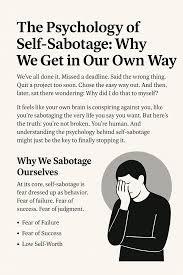
Why does a person work tirelessly toward a goal, endure years of discipline and sacrifice, and then hesitate, delay, or even destroy their progress at the very moment success seems within reach? Why does someone who longs for love push it away when intimacy deepens? Why does an individual who desires stability create chaos just as life begins to feel secure? Self-sabotage is one of the most puzzling and painful psychological patterns. It appears irrational from the outside, yet internally it often follows a hidden logic shaped by fear, memory, identity, and unresolved emotional conflict. To understand why we sabotage ourselves when we are closest to success, we must explore the deeper layers of the human psyche—where survival mechanisms, attachment wounds, and unconscious beliefs quietly shape behavior.
At the surface level, self-sabotage looks like procrastination, impulsive decisions, broken commitments, missed opportunities, or sudden withdrawal. A student studies diligently for months but fails to submit the final application. An employee performs exceptionally yet misses important deadlines before promotion. A person in a loving relationship begins arguments without clear cause. These behaviors may appear careless or irresponsible, but they often mask something deeper: an internal conflict between desire and fear. Part of the individual wants success. Another part fears what success represents.
Success is rarely just about achievement. Psychologically, success brings visibility, responsibility, change, and vulnerability. It may disrupt familiar dynamics in relationships. It may trigger expectations from others. It may expose the individual to judgment or envy. For someone whose nervous system associates visibility with danger—perhaps due to early criticism or emotional invalidation—success can feel threatening rather than rewarding. The body reacts not to the rational meaning of success but to the emotional memory attached to being seen.
Childhood experiences often lay the foundation for self-sabotage. If a child grows up in an environment where achievements are ignored, minimized, or criticized, they may internalize the belief that success is unsafe. A parent who responds to good grades with indifference, or who pressures perfection without offering warmth, can create an association between achievement and emotional disconnection. Later in life, when success approaches, the unconscious mind may attempt to protect the individual from anticipated rejection by preventing success altogether. In this way, self-sabotage becomes a misguided form of self-protection.
Attachment theory provides further insight. Individuals with insecure attachment styles may struggle with consistency when life becomes stable. If love in childhood was unpredictable—sometimes available, sometimes withdrawn—the nervous system adapts to instability as normal. Calmness may feel unfamiliar and therefore uncomfortable. When success or healthy relationships create stability, anxiety may increase. To reduce this anxiety, the individual unconsciously recreates familiar chaos. It is not happiness they fear; it is unfamiliarity. The psyche often prefers known pain over unknown peace.
Impostor syndrome is another psychological factor closely related to self-sabotage. When individuals achieve something that conflicts with their internal self-image, cognitive dissonance arises. If someone deep down believes they are inadequate, unworthy, or not intelligent enough, external success contradicts this belief. Instead of updating the belief, the psyche may attempt to restore consistency by undermining the success. Mistakes, delays, or withdrawal serve to confirm the negative self-concept. In this sense, self-sabotage protects identity coherence. The individual would rather remain consistent with their internal narrative than risk redefining who they are.
Fear of responsibility also plays a significant role. Success expands choice and accountability. A promotion increases leadership expectations. A public platform increases influence. Financial stability increases decision-making power. These expansions can feel overwhelming. For individuals who grew up in environments where responsibility was burdensome or unsafe, added responsibility may trigger stress responses. Sabotage reduces pressure by shrinking opportunity. It returns life to a manageable scale.
Another dimension involves fear of separation. Success can alter relational dynamics. If someone rises socially or professionally, they may outgrow certain friendships or family roles. For individuals who unconsciously fear abandonment, surpassing loved ones may feel like betrayal. To preserve belonging, they may limit their own growth. Loyalty conflicts are powerful. A child who observed a parent struggle financially may feel guilt about earning more money. A sibling who experienced rivalry may avoid standing out. Self-sabotage then becomes a strategy to maintain relational equilibrium.
Neuroscience suggests that the brain is wired for familiarity. The basal ganglia, involved in habit formation, reinforces repeated behavioral patterns. Even dysfunctional behaviors can feel comfortable if they are predictable. Success introduces unpredictability. New routines, new environments, new expectations require cognitive adaptation. The brain may resist this change, especially if stress levels are already high. Sabotage can restore the comfort of the known.
Emotional regulation capacity influences self-sabotage as well. Success often triggers intense emotions—excitement, anticipation, anxiety. Individuals with limited skills in managing emotional intensity may unconsciously dampen positive experiences to avoid overwhelm. This phenomenon is sometimes called “upper limit problems,” where people tolerate only a certain level of happiness before creating problems to return to a familiar baseline. The psyche may equate intense joy with potential loss, believing that if something feels too good, it will inevitably disappear. To avoid future disappointment, it reduces current joy.
Perfectionism can paradoxically lead to self-sabotage. When standards are impossibly high, the fear of not meeting them becomes paralyzing. Rather than risk imperfect performance, individuals may delay action. Procrastination protects the fantasy of potential. If the project is never completed, it can never be judged. In this way, sabotage shields the ego from failure—but it also prevents success. Perfectionism often develops in response to conditional love, where approval was contingent on achievement. The individual internalizes relentless standards and fears falling short.
Trauma adds another layer of complexity. Traumatic experiences, particularly those involving humiliation, betrayal, or sudden loss, can create associations between peak moments and danger. If a person once felt proud before experiencing public embarrassment, their nervous system may link pride with threat. As adults, moments of accomplishment may unconsciously activate trauma responses—racing heart, intrusive thoughts, or urges to withdraw. Sabotage becomes a means of reducing activation.
Cultural influences should not be overlooked. Some societies emphasize modesty and discourage standing out. Others promote relentless competition. Internal conflict can arise when personal ambition clashes with cultural values. Individuals may struggle between self-expression and conformity. If success feels like a violation of collective norms, sabotage can serve as a compromise.
The internal dialogue accompanying self-sabotage is often subtle. Thoughts like “I’ll start tomorrow,” “It’s not ready yet,” or “Maybe this isn’t for me” seem rational. However, beneath them may lie deeper beliefs: “If I succeed, people will expect more,” “If I fail publicly, I’ll be humiliated,” or “If I change, I might lose love.” These beliefs operate largely outside conscious awareness. Bringing them into awareness requires reflection and emotional honesty.
Self-worth sits at the center of this pattern. Individuals who feel fundamentally unworthy may unconsciously reject experiences that contradict this belief. Compliments feel uncomfortable. Opportunities feel suspicious. Success feels undeserved. The psyche seeks balance between internal belief and external reality. Until self-worth expands, success may feel like a threat to equilibrium.
Breaking the cycle of self-sabotage involves more than willpower. It requires curiosity rather than self-criticism. Instead of asking, “Why am I so lazy?” one might ask, “What am I afraid will happen if I succeed?” This shift transforms sabotage from moral failure into psychological signal. Often, the feared outcome is emotional rather than practical. It might involve exposure, rejection, or loss of identity.
Developing emotional tolerance is crucial. Learning to sit with anxiety without acting impulsively builds resilience. Mindfulness practices strengthen awareness of urges without immediate reaction. Therapy can help uncover childhood narratives and attachment wounds. Cognitive restructuring allows individuals to challenge distorted beliefs about worthiness and danger.
Rewriting identity is another essential step. Instead of identifying as someone who “always messes things up,” individuals can gradually adopt narratives of growth and adaptability. Identity shifts occur through consistent small actions. Completing minor tasks builds evidence that success can be safe. Celebrating small wins trains the nervous system to associate achievement with stability rather than threat.
Supportive relationships also buffer against sabotage. When individuals feel accepted independent of performance, fear decreases. Secure attachment provides a foundation for risk-taking. Encouragement from mentors or friends can counteract internal doubt. However, reliance solely on external validation may perpetuate vulnerability. The goal is internal security complemented by external support.
Understanding the protective intention behind sabotage fosters compassion. The psyche developed these strategies at a time when they were adaptive. Perhaps withdrawing from attention once prevented ridicule. Perhaps minimizing achievement once preserved belonging. Recognizing this historical context reduces shame. Yet what once protected may now restrict. Growth requires updating these strategies to align with present reality.
Visualization techniques can assist in this process. Imagining success in vivid detail while noticing emotional responses reveals hidden fears. If tension arises, it can be explored gently. What part of me feels threatened? What does it believe will happen? Engaging with these inner parts—sometimes conceptualized in therapeutic models as “inner child” or “protective parts”—creates integration rather than suppression.
Accountability structures help bridge intention and action. Deadlines, public commitments, or collaborative projects reduce opportunities for avoidance. However, these tools must be paired with emotional work. Without addressing underlying fear, external pressure may intensify sabotage.
Self-compassion remains foundational. Harsh self-judgment reinforces negative identity beliefs and increases anxiety. Compassion acknowledges struggle while encouraging responsibility. Research suggests that self-compassion enhances motivation more effectively than self-criticism because it reduces fear of failure.
It is important to differentiate between authentic misalignment and sabotage. Not every withdrawal indicates fear. Sometimes goals truly change. Discernment requires honest evaluation. Are you stepping back because the path no longer aligns with your values, or because it threatens your comfort? Clarity emerges through reflection rather than impulsive reaction.
Over time, as individuals experience safe success repeatedly, neural pathways shift. The nervous system learns that achievement does not inevitably lead to harm. Confidence grows not from affirmations alone but from lived evidence. Each completed project, each healthy relationship maintained, becomes proof that expansion is survivable.
Self-sabotage often intensifies during transitional life phases—graduation, marriage, career shifts, parenthood. These transitions redefine identity. The old self dissolves while the new self is still forming. Uncertainty increases vulnerability. Recognizing these periods as psychologically sensitive encourages gentleness rather than panic.
The ultimate paradox of self-sabotage is that it arises from the desire to avoid pain but frequently creates more pain. By preventing success, individuals confirm fears of inadequacy. Breaking this paradox requires tolerating short-term discomfort to achieve long-term alignment.
At its core, the question is not “Why do I ruin good things?” but “What part of me is trying to stay safe?” When safety is redefined—no longer tied to invisibility or limitation—growth becomes less threatening. Success transforms from a spotlight exposing flaws into an opportunity expressing authenticity.
Human beings are complex systems of memory, emotion, belief, and biology. Self-sabotage is not evidence of weakness; it is evidence of unresolved conflict. By approaching this conflict with curiosity, patience, and support, individuals can gradually align desire with action. The closer one moves toward integrating past wounds with present awareness, the less power sabotage holds.
Success, then, becomes not a battlefield but a continuation of self-discovery. When individuals learn that they can survive visibility, responsibility, and expansion without losing connection or worth, the need to sabotage diminishes. What remains is not perfection but progress—imperfect, courageous, and conscious.
And perhaps the deeper transformation is this: realizing that success is not merely external achievement but internal reconciliation. When the fearful parts of the psyche feel heard rather than silenced, they no longer need to interrupt growth. They can rest. In that rest, the path forward becomes clearer.