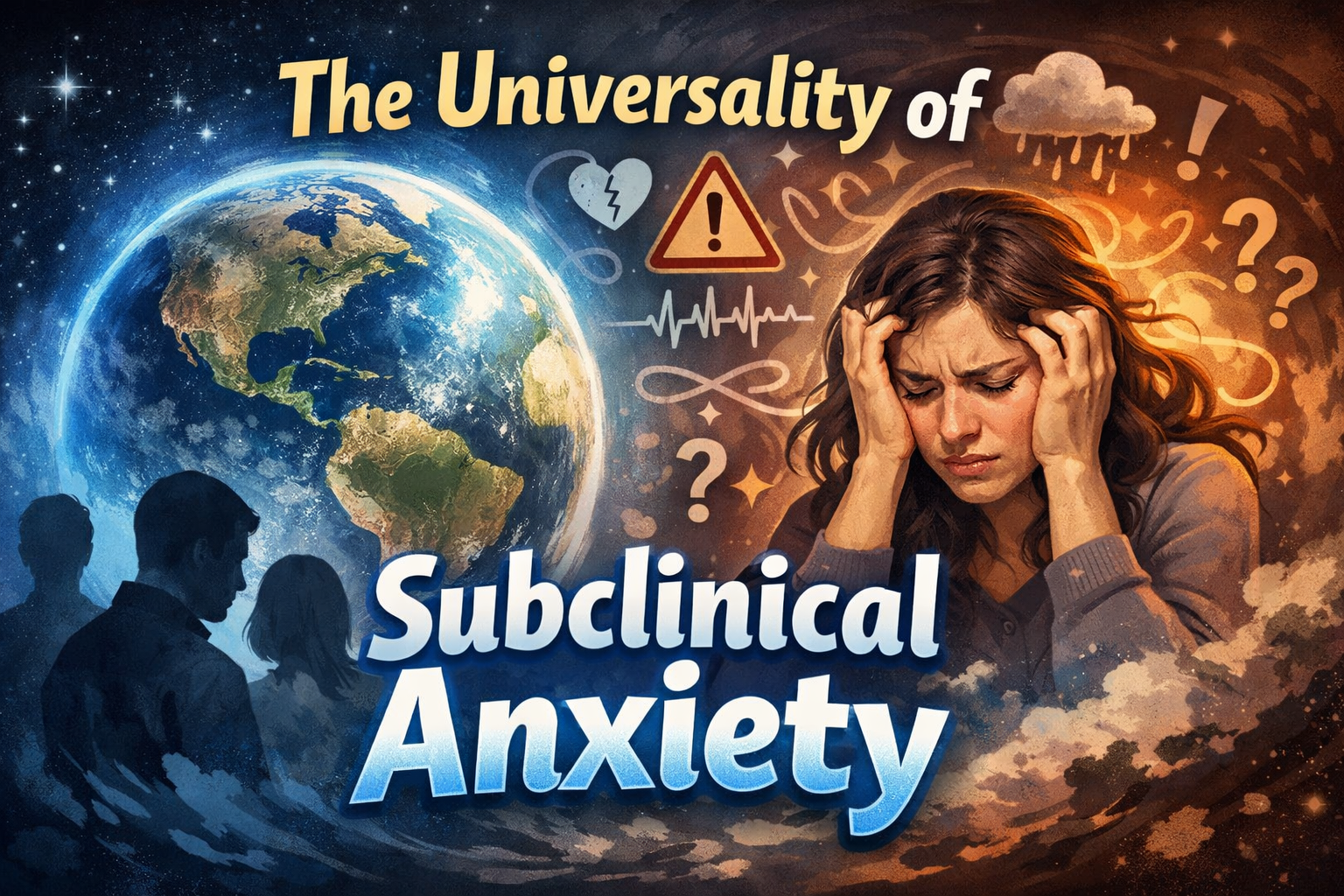
Anxiety, in its clinical form, is classified as a mental disorder that can significantly impair daily functioning. However, when examined on a broader psychological spectrum, anxiety reveals itself as a nearly universal human condition. Subclinical anxiety—defined as persistent anxious thoughts and physiological responses that do not meet diagnostic thresholds—can be observed in an overwhelming majority of individuals. While not pathological in itself, this condition quietly shapes perception, decision-making, and emotional regulation in almost every human life.
From an evolutionary standpoint, anxiety emerged as an adaptive mechanism. The human brain evolved to detect threats rapidly, prioritize negative information, and anticipate potential dangers. These cognitive tendencies, while essential for survival in hostile environments, remain active in modern contexts where threats are largely abstract or symbolic. As a result, individuals frequently experience excessive worry about social evaluation, future uncertainty, productivity, or personal adequacy. Such concerns, though normalized and socially reinforced, represent core components of subclinical anxiety.
One of the defining characteristics of this condition is cognitive hypervigilance—a heightened sensitivity to potential problems, mistakes, or rejection. People often replay past interactions, catastrophize minor setbacks, or mentally rehearse future scenarios in an attempt to maintain control. This constant mental scanning is rarely recognized as a psychological issue because it is so widespread. Yet research in cognitive psychology demonstrates that chronic worry consumes attentional resources, diminishes working memory capacity, and contributes to emotional fatigue. Another pervasive feature is somatic anxiety, which manifests through bodily sensations such as muscle tension, accelerated heartbeat, shallow breathing, or gastrointestinal discomfort. Many individuals interpret these sensations as normal stress responses without acknowledging their psychological origin. Over time, the body becomes conditioned to remain in a state of low-grade arousal, blurring the boundary between normal functioning and persistent physiological stress. Importantly, subclinical anxiety is reinforced by contemporary social structures. Digital connectivity, performance-based education systems, economic instability, and constant comparison through social media intensify self-monitoring and fear of inadequacy. In such an environment, anxious cognition is not only common but often rewarded, as vigilance and over-preparation are mistaken for responsibility or ambition. Despite its prevalence, subclinical anxiety is frequently dismissed because it does not disrupt external functioning. Individuals continue to work, study, and socialize, while internally navigating relentless mental pressure. This invisibility contributes to the misconception that psychological well-being is binary—either disordered or healthy—when in reality it exists on a continuum. The danger lies not in anxiety itself, but in its normalization to the point where chronic psychological strain is considered an inevitable aspect of being human.