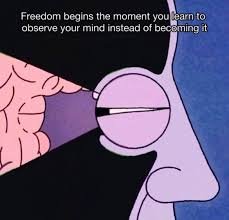
Human psychological life depends not only on perception or emotion, but on meaning attribution — the continuous, mostly unconscious process by which the mind assigns importance, relevance, and value to internal and external events. Meaning tells us what to attend to, what to ignore, what to pursue, and what to avoid. It organizes experience into a hierarchy. When this system collapses, the world does not disappear, but it becomes radically undifferentiated. Everything feels equally irrelevant — or equally overwhelming. Nothing stands out. Nothing calls. Nothing matters.
The collapse of meaning attribution is distinct from depression, anhedonia, or apathy. In depression, meaning still exists but feels unreachable. In apathy, interest is diminished but selective. In meaning collapse, the mechanism that generates significance itself fails. The mind loses its internal compass. Experience becomes flat not because emotion is gone, but because value assignment has dissolved.
This phenomenon appears in severe existential depression, late-stage burnout, schizophrenia-spectrum disorders, advanced dissociation, prolonged trauma exposure, and certain neurodegenerative or neuroinflammatory states. Across diagnoses, the subjective experience converges: the person no longer knows why anything should matter more than anything else — including themselves.
At a basic level, meaning attribution relies on the integration of emotion, memory, and prediction. Emotion flags significance, memory contextualizes it, and prediction uses it to guide future action. When chronic stress, trauma, or neurobiological disruption decouples these systems, meaning collapses. The brain continues to register stimuli, but cannot rank them. A loud sound, a moral dilemma, a personal loss, and a trivial detail arrive with the same internal weight: near zero.
From the inside, this state is profoundly disorienting. The individual may describe feeling “blank,” “lost,” or “ungrounded,” but these words barely capture the experience. The deeper reality is indecision at the level of reality itself. The person cannot decide what deserves attention, effort, or care. Choice becomes impossible not because options are unclear, but because no option carries intrinsic value.
This collapse creates a unique paralysis. Without meaning, motivation cannot form. Without motivation, agency dissolves. The person may sit for hours unable to begin or end an activity, not due to indecision, but because beginning and ending feel equivalent. Time passes, but nothing accumulates into significance. Life becomes a sequence of unweighted moments.
In schizophrenia-spectrum conditions, collapse of meaning attribution can manifest paradoxically as excess meaning. When the system that filters significance breaks down, the mind may attempt to compensate by assigning meaning indiscriminately. Trivial events become loaded with cosmic importance. Coincidences become messages. This is not insight, but a desperate attempt to restore structure to a value-less world. Delusion, in this sense, is meaning run amok after meaning has first collapsed.
In trauma-related states, meaning collapse is often defensive. When meaning has repeatedly led to pain — when caring results in loss, attachment results in betrayal, or hope results in humiliation — the psyche learns that assigning value is dangerous. The safest strategy becomes disengagement at the level of significance itself. If nothing matters, nothing can hurt. Over time, this defense generalizes until the entire world loses emotional gravity.
Existentially, collapse of meaning attribution produces a quiet but devastating nihilism. This is not philosophical skepticism; it is experiential void. The individual does not believe life is meaningless — they feel it at a visceral level. Language about purpose, values, or goals sounds foreign or naive. Moral distinctions blur. Even suffering loses its protest, because protest requires believing that something should be different.
Interpersonally, this state creates profound disconnection. Relationships depend on selective valuation — caring about this person more than others, this moment more than another. When valuation collapses, intimacy becomes impossible. The individual may appear emotionally distant or indifferent, not because they lack care, but because their system cannot prioritize attachment over neutrality.
Clinically, collapse of meaning attribution is often mistaken for resistance, laziness, or lack of insight. Interventions that rely on goal-setting, cognitive reframing, or motivational enhancement frequently fail, because they presuppose an intact value system. Asking “What matters to you?” becomes an unanswerable question.
Treatment must therefore begin beneath meaning, not above it. The task is not to convince the person that things matter, but to help the nervous system relearn how significance feels. This often involves grounding in sensory experience, rhythmic activity, and relational presence — experiences that generate salience without requiring interpretation. Meaning must re-emerge bottom-up, not be imposed top-down.
The first signs of recovery are subtle. A sound captures attention. A moment lingers. A person feels slightly more real than the background. These micro-signals indicate that the valuation system is restarting. Over time, differentiation returns. Some things begin to matter more than others. Choice becomes possible again. The world regains depth.
Ultimately, the collapse of meaning attribution reveals a fundamental psychological truth: meaning is not an abstract belief, but a biological and emotional function. When it fails, existence flattens. When it returns, life reclaims its contours. Healing is not the rediscovery of grand purpose, but the quiet restoration of the ability to feel that this matters more than that — and that one’s own existence matters at all.