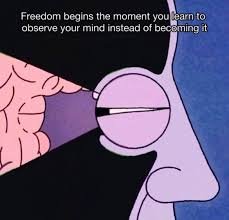
After intense Irreversibility Anxiety, some individuals do not return to their previous mental state, yet they also do not deteriorate into psychosis or collapse. Instead, they enter a little-described psychological phase that can be called Post-Irreversible Adaptation Void. This state emerges not at the peak of fear, but after the mind realizes—often with surprise—that it has continued functioning despite the conviction that return was impossible.
In this phase, the acute terror has faded, but relief does not arrive. The individual no longer feels trapped in panic, yet does not feel restored either. The defining feature is a void-like neutrality: the sense that something fundamental ended, but nothing clearly replaced it. Patients often say, “I survived it, but I don’t know what I survived,” or “I’m functioning, but I don’t feel re-entered into life.”
Unlike depression, the void is not characterized by sadness, hopelessness, or self-criticism. Energy may be adequate, sleep may normalize, and cognitive clarity often improves. The problem is subtler: the old sense of psychological elasticity—the trust that one can fully inhabit states and then leave them—has not yet returned. Life feels navigable but strangely non-immersive, as if the mind is operating in a post-event mode without a clear narrative of what changed.
Phenomenologically, this state involves a thinning of existential intensity. Experiences register, decisions are made, conversations occur, but with reduced depth. This is not emotional numbing in the classic sense; emotions can occur, but they feel provisional, as if they are being tested rather than inhabited. The individual may fear that this flattened mode is permanent, yet the fear itself lacks urgency, creating a quiet, unsettling ambiguity.
This condition differs from depersonalization in an important way. In depersonalization, the self feels unreal or detached. In the Post-Irreversible Adaptation Void, the self feels real but post-traumatic, even when no external trauma occurred. The trauma was internal and structural: the confrontation with perceived irreversibility. The psyche reorganized itself to survive that confrontation, but has not yet reintegrated flexibility.
Neuropsychologically, this phase may represent a protective stabilization. After extreme existential threat, the brain may reduce intensity to prevent reactivation of catastrophic fear. This creates a buffer zone—safe, functional, but experientially muted. Clinically, this is often mistaken for recovery or dismissed as residual anxiety, causing patients to feel unseen. They know something is different, but lack language to describe it.
A critical risk in this phase is premature forcing of “normality.” When individuals push themselves to feel the way they did before—seeking emotional intensity, insight, or existential certainty—the void may deepen or reactivate irreversibility fears. Conversely, passive resignation can cause the state to solidify. The challenge lies in allowing gradual re-engagement without demanding restoration.
Therapeutically, the task is not reassurance or interpretation, but re-flexibilization. Gentle exposure to change—shifts in routine, environment, bodily states—can slowly rebuild trust in psychological movement. Importantly, the individual must experience change without monitoring it. Recovery here is not an insight, but a series of unnoticed transitions that re-teach the nervous system that states evolve on their own.
The Post-Irreversible Adaptation Void reveals a rarely acknowledged truth: surviving a perceived point of no return does not immediately restore the sense of return. The mind may live on before it knows how to live back. This phase is not pathology in the traditional sense, but a transitional ecology of consciousness—quiet, uncertain, and deeply human.
Understanding this state challenges psychiatry to recognize not only breakdown and recovery, but the fragile psychological terrain in between, where the mind is no longer collapsing, yet has not learned how to flow again.