Is memory a faithful archive of lived experience, or is it an active reconstruction shaped by present needs, beliefs, and emotional states? The intuitive metaphor of memory as a recording device—storing events as they occurred and retrieving them intact—has long dominated common understanding. Yet contemporary cognitive science, neuroscience, and philosophy increasingly challenge this archival model. Evidence suggests that memory is not a static record but a dynamic, reconstructive process. To remember is not merely to retrieve the past but to recreate it within the interpretive frameworks of the present.
The archival model of memory implies stability, durability, and fidelity. In this view, experiences are encoded, stored, and later accessed without substantial alteration. Such a model aligns with everyday language: we “store” memories, “retrieve” them, and “lose” them. However, empirical findings undermine this metaphor. Psychological research has repeatedly demonstrated that recollections are susceptible to distortion through suggestion, emotional reinterpretation, and contextual reframing. Individuals can develop vivid memories of events that never occurred, particularly when exposed to misleading information. These findings indicate that memory is malleable rather than fixed.
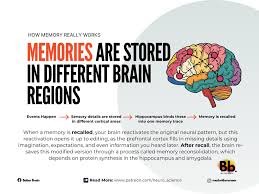
Neuroscientific research reinforces this perspective. Memory formation involves complex interactions among the hippocampus, prefrontal cortex, and distributed cortical networks. Encoding does not produce a literal imprint of experience but rather a pattern of neural activation that is reassembled during recall. Each act of remembering reactivates and potentially modifies the memory trace, a process known as reconsolidation. During reconsolidation, memories become temporarily labile and subject to alteration before being stored again. This cyclical updating mechanism suggests that memory is continuously rewritten rather than preserved in original form.
The reconstructive nature of memory also reflects its adaptive function. From an evolutionary standpoint, the purpose of memory may not be precise preservation but flexible guidance for future behavior. Accurate recall of every detail would be computationally inefficient and potentially maladaptive. Instead, memory abstracts patterns, extracts meaning, and integrates new information. Such abstraction enables generalization and problem-solving but inevitably sacrifices exactitude. Memory prioritizes coherence and relevance over literal accuracy.
Emotion exerts a powerful influence on reconstruction. Emotional arousal enhances the consolidation of certain aspects of experience while narrowing attention to central features. Peripheral details may fade or transform. Over time, the emotional tone associated with a memory can shift, altering interpretation. For instance, an event initially experienced as humiliating may later be reframed as formative or humorous. The remembered event thus reflects ongoing narrative integration rather than immutable fact.
Social interaction further shapes memory reconstruction. Recollections are often shared, negotiated, and co-constructed within communities. Collective memory emerges through repeated retelling, with each iteration subtly modifying content. Social conformity pressures can influence individual recall, leading people to align their memories with group consensus. Memory, therefore, is not solely an internal cognitive process but a socially embedded phenomenon.
Language plays a crucial mediating role. Verbal encoding transforms perceptual experience into symbolic representation. The vocabulary and conceptual categories available at the time of recall influence reconstruction. Descriptive framing can alter perceived details; for example, wording that implies intensity or causation can change how an event is remembered. This linguistic modulation demonstrates that memory is filtered through interpretive schemas.
The phenomenon of autobiographical memory illustrates the narrative dimension of reconstruction. Individuals construct life stories that provide continuity and identity. Memories are selected and organized to support coherent self-concepts. Inconsistencies are often resolved through reinterpretation rather than retention of contradiction. The self is not merely shaped by memory; memory is shaped by the evolving self. As beliefs and values change, recollections are subtly reconfigured to maintain narrative alignment.
Neuropsychological conditions provide additional insight. Patients with amnesia often retain procedural memory while losing episodic recall, indicating that different memory systems operate under distinct principles. Conversely, individuals with hyperthymesia—exceptionally detailed autobiographical recall—still exhibit distortions upon close examination. Even seemingly exact memory does not escape reconstructive influence. These cases suggest that reconstruction is intrinsic to memory architecture rather than a flaw in particular individuals.
Philosophical analysis deepens the inquiry. If memory is reconstructive, what becomes of epistemic reliability? Knowledge of the past depends upon trustworthy recollection. A purely reconstructive account might appear to undermine confidence in memory as a source of evidence. However, reconstruction does not entail radical unreliability. Cognitive systems evolved to balance flexibility with accuracy. While specific details may shift, core structures often remain stable. Memory is probabilistic rather than arbitrary.
The relationship between memory and imagination further complicates the distinction. Neuroimaging studies reveal overlapping neural substrates for remembering the past and imagining the future. Both involve constructive simulation. This overlap suggests that memory may function as a database of elements recombined to anticipate possibilities. In this framework, recollection and projection share cognitive mechanisms. Memory becomes a form of constrained imagination grounded in prior experience.
Trauma research highlights both the strengths and vulnerabilities of reconstructive memory. Traumatic memories can be intrusive and vividly sensory, yet they may also be fragmented or dissociated. Therapeutic interventions often involve narrative reconstruction, enabling individuals to recontextualize and integrate traumatic experiences. The possibility of therapeutic modification underscores the plasticity of memory but also raises ethical questions regarding suggestibility and false recollections.
Technological metaphors frequently mislead understanding. Comparing memory to digital storage implies discrete files retrievable without alteration. Biological memory operates differently. Neural networks encode information in distributed patterns sensitive to context. Recall depends on cues that activate partial representations, which are then completed through inference. This inferential completion is inherently reconstructive. Rather than retrieving a complete record, the brain reconstructs a plausible scenario consistent with available traces.
Developmental psychology demonstrates that reconstructive processes emerge early. Children’s memories are particularly susceptible to suggestion, yet adults remain vulnerable as well. Over time, repeated storytelling can solidify altered versions of events, making them subjectively indistinguishable from original perceptions. Confidence in memory does not reliably correlate with accuracy, revealing a gap between subjective conviction and objective fact.
The reconstructive model also aligns with predictive processing theories of cognition. According to these theories, the brain continuously generates predictions about sensory input and updates them through error correction. Memory contributes to predictive models by supplying priors. In this view, recall involves reactivating predictive frameworks rather than retrieving static data. Reconstruction reflects the brain’s fundamental strategy of model-based inference.
Legal contexts illustrate practical consequences. Eyewitness testimony has historically been treated as compelling evidence, yet research shows its fallibility. Memory distortion through leading questions, stress, or cross-racial identification challenges assumptions about reliability. Recognizing reconstructive dynamics has prompted reforms in interrogation and lineup procedures. The justice system increasingly acknowledges that memory is interpretive rather than mechanical.
Despite abundant evidence for reconstruction, it would be misleading to conclude that memory is fictional. Reconstruction operates within constraints imposed by prior encoding, neural architecture, and environmental cues. Most everyday memories are sufficiently accurate for practical purposes. The reconstructive model emphasizes process rather than perfection. Memory is neither a perfect archive nor an arbitrary invention; it is a dynamic system balancing stability and adaptability.
Existentially, the reconstructive nature of memory influences identity. If recollections evolve, the self anchored in them also evolves. Personal continuity becomes less about static preservation and more about narrative coherence. The past is continually reinterpreted to serve present understanding. This plasticity enables growth but complicates notions of authenticity. The remembered self is partly a creation of ongoing reflection.
Is memory a reconstruction rather than a record? The weight of empirical and theoretical evidence supports the reconstructive account. Memory does not function as a passive repository but as an active process of reassembly shaped by biological, emotional, linguistic, and social factors. Yet reconstruction does not negate connection to reality; it transforms it into a living, adaptive narrative. To remember is to engage in a dialogue between past traces and present perspective. The past, in this sense, is never simply retrieved—it is continually reimagined within the constraints of what once occurred.