One of the most unsettling experiences in severe psychopathology is not the loss of identity itself, but the loss of ownership over identity. In this state, thoughts still occur, emotions still arise, and actions still unfold — yet none of them feel authored by the self. The individual does not say “I am gone,” but rather “this is happening, but it is not mine.” Consciousness persists, cognition functions, behavior continues — but the sense of being the subject behind experience collapses.
Normally, human experience is structured by an implicit ownership tag. Thoughts feel like my thoughts. Feelings feel like my feelings. Actions feel initiated by me. This ownership is not intellectual; it is prereflective and automatic. It is the glue that binds mental events into a self. When this glue dissolves, the mind fragments into processes without a center.
This phenomenon appears across several psychiatric conditions: depersonalization disorder, schizophrenia-spectrum disorders, severe dissociation, trauma-related identity disturbances, and some melancholic or catatonic states. Despite differing diagnoses, the subjective experience converges on the same core disturbance — a rupture between experience and authorship.
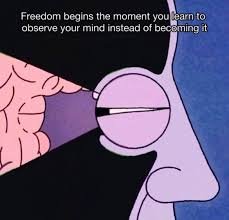
From the inside, loss of ownership feels profoundly alienating. The person may think clearly, speak coherently, and behave purposefully, yet experience all of this as mechanical. Thoughts arise “by themselves.” Emotions feel imposed rather than felt. Actions seem executed by the body rather than chosen. The individual becomes a witness to their own mind — present, alert, but dispossessed.
This is not metaphorical detachment. Patients often say, “I know this is my body, but it doesn’t feel like it belongs to me,” or “I hear my thoughts, but they don’t feel like they come from me.” In psychotic variants, this can evolve into thought insertion or passivity experiences, where mental events are attributed to external forces. In non-psychotic forms, insight remains intact, making the experience even more disturbing: the person knows nothing supernatural is occurring, yet the loss of ownership feels absolute.
Neurocognitively, ownership emerges from the integration of prediction, agency, and sensory feedback. The brain constantly predicts its own actions and thoughts; when prediction matches outcome, ownership is inferred. In conditions where this predictive loop is disrupted — due to trauma, neurodevelopmental vulnerability, or stress-induced dysregulation — mental events lose their signature of self-generation. Experience becomes untagged.
Psychodynamically, loss of ownership often develops as a defense against unbearable internal conflict. When thoughts, desires, or emotions feel dangerous — morally unacceptable, overwhelming, or threatening to attachment — the psyche distances itself from them. Over time, this distancing generalizes. The mind learns not only to disown specific contents, but to disown authorship itself. What begins as protection becomes alienation.
In trauma-related conditions, ownership is sacrificed to survive. If feeling leads to punishment, desire leads to loss, or agency leads to harm, the safest solution is to stop feeling like an agent altogether. The self becomes an observer because observation is safer than participation. In this sense, loss of ownership is not pathology at its origin — it is an adaptation that outlives its usefulness.
Existentially, identity without ownership creates a unique form of despair. The person exists, but does not inhabit existence. Responsibility feels abstract. Choice feels illusory. Moral agency feels compromised. This can lead to profound guilt or fear: “If my actions don’t feel like mine, am I responsible for them?” The self becomes legally and socially accountable, yet subjectively absent.
Interpersonally, this state is deeply isolating. Relationships require presence, intention, and emotional investment. When ownership is lost, interaction feels scripted. Words emerge without emotional backing. Affection is recognized but not felt as coming from within. Others may sense distance or inauthenticity, reinforcing the individual’s fear that they are not truly there.
Therapeutically, restoring ownership is delicate. Directly challenging the experience (“These are your thoughts”) often fails, because ownership cannot be argued into existence. Instead, treatment focuses on reestablishing agency at the most basic levels: bodily movement, sensory grounding, intentional micro-actions, and relational attunement. Ownership returns through doing, not thinking.
Somatic approaches are particularly important. When the body is re-experienced as a source of sensation rather than an object, the mind slowly relearns authorship. Relational consistency also plays a crucial role. Being met as a subject — not analyzed as an object — allows the patient to feel real in the presence of another, which can later be internalized.
Recovery does not arrive suddenly. Ownership flickers. A thought feels briefly “mine.” An action feels chosen. An emotion feels internally generated. These moments are fragile and often frightening at first. But over time, they accumulate. The self reclaims its position not as controller, but as participant.
Ultimately, identity without ownership reveals a fundamental truth about human consciousness: the self is not the sum of mental events, but the felt sense of authorship that binds them together. When that sense dissolves, the person does not vanish — but they become homeless within their own mind. Healing is the slow return home.