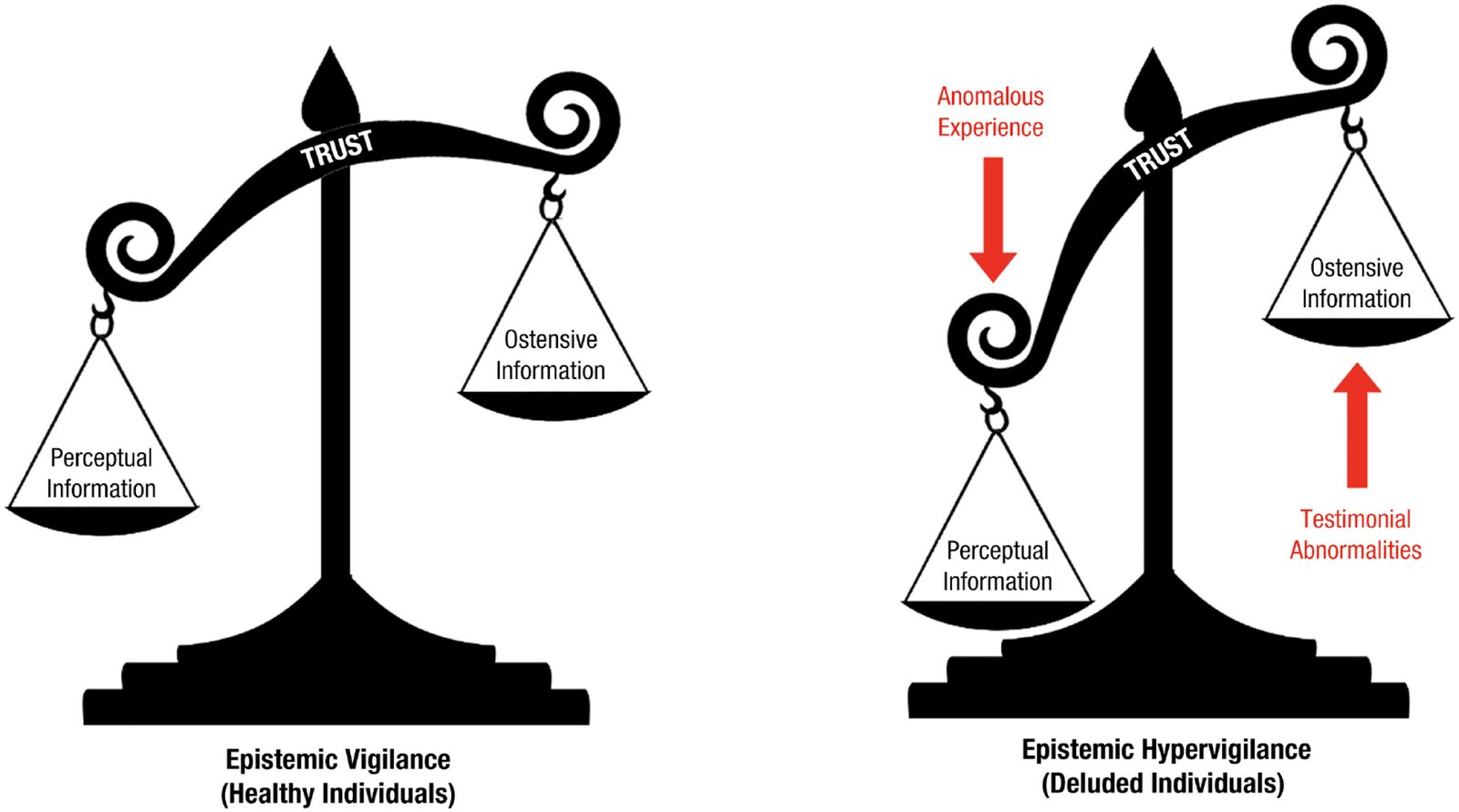
In classical psychiatry, vigilance is often treated as a neutral or even adaptive cognitive function: the capacity to remain alert to relevant stimuli, detect threats, and update beliefs accordingly. However, a little-examined phenomenon exists at the border between cognition, anxiety, and psychosis, which can be provisionally termed epistemic hypervigilance. This condition is not formally recognized in diagnostic manuals, yet it appears across clinical observations in patients who do not fit neatly into obsessive–compulsive disorder, paranoia, or schizophrenia. Epistemic hypervigilance refers to a persistent, involuntary state in which the mind becomes excessively alert to meaning itself—treating ordinary information, language, coincidence, and internal thoughts as if they carry hidden, urgent, or destabilizing significance.
Unlike classic paranoia, epistemic hypervigilance does not necessarily involve fixed persecutory beliefs. Instead, the individual experiences a chronic sense that “something is about to be understood,” “something important is being missed,” or “this detail cannot be random.” The person may remain intellectually skeptical and even insight-oriented, yet is unable to disengage from constant interpretive scanning. Everyday stimuli—phrases overheard in conversation, repeated numbers, subtle changes in tone, minor bodily sensations—are experienced as epistemically charged, as if they demand interpretation. This creates a paradoxical mental state: the subject doubts their interpretations while simultaneously being unable to stop generating them.
Clinically, epistemic hypervigilance differs from obsessive rumination. Obsessions are typically recognized as intrusive and irrational, whereas hypervigilant meaning-search often feels compulsively rational. The individual may report that their mind is “over-working,” “connecting too much,” or “refusing to leave things unresolved.” Importantly, this is not merely curiosity or philosophical reflection; it is experienced as exhausting, destabilizing, and often frightening. Patients frequently describe a loss of cognitive rest, as if the mind has lost its capacity for epistemic trust—the basic assumption that most things do not require deep interpretation.
Neurophenomenologically, this state may involve dysregulation in salience attribution systems, particularly dopaminergic circuits implicated in assigning importance to stimuli. When salience becomes uncoupled from actual relevance, the mind begins to over-tag neutral events as meaningful. Unlike full psychosis, however, reality testing may remain partially intact. The individual senses that the meaning overload is internal, yet cannot prevent it. This intermediate zone may explain why epistemic hypervigilance is often misdiagnosed as anxiety, high intelligence, or early psychosis depending on the clinician’s framework.
One of the most overlooked consequences of epistemic hypervigilance is its impact on identity. Because meaning-making is central to self-narrative, excessive interpretive activity can fragment the sense of self. Patients may report feeling “mentally exposed,” “too conscious,” or unable to return to a previous, more automatic way of being. Over time, this can lead to depersonalization, existential distress, and secondary depression—not because life lacks meaning, but because meaning has become oppressive.
Treatment remains largely exploratory. Standard antipsychotics may reduce salience intensity but risk blunting cognition excessively. Cognitive-behavioral approaches often fail because the problem is not faulty beliefs, but an overactive epistemic engine. Some emerging therapeutic strategies focus instead on restoring epistemic trust: helping patients relearn that uncertainty can be tolerated and that not all stimuli require interpretation. Mindfulness-based interventions, when carefully adapted, may help by shifting attention away from meaning extraction toward raw perception, though they can initially worsen symptoms if introduced too abruptly.
Epistemic hypervigilance challenges psychiatry’s traditional categories. It raises a deeper question: can the drive to understand reality itself become pathological, not because it is delusional, but because it is unrelenting? As psychiatry increasingly engages with predictive processing and Bayesian models of the mind, this phenomenon may offer a crucial insight—mental illness does not always arise from false beliefs, but sometimes from an inability to stop asking what something means.